
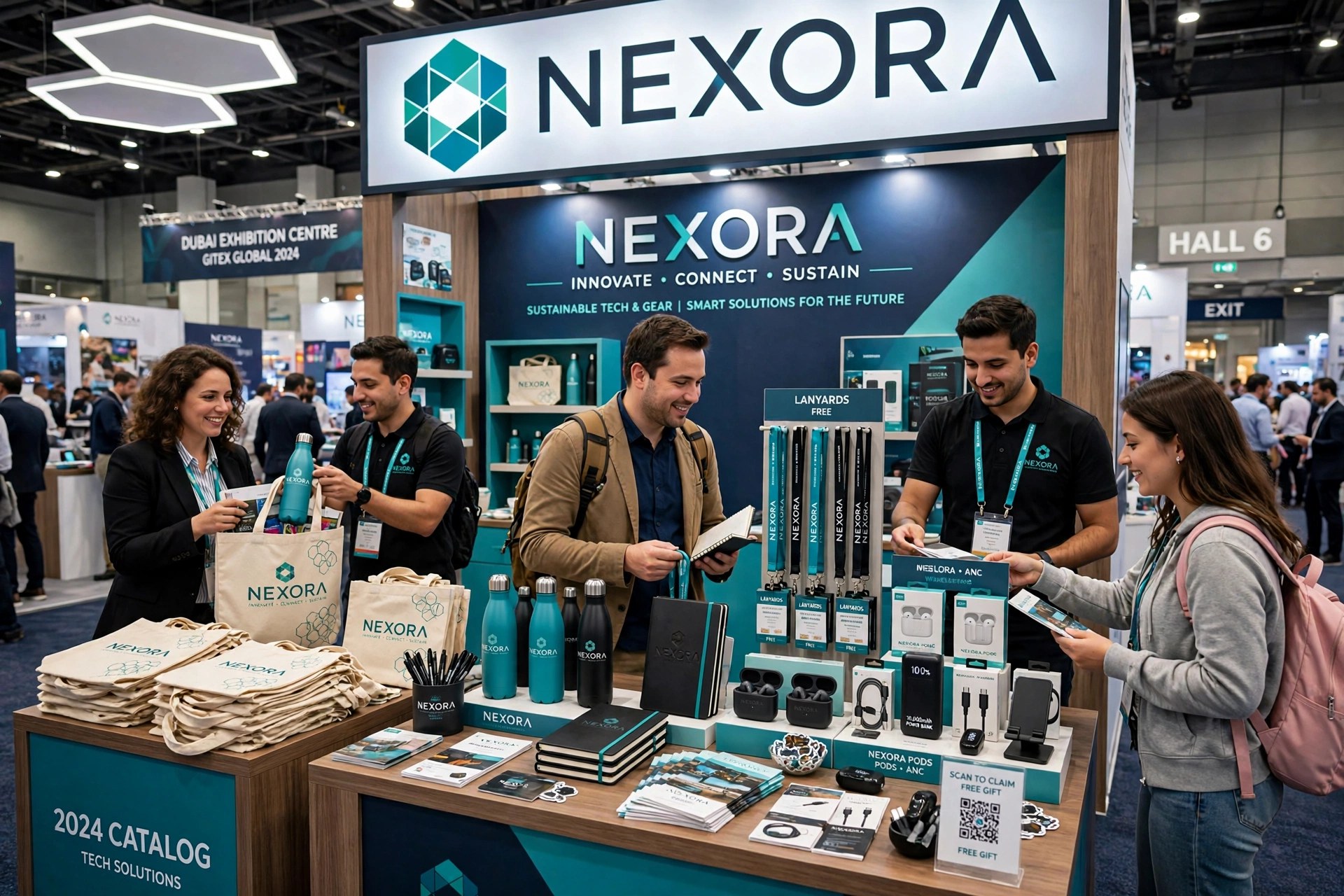
Walk through any exhibition at Dubai World Trade Centre, any conference in Abu Dhabi, or any mall activation in the Emirates, and you will see the same truth in action: brands compete for memory, and promotional products in Dubai are one of the most cost-effective weapons in that fight. A well-chosen branded item keeps working long after the event ends — on desks, in cars, at gyms, and in the hands of people your sales team has never met.
But the category is wide, the quality range is enormous, and the wrong choice wastes money quietly: items that break, sizes that do not fit, printing that peels, delivery that misses the event date. This complete guide is written for marketing managers, event organisers, procurement teams, and business owners in the UAE. It covers the major product categories, how promotional products are used at events and exhibitions, the main branding methods, how to choose items based on your actual goal, and a realistic ordering process from brief to delivery.
What Counts as a Promotional Product?
A promotional product is any useful item branded with your logo, message, or campaign identity and given to customers, prospects, employees, or event audiences. The family is broad: apparel, drinkware, bags, stationery, tech accessories, event essentials like lanyards and badges, and premium items that blur into corporate gifting.
That overlap is worth understanding. Promotional products and corporate gifts in Dubai come from the same catalogue but follow different logic: promotional items are typically distributed at scale to build awareness and leads, while corporate gifts are given selectively to strengthen specific relationships. Many UAE companies buy both from one supplier, which keeps branding consistent across everything the public and clients ever touch.
The Main Promotional Product Categories
Apparel and uniforms
T-shirts, polos, caps, hoodies, and jackets are the most visible promotional products you can buy — your audience literally wears your brand. Quality and fit decide everything: a soft, well-cut shirt gets worn weekly; a stiff, mis-sized one becomes a cleaning rag. Event crews, brand ambassadors, and exhibition teams in Dubai rely on coordinated apparel to look professional and be instantly identifiable in a crowded hall. For most campaigns, a well-made run of custom t-shirts in Dubai with a clean design is the workhorse item.
Drinkware
Branded bottles, travel mugs, tumblers, and ceramic mugs enjoy exceptionally high daily use in the UAE, where hydration is a lifestyle and the commute is long. Drinkware offers a generous branding area, suits every audience from students to executives, and survives for years when the base product is good. Insulated stainless steel is the premium standard; quality plastic and aluminium serve volume campaigns.
Bags
Tote bags, drawstring bags, backpacks, laptop bags, and conference bags turn recipients into moving media — especially at exhibitions, where a good bag collects competitors’ brochures all day while displaying your logo. The exhibition tote is a strategic item: if your bag is the sturdiest and most comfortable at the show, it is the one people keep carrying.
Stationery and office items
Notebooks, pens, desk organisers, sticky notes, and calendars are the quiet achievers of the category. They live on desks — including the desks of decision-makers — and get used in meetings where your brand sits in front of exactly the right people. A quality notebook and pen set at a conference signals a serious brand before a word is spoken.
Tech accessories
Power banks, USB drives, wireless chargers, earbuds, phone stands, and cable kits carry high perceived value and genuine daily utility. Tech items are the first choice for younger audiences, IT and telecom brands, banks courting digitally minded customers, and any campaign where “premium and useful” matters more than unit cost.
Event and exhibition essentials
Every event in the UAE runs on these: lanyards, ID badges and holders, wristbands, caps, and registration giveaways. Professionally printed custom lanyards in Dubai with matching badge holders are not a detail — they are the visual system that makes an event look organised. Add pins and badges for membership, awards, and brand collectibility; a focused range like custom lapel pins in Dubai works especially well for launches, loyalty programmes, and National Day campaigns.
Eco-friendly promotional products
Sustainability has moved from a niche request to a mainstream expectation in UAE procurement. Jute and cotton bags, bamboo items, recycled notebooks, wheat-straw products, and reusable drinkware let brands align the message with the medium. Audiences notice — and photograph — eco items that are genuinely well made; they notice greenwashing just as fast, so choose real materials and honest messaging.
How Promotional Products Are Used: Events, Exhibitions, and Beyond
Exhibitions and trade shows
Dubai hosts some of the world’s largest trade shows — GITEX, Arab Health, Gulfood, ADIPEC, and hundreds more. The exhibitor’s challenge is identical at all of them: stop footfall, start conversations, and be remembered after the hall closes. Promotional products serve each stage: an attractive giveaway draws people to the stand, a quality item earns the conversation, and a useful product carries the brand back to the office, where it sits in front of colleagues who never attended. Plan quantities against realistic footfall, and reserve a small stock of premium items for qualified prospects rather than giving everything to everyone.
Conferences and corporate events
For conferences, the delegate kit is the standard: lanyard and badge, tote or folder, notebook and pen, bottle, and sponsor materials. Sponsors should negotiate visibility into the kit itself, not just the backdrop. Internal events — sales kick-offs, town halls, training days — use the same mechanics to build team identity.
Mall activations, roadshows, and outdoor promotions
Consumer activations reward instant-impact items: caps, fans, sunglasses, stress balls, and sample-friendly bags. In Dubai’s climate, anything that helps with sun and heat earns genuine gratitude — and gratitude is a brand emotion money usually cannot buy.
Retail, hospitality, and loyalty programmes
Hotels, restaurants, real estate agencies, clinics, and automotive brands across the UAE use promotional products as loyalty touches: a quality keychain with a new car, a branded amenity for hotel guests, a welcome pack for new property owners. The rule in these settings is premium restraint — the item must match the price point of the core purchase.
Recruitment, onboarding, and internal branding
Not every promotional product faces the public. Employer-branding items — welcome kits, team apparel, anniversary merchandise — build internal culture with the same catalogue and the same quality rules. Companies that treat internal items as second-class undermine the message; your own team is the first audience that judges whether the brand is real.
Branding Methods Explained: How Your Logo Gets on the Product
The branding method determines how premium the finished item looks and how long the branding survives. These are the methods you will meet in the Dubai market:
- Screen printing. The volume standard for apparel, bags, and flat items. Bold, durable colours; ideal for simple logos and large runs.
- Embroidery. Stitched logos for polos, caps, jackets, and uniforms. The most premium look for textiles and extremely durable.
- Heat transfer and DTF printing. Full-colour, photographic designs on apparel — ideal for detailed artwork and smaller runs.
- Sublimation. All-over, edge-to-edge colour on compatible fabrics and coated items like mugs; vibrant and permanent.
- Laser engraving. Etched branding on metal, wood, and leather-style goods. Subtle, permanent, and unmistakably premium — perfect for bottles, pens, and awards.
- UV and digital printing. Crisp full-colour logos on hard goods — bottles, notebooks, tech items — with fast turnaround.
- Pad printing. Precise small-area printing on curved or irregular items like pens and stress balls.
- Debossing and embossing. Impressed logos on leather and notebook covers for a quiet, executive finish.
Matching method to material is a specialist judgement. A good supplier will steer you: the team at Vision Advertising advises on method during quoting, because the cheapest print on the wrong product is the most expensive mistake in this category.
Choosing by Goal: Awareness, Leads, or Premium Positioning
The most common promotional mistake is choosing the product before defining the job it must do. Start from the goal:
Goal: maximum awareness at minimum cost per impression
Choose high-carry, high-visibility items: tote bags at exhibitions, caps at outdoor events, bottles everywhere. Favour durable versions of simple products — impressions accumulate only while the item survives. Big, clean branding is appropriate here; this is advertising media.
Goal: lead generation and conversations
At a stand or activation, the giveaway is bait and reward: attractive enough to stop people, structured enough to justify a data exchange. Tier your stock — an appealing standard item for general footfall, and a noticeably better item for visitors who complete a demo, meeting, or form. Scarcity and design (limited colours, event-exclusive artwork) measurably increase take-up.
Goal: premium positioning and relationship value
When the audience is small and valuable — partners, VIP clients, media, senior executives — promotional logic merges with gifting logic. Choose fewer, better items: engraved drinkware, quality tech, leather goods, premium gift sets, elegant packaging. Branding shrinks to a whisper. The product must be indistinguishable from something the recipient would buy themselves.
Goal: team identity and internal campaigns
Consistency and comfort rule. Involve wearers in sizing and style choices where possible, standardise the kit across locations, and keep a replenishment path open so new joiners and new events never break the visual system.
The Ordering Process: From Brief to Delivery Without Drama
- Write a real brief. Audience, quantity, event date, distribution method, budget range, brand assets. Ten minutes here saves days later.
- Shortlist products with use in mind. Where will the recipient be when they use it? What competes for the same pocket, desk, or bag?
- Request samples. Handle the actual product. Check weight, finish, print area, and — for apparel — sizing against real people.
- Approve artwork formally. Confirm logo version, colours against your brand guidelines, placement, and any text (with Arabic proofread by a native speaker). Most disappointments in this industry are approved proofs nobody actually read.
- Confirm production schedule in writing. Standard branded items commonly need a few working days to a couple of weeks depending on quantity and method; custom manufacturing and peak seasons need more. Build buffer before immovable dates — the exhibition will not move for your tote bags.
- Quality-check before dispatch. For sizeable orders, inspect a sample from the production run, then verify counts and packing splits per location.
- Distribute and measure. Track what was taken, what was left, and what people used afterwards. Leftover stock is data: the item, the design, or the quantity logic needs adjusting next time.
Multi-site companies should confirm delivery splits across Dubai, Abu Dhabi, Sharjah, and other Emirates at order stage. You can explore the breadth of categories in one place in the Vision Advertising shop while building your shortlist.
Budgeting and Minimum Orders: What to Expect
Promotional products are quoted per project because price depends on the item, quantity, branding method, and timeline — anyone promising a universal price list is guessing. As a general planning picture: most branded items carry minimum order quantities that keep branding economical, unit costs fall as quantities rise, and premium methods like embroidery and engraving cost more than basic prints while delivering a visibly better result. The smartest budget question is not “what is the cheapest item?” but “what is the cost per month of use?” — a bottle carried daily for two years is cheaper media than a novelty discarded in a week, whatever the invoice says.
Beware the two classic false economies: rock-bottom base products that fail in public (your logo on a broken item is negative advertising), and last-minute rush orders that burn budget on urgency instead of quality. An annual or quarterly plan with a standing supplier — even a loose one — consistently outperforms event-by-event scrambling.
Frequently Asked Questions
What are the most popular promotional products in Dubai?
Drinkware (insulated bottles, mugs), tote bags and backpacks, apparel (t-shirts, polos, caps), notebooks and pens, tech accessories (power banks, chargers, earbuds), and event essentials such as lanyards and badges are consistently the most ordered categories in the UAE. Eco-friendly lines — jute bags, bamboo items, recycled notebooks — have grown rapidly as sustainability expectations rise.
How long does it take to produce branded promotional products?
It depends on the product, quantity, and branding method. As a general guide, standard items with common branding methods take from a few working days to a couple of weeks after artwork approval; custom-manufactured items, large volumes, and peak seasons (the run-up to major exhibitions, Ramadan, and December) require longer. Confirm a written schedule with your supplier and keep buffer before fixed event dates.
What branding method should I choose for my logo?
Match the method to the material and the impression you want: embroidery for premium apparel, laser engraving for metal and leather-style goods, screen printing for bold volume runs on bags and shirts, UV/digital printing for full-colour hard goods, and sublimation for all-over designs. Your supplier should recommend the method after seeing your artwork and the product — if they do not ask about either, that is a warning sign.
Are there minimum order quantities?
Usually, yes — most branded products have minimum quantities that vary by item and branding method, because setup costs are spread across the run. Some everyday items are available in relatively small quantities, while custom-manufactured pieces require larger runs. Share your target quantity in the brief; a good supplier will steer you to products whose minimums fit your scale.
Can promotional products be delivered across the UAE for an event?
Yes. Established suppliers deliver across Dubai and the other Emirates, split shipments by location, and coordinate timing around event schedules. Share venue delivery windows and site contacts early — exhibition venues have strict goods-in procedures, and planning them in advance is the difference between a calm setup day and a crisis.
Put Your Brand in Their Hands — Literally
Promotional products work because they are useful, tangible, and personal in a way digital impressions can never be. Choose items your audience will genuinely keep, brand them with the right method and the right restraint, and plan the order like the deadline matters — because at an exhibition, it does.
Vision Advertising supplies promotional products across Dubai and the UAE — apparel, drinkware, bags, tech, event essentials, eco lines, and premium branded gifts — with in-house guidance on products, branding methods, and logistics from brief to delivery. Start with a browse of the range or tell us about your campaign through our contact page; you can also email [email protected] or call +971 50 970 9564. Let us help you choose items people keep — and remember you by.
Measuring the Return on Promotional Products
Promotional spend is often judged by gut feel because it is rarely measured properly. You can do better with simple, honest tracking. At events, count distributed items against leads captured and stand conversations, and compare cost per conversation with your other channels. After the event, watch for the signals that matter: recipients using the item in meetings and social posts, inbound enquiries mentioning the event, and repeat stand visits at the next edition. For direct-mail or gift-style distributions, tie the send to a trackable action — a QR code to a campaign page, a dedicated landing link, or a follow-up call list — and record response rates by audience segment. Internally, ask recipients directly in post-event surveys which items they kept; the answers will ruthlessly improve your next order. None of this requires sophisticated tooling — it requires deciding before the event what success looks like, and writing the numbers down afterwards.
Trends Shaping Promotional Products in the UAE
Several shifts are redefining what UAE buyers ask for. Retail-quality design is the biggest: audiences compare your giveaway to products they buy, so minimalist design, good materials, and subtle branding now outperform loud, cheap merchandise at every level. Sustainability with proof follows close behind — buyers increasingly ask what an item is made from and how long it will last, not just whether it carries a green label. Tech integration is maturing beyond novelty: NFC-enabled cards and tags, QR-linked experiences, and genuinely useful charging and audio products have replaced gimmick gadgets. Local and cultural relevance is rising too — UAE-themed designs, National Day editions, Ramadan-appropriate collections, and Arabic calligraphy elements (done respectfully and proofed properly) connect in ways generic imports cannot. Finally, speed and flexibility have become deciding factors: buyers want reliable local production, honest timelines, and the ability to top up quantities without restarting the entire process. Planning your promotional calendar around these trends — rather than ordering in a panic before each event — is the simplest competitive advantage available in this category.
One final thought for UAE marketing teams building their annual calendar: map your promotional needs against the year’s fixed moments — major exhibitions, Ramadan, National Day, back-to-school, and year-end — and brief your supplier on the whole calendar at once. You will get better product suggestions, steadier quality, and calmer deadlines, and your brand will show up consistently everywhere your audience encounters it.




