It is the smallest item in the exhibition hall and the one everybody actually wears. A lanyard carries your brand at chest height, in every conversation, every photograph and every coffee queue — which is why custom lanyards in Dubai deserve more thought than the last-minute afterthought they often become. Order them well and they look like part of a professional event system; order them carelessly and they are the scratchy, twisted, wrong-coloured detail that quietly cheapens everything else you organised.
This guide covers the full decision set for Dubai and UAE buyers: the four main lanyard materials and how they differ, the print methods that go with them, clips and attachments (including the safety options venues increasingly expect), badge holders and ID cards, how lanyards are used across events, exhibitions and everyday staff ID, and a practical ordering checklist that prevents the usual mistakes.
Why Custom Lanyards in Dubai Matter More Than They Look
Dubai runs on events and on managed access. Trade exhibitions at Dubai World Trade Centre, conferences in DIFC and Business Bay, government and corporate facilities, schools, hospitals, warehouses and construction sites all rely on visible identification — and the lanyard is what makes that identification wearable, readable and brandable.
Three jobs, one product:
- Identification: A colour-coded lanyard tells security and staff at a glance who belongs where — exhibitor, visitor, speaker, media, crew, VIP.
- Branding: It is quite possibly the most-photographed item at any event. Sponsor and organiser logos on lanyards appear in attendee selfies, press shots and social posts long after the event ends.
- Function: It keeps the badge, access card or keys attached to the person, the right way up, all day.
Because volumes are high and unit costs are modest, lanyards are also one of the most forgiving items in the merchandise budget — provided the material and hardware choices are right.
Lanyard Materials Compared: Polyester, Satin, Woven and Sublimation
Material determines how a lanyard looks, feels against the neck, how it takes print, and how long it survives. The four options below account for the overwhelming majority of orders in the UAE.
Flat Polyester Lanyards: The Workhorse
Standard polyester is the default event lanyard worldwide: a flat woven strap, typically screen-printed or heat-transferred with a logo and text. It is durable, colourfast, inexpensive at volume and available in a wide range of stock colours that can get close to most brand palettes.
Best for: Large exhibitions, conferences, giveaways and any high-volume order on a sensible budget.
Watch out for: Print sits on the surface, so very fine detail softens; the strap has a slightly textured feel that some premium events prefer to upgrade from.
Satin Lanyards: The Smooth, Premium Feel
Satin lanyards sew a smooth satin strip — printed in full colour — onto a polyester base strap. The satin layer feels noticeably softer against the skin and gives the print a slight sheen, which is why satin is the common upgrade for corporate conferences, gala registrations and VIP or speaker lanyards.
Best for: Corporate summits, premium conferences, delegate and speaker lanyards where comfort matters over a long day.
Watch out for: Slightly higher cost than flat polyester; the layered construction is a little thicker, which is worth checking against small badge-holder holes.
Woven Lanyards: The Most Durable Branding
Woven lanyards stitch the design directly into the fabric with coloured thread — the text and logo become part of the strap itself. Nothing can peel, crack or wash off, because there is no surface print to damage. Woven lanyards survive years of daily use, which makes them the standard for permanent staff ID in schools, hospitals, facilities and security-conscious organisations.
Best for: Staff ID worn daily, long-life uniforms programmes, simple bold text and logos.
Watch out for: Thread cannot reproduce gradients, photographs or very fine detail. Keep the design to strong lettering and simple marks.
Sublimation (Dye-Sub) Lanyards: Full-Colour Freedom
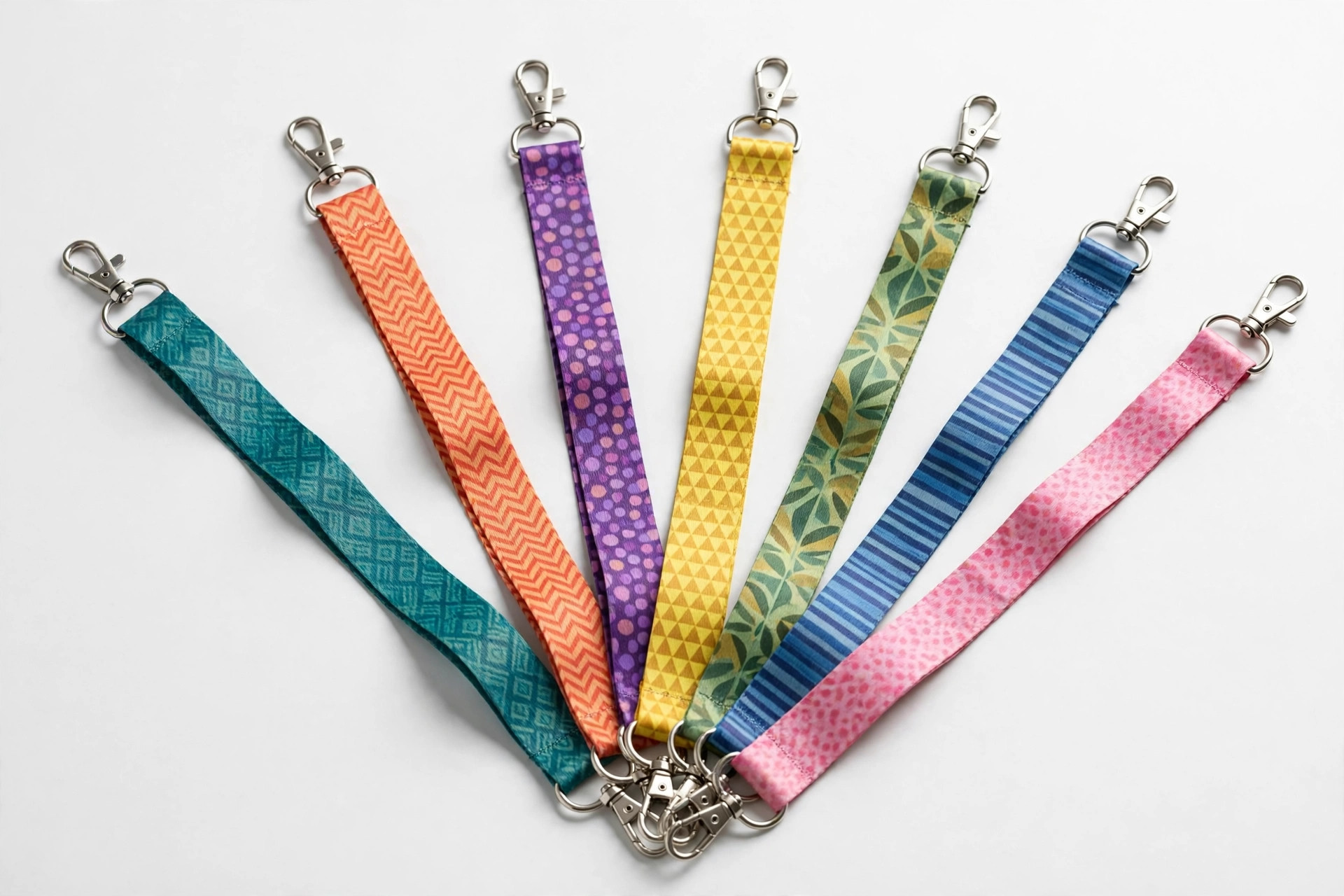
Sublimation printing dyes the polyester strap itself, allowing edge-to-edge, full-colour artwork — photographs, gradients, complex patterns and different designs on each side. The print is smooth, will not crack, and the colour range is effectively unlimited, which is why creative agencies and consumer brands love it for festivals, product launches and youth-focused events.
Best for: Colourful creative designs, photographic artwork, double-sided branding, events where the lanyard is part of the visual identity.
Watch out for: Very small text can soften slightly as the dye settles into the fabric; for tiny legal text or intricate crests, woven or satin may read more crisply.
Width: The Quiet Design Decision
Lanyards commonly come in widths around 10 mm, 15 mm, 20 mm and 25 mm. Narrow straps suit light badges and a discreet look; the popular middle widths carry a standard badge comfortably and give text room to breathe; wide straps maximise brand impact and comfort for heavy badges or attached items. When in doubt, the middle of the range is the event industry default for good reason.
Print Methods for Custom Lanyards
Material and print method travel together, so it helps to understand the pairing:
- Screen printing on polyester: crisp, opaque logos in one or a few flat colours; the economical standard for big runs.
- Heat transfer: good for slightly more detailed flat artwork on polyester at volume.
- Sublimation: full-colour, photographic, both sides — as described above.
- Weaving: the design is the fabric; maximum durability, minimum detail.
- Satin overlay printing: full-colour print on the satin strip, combining colour freedom with the soft feel.
Whichever route you choose, ask for a digital proof showing the design repeated along the strap, and confirm how the artwork handles the area where the clip attaches — a logo chopped in half at the crimp is a classic proofing miss. Repeating patterns should be checked for where the repeat starts and ends so text is never cut mid-word.
Clips, Attachments and Safety Features
The hardware at the end of the strap decides how the badge hangs, how secure the attachment is, and whether the lanyard meets venue safety expectations. Options to know:
- Metal trigger/swivel hook (lobster clip): The event standard. Swivels so the badge self-corrects and rarely hangs backwards; clips through a standard badge-holder slot.
- Crocodile/alligator clip: Grips the badge or card directly with serrated jaws. Secure and low-profile, popular for staff ID.
- Split ring: For keys, USB drives and access fobs as much as badges.
- Bulldog clip: A flat, wide grip that keeps rigid cards facing forward.
- Safety breakaway: A small connector behind the neck that releases under tension. Strongly recommended — and in many schools, hospitals, warehouses and industrial sites effectively required — because it prevents the strap becoming a hazard if it snags on machinery, doors or escalators.
- Double-clip (two-end) lanyards: A clip at each end attaches to both top corners of a wide badge, keeping it level and readable. The professional choice for conferences where badges must face forward for scanning and photography.
- Adjustable bead and quick-release buckle: A detachable buckle near the clip lets the wearer remove the badge without taking the lanyard off — handy for access-card tapping — while an adjuster keeps badge height consistent across different wearers.
A practical note on readability: badges hang backwards mainly because of single attachment points and light holders. If your event relies on name-checking or badge scanning, specify double clips and a holder with a reinforced slot, and the problem largely disappears.
Badge Holders, ID Cards and the Complete ID System
A lanyard alone is only half the product. The badge it carries is what people actually read, so plan the two together.
Badge Holders
- Flexible vinyl holders: The economical event default, in portrait or landscape formats sized around common badge inserts. Clear front, slot or holes at the top for the clip.
- Rigid holders: Hard plastic shells that protect access and proximity cards from bending and cracking — the right choice for staff cards used daily with readers.
- Eco and premium options: Recycled-material holders and leather or PU card cases exist for executive settings; match the holder grade to the audience.
- Size discipline: Order holders and printed inserts to the same confirmed size. A beautiful badge rattling in an oversized holder looks improvised.
Printed ID Cards and Event Badges
PVC ID cards are printed like credit cards — full-colour, durable, and compatible with encoding options for access systems. Event badges range from simple printed card inserts to fully printed rigid badges with attendee name, company, category colour band and QR code for lead retrieval or session scanning. Decide early what data each badge must carry, because category colour-coding (visitor, exhibitor, speaker, media, organiser) is one of the most useful event-management tools a lanyard system provides.
Lanyards also sit naturally inside a wider identity kit. Many organisers pair them with custom lapel pins for speakers, award winners or members — the pin marks status while the lanyard handles access — and with other event items from the wider range of promotional products in Dubai so the whole delegate kit looks designed rather than assembled.
Custom Lanyards in Dubai at Work: Events, Exhibitions and Everyday Staff ID
Conferences and Exhibitions
This is lanyard heartland. Organisers typically order by delegate category, using strap colour or print to distinguish access levels, and add sponsor branding as part of sponsorship packages — lanyard sponsorship is valuable precisely because the logo is worn all day and appears in photographs. For multi-day events, confirm the strap is comfortable for long wear (satin or a wider width helps) and that the badge system survives queues, scanning points and outdoor transfers between halls.
Corporate Offices and Staff ID
For daily-wear staff lanyards, durability beats novelty: woven or quality polyester straps, rigid holders for access cards, and safety breakaways as standard. A consistent staff lanyard is also part of the internal-branding picture discussed in our guide to corporate gifts for employees in Dubai — small, well-made everyday items shape how professional a workplace feels to the people in it.
Schools, Healthcare and Facilities
These sectors add two requirements: breakaway safety as a default, and colour systems that communicate role and safeguarding status (staff vs visitor vs contractor) at a distance. Visitor lanyards in a loud, distinctive colour — often with “VISITOR” woven or printed along the strap — are a simple, effective security habit.
Hospitality, Retail and Events Staffing
Here the lanyard is part of the uniform. Match strap colour to the uniform palette, keep branding refined, and choose clips that will not scratch delicate surfaces or snag fabrics. Double-end lanyards keep name badges level through a whole shift of movement.
Ordering Checklist for Custom Lanyards
Work through this list before you confirm any order and you will avoid nearly every common lanyard mistake:
- Purpose and audience: Event delegates, staff, students, visitors — and the categories within each.
- Material: Polyester for volume value, satin for comfort, woven for permanence, sublimation for full-colour design.
- Width: Matched to badge size and design detail; the mid-widths suit most badges.
- Print method and sides: One side or both — double-sided print keeps the brand visible even when the strap twists.
- Artwork: Vector logo, correct brand colours, text sized to stay legible at strap width; request a proof showing the repeat.
- Clip type: Trigger hook as standard; consider crocodile clips or split rings for cards and keys.
- Safety: Breakaway connectors for schools, healthcare, industrial sites and children — and wise almost everywhere.
- Badge system: Holder type and exact size, insert or PVC card printing, category colour plan, QR or data requirements.
- Quantities by category: Count each colour/category separately, then add a buffer — events always consume spares through late registrations and lost badges. A buffer in the region of 10% is a sensible general habit.
- Timeline: Confirm the production and delivery schedule against your event date, with extra care in peak exhibition season. As a general guide, standard orders often complete within several working days to roughly two weeks depending on material, print method and quantity, while fully custom or very large orders need longer — always confirm against your specific brief rather than assuming.
- Sample check: For staff programmes and premium events, approve a physical sample — check print clarity, strap comfort, clip quality and how the badge hangs.
You can review lanyard styles, badge holders and related ID products in our online shop while preparing your brief, and the Vision Advertising team can match materials and hardware to your event or workplace requirements.
Eco-Friendly Materials and Reuse Programmes
Sustainability questions now reach lanyards just as they reach every other event purchase. The main options:
- Recycled PET (rPET) straps: Made from recycled plastic bottles, rPET lanyards print and wear much like standard polyester, including by sublimation, so choosing them does not mean giving up full-colour design. For many events this is the simplest credible eco upgrade.
- Bamboo fibre and plant-based straps: Softer, natural-feel materials that suit eco-positioned brands and conferences. Print detail is a little softer than on polyester, so bold, simple designs work best.
- Reuse systems: The greenest lanyard is the one used twenty times. Staff and recurring-event programmes that collect lanyards back — with a return point at the exit or reception — cut waste and cost simultaneously. Pair reuse with a strap material that survives washing, and avoid printing year-specific artwork on straps you intend to reuse; put the date on the badge insert instead, so the strap stays evergreen.
Whichever route you choose, keep the claim honest: specify what the strap is actually made from and how the reuse or recycling will really happen, rather than reaching for vague green language the event cannot back up.
Common Lanyard Mistakes to Avoid
Most lanyard disappointments trace back to a handful of repeat errors:
- Ordering too late. Lanyards are often the last item briefed and the first item needed on event morning. They should be ordered with the badges, as one system, weeks — not days — before doors open.
- Text designed too small. Lettering that looks fine on a monitor becomes unreadable on a 15 mm strap worn at chest distance. Design at actual size and print a test strip.
- Single-sided print. The strap twists; half the time your logo faces the wearer’s chest. Print both sides.
- Ignoring the breakaway. Skipping the safety connector saves almost nothing and fails venue or school requirements surprisingly often.
- Badge and holder mismatch. Holders ordered in a different format from the printed badges, or clips that do not suit the holder’s slot, create a fiddly registration desk and a shabby look. Confirm the three parts — strap, clip, holder — fit as a set.
- No spares plan. Late registrations, lost badges and day-two replacements are certainties at any real event. Order the buffer with the main run; emergency top-ups mid-event are slower and costlier.
- Forgetting the wearer’s day. Sharp-edged cheap clips, rough straps and badges that flip backwards are small irritations multiplied by every attendee, every hour. A physical sample, worn for ten minutes, exposes all three.
Frequently Asked Questions
What is the most popular lanyard material for events in Dubai?
Flat polyester is the volume standard for exhibitions and conferences because it is durable, colourfast and economical in large quantities. Satin is the most common upgrade when delegate comfort and a premium feel matter, while sublimation is chosen when the design needs full colour or photographic artwork.
Should our lanyards have a safety breakaway?
For schools, hospitals, warehouses, industrial sites and any lanyard worn by children, yes — treat it as standard. For general office and event use it is still a sensible, low-cost safety feature, and some venues and organisations require it, so it is worth specifying by default.
Can lanyards be printed on both sides?
Yes, and it is usually worth it. A strap twists constantly in normal wear, so double-sided printing keeps your branding and category colours visible from every angle. Sublimation and satin lanyards are printed on both sides as a matter of course in most full-colour designs.
How long do custom lanyard orders usually take?
Timelines depend on material, print method, hardware and quantity. As general orientation, straightforward orders on standard materials often complete within several working days to about two weeks, while woven designs, special clips and very large event orders take longer. Peak exhibition season stretches schedules across Dubai, so ordering early — and locking category quantities early — is the safest plan.
What badge holder size should I order with my lanyards?
Match the holder to the printed badge or card, not the other way round. Confirm the insert size first, then choose a holder in the same format (portrait or landscape) with a small margin, and check that the clip type suits the holder’s slot. If the badge carries an access or proximity card used daily, choose a rigid holder to protect it.
Order Custom Lanyards That Make Your Event Look Organised
A good lanyard is invisible in the best way: comfortable all day, readable at a glance, branded without shouting, and safe by design. Choose the material for the job, the clip for the badge, and the system — strap, holder and card — as one decision, and your event or workplace ID will look as professional as everything else you run. To discuss materials, request samples or get a quote, contact Vision Advertising on +971 50 970 9564 or email [email protected].