
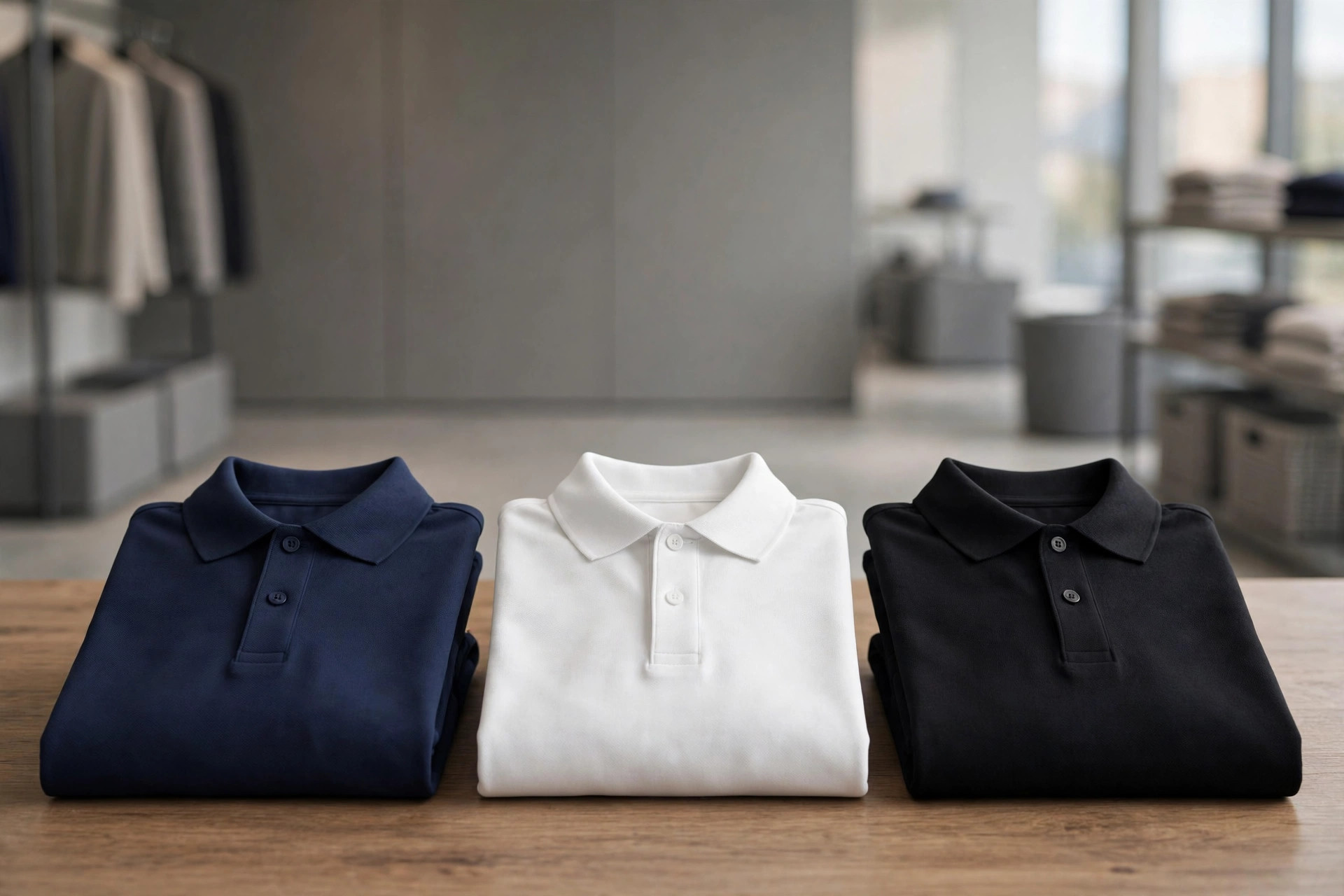
Every week, someone in Dubai sends us a logo file and asks the same question in two different ways. The first version: “Which one is better, embroidery or printing?” The second, more honest version: “Which one will still look good after my staff have washed it forty times?”
That second question is the right one. A branded polo or cap doesn’t fail on the day it’s delivered — it fails in month three, when the print starts cracking across the chest, or when the embroidered logo puckers the fabric around it and the shirt looks tired even though it’s almost new. The choice between embroidery vs printing isn’t really about which method is “better.” It’s about matching the method to the garment, the logo, the budget, and how hard that item is going to be worked.
We’ve produced both for years — embroidered uniforms for hotel teams that get washed daily, printed tees for events where the shirt only needs to survive a weekend, and everything in between. This guide is the conversation we have with buyers, written down: how each method actually works, where each one fails, what the numbers look like in AED, and the honest answer to which logo branding lasts longer (spoiler: it depends, but not in the vague way people usually mean).
The short answer, before the detail
If you need one paragraph before a meeting, here it is. Embroidery outlasts every print method on garments that get washed often — uniforms, polos, caps, workwear. Stitched thread doesn’t crack or peel, and a well-digitized logo will usually outlive the shirt itself. Printing wins when the design is large, photographic, full of gradients, or when you need hundreds of pieces cheaply and quickly. A conference tee worn twice doesn’t need embroidery. A front-desk polo washed five times a week does.
Where it gets interesting — and where buyers lose money — is the middle ground. Hoodies, tote bags, performance fabrics, tiny text in a logo, orders of 50 versus 500 pieces: each of those flips the answer. That’s what the rest of this guide works through.
What actually happens when your logo gets embroidered
Embroidery isn’t printing with thread. Your logo has to be rebuilt, stitch by stitch, in a process called digitizing. A digitizer takes your artwork and decides where every stitch goes: which areas get a flat satin stitch, which get a textured fill, how the machine will move, where it will pause to change thread colours. This is a skilled, manual job, and it’s the single biggest factor in whether your embroidery looks crisp or cheap. Two workshops can run the same logo on the same machine and produce completely different results, purely because of digitizing quality.
A typical left-chest logo — say 8 to 10 cm wide — runs somewhere between 5,000 and 9,000 stitches. More detail means more stitches, and more stitches means more machine time, which is why embroidery pricing is ultimately priced on stitch count, not on how the logo looks to you. Digitizing is a one-time setup, usually AED 50 to AED 150 depending on complexity, and the file is kept for reorders. That’s why your second order of the same uniform is always simpler than the first.
Thread choice matters more than most buyers realise. Rayon thread has a beautiful sheen and is fine for garments washed gently, but it weakens with chlorine and harsh detergents. Polyester thread is slightly less glossy and far tougher — it resists bleach, industrial laundry chemicals, and the Dubai sun. For anything going to a hotel laundry or a site crew, we specify polyester thread without really asking anymore. It’s one of those decisions that’s invisible on delivery day and obvious six months later.
Behind the fabric sits stabilizer (backing), a material that’s hooped with the garment to stop the stitches pulling the fabric out of shape. Too light a backing on a stretchy piqué polo and the logo area puckers — that wavy, gathered look around an embroidered logo is almost always a backing or digitizing problem, not a machine problem. On caps, a stiff buckram backing holds the structure. None of this is glamorous, but embroidery quality lives in these details.
And what “printing” actually covers — because it’s five different methods
Buyers say “printing” like it’s one thing. It isn’t, and the differences in durability between print methods are bigger than the difference between printing and embroidery. When someone tells you a printed logo faded, the first question is: printed how?
Screen printing
The workhorse. Ink is pushed through a mesh screen — one screen per colour — and cured with heat so it bonds into the fabric. A good screen print sits slightly into the garment, feels soft after the first wash, and holds up for years. Setup costs per colour make it uneconomical for tiny runs, but at volume it’s the cheapest quality method there is. Most of the printed t-shirts in Dubai that survive years of washing are screen printed, though the people wearing them rarely know it.
DTG (direct-to-garment)
DTG is essentially an inkjet printer for shirts. It handles photographs, gradients, and twenty-colour artwork with no setup screens, which makes it brilliant for small runs and one-off samples. The trade-off is durability and fabric range: DTG inks sit more on the surface, need pre-treatment on dark garments, and typically start looking faded sooner than screen print — often noticeably after 30 to 50 washes. On white and light shirts it performs best.
Heat transfer and vinyl
A design is cut or printed onto a film, then heat-pressed onto the garment. Modern transfer films are far better than the stiff, plastic-feeling transfers of ten years ago, and for names, numbers, and small runs of complex logos this is often the pragmatic choice. The weakness is the bond: it’s a layer sitting on top of the fabric, and over time — especially with hot washes and tumble drying — edges can lift and surfaces crack. Fine for event wear and short-life garments; risky for a uniform expected to last two years.
Sublimation
Sublimation is the odd one out, because the dye becomes part of the fabric itself. It only works on polyester (or high-poly blends) and light colours, but within those limits it’s remarkable: the print cannot crack or peel because there’s nothing on the surface to crack or peel. Full-colour, edge-to-edge prints on sports jerseys and performance wear are sublimation’s home ground. Try it on a cotton tee, though, and you’ll get a faint, washed-out ghost of your design — the dye has nothing to bond with.
Pad printing — the one that isn’t for clothes
Pad printing turns up in these conversations because buyers see it on quotes for pens, USB drives, and mugs. A silicone pad picks ink from an etched plate and stamps it onto a curved or uneven surface. It’s excellent for hard goods and irrelevant for apparel — nobody pad prints a polo shirt. We mention it here because if your order mixes garments with giveaway items, the garments and the gifts will be branded by completely different processes, with different artwork requirements and timelines. Worth knowing before you promise everything by Thursday.
Durability, head to head — where each method actually dies
Let’s talk about failure, because that’s what durability really means. Nobody’s logo disappears overnight. Each method has a characteristic way of giving up, and once you’ve seen a few hundred returned uniforms, the patterns are predictable.
Screen printing fails by cracking and fading. The ink film flexes with the fabric thousands of times; eventually fine cracks appear across the design, and dark inks on dark shirts grey out gradually. On a quality plastisol or water-based print, washed inside-out in cool water, you’re looking at 50 to 80 washes before it looks genuinely tired — by which point, honestly, the shirt itself is usually tired too. Heat and tumble dryers accelerate everything. A print that could have lasted three years can look old in eight months if it’s being boiled in an industrial wash and blasted dry daily. We see this with restaurant and housekeeping garments more than anywhere else.
DTG fails by fading, mostly. The image softens and loses contrast wash by wash. It rarely cracks dramatically; it just quietly stops looking like the artwork you approved. Transfers fail at the edges — lifting, curling, then cracking across the lifted areas. Sublimation essentially doesn’t fail in the wash at all; the garment wears out first. Its enemies are different: heat damage and the fact it can’t be used on cotton in the first place.
Embroidery’s failure mode surprises people, because the stitching itself almost never wears out. Polyester thread will hold its colour through 100+ washes, bleach splashes, and sun exposure that would destroy ink. What fails is everything around it. Cheap thread can fray. Poor digitizing leaves loops that snag on Velcro, jewellery, and seatbelts. And on thin or stretchy fabric, the embroidered area can pucker over time as the garment relaxes around a stiff patch of stitching. The logo survives; the shirt’s shape around it doesn’t. That’s a production quality issue, not an argument against embroidery — but it does mean the cheapest embroidery quote is often the most expensive one over a year.
One Dubai-specific factor worth naming: sun and heat. Delivery riders, site engineers, valet teams, pool staff — their garments live outdoors in 45-degree summers. UV degrades print inks noticeably faster than quality embroidery thread, and sweat plus sunscreen is unkind to transfer films. For outdoor crews, this alone usually settles the argument.
Every method, side by side
| Method | Best fabrics | Durability / wash life | Minimums | Cost at 50 vs 500 pieces | Finish and look |
|---|---|---|---|---|---|
| Embroidery | Piqué cotton, twill, canvas, fleece, cap fabrics | Excellent — typically outlasts the garment, 100+ washes | Low; even 10–20 pieces workable | Per-piece cost barely drops with volume; stitch count rules the price | Raised, textured, premium; limited fine detail |
| Screen printing | Cotton and cotton blends, flat weaves | Very good — 50 to 80 washes before visible ageing | Usually 50+ per design to make sense | Expensive per piece at 50, dramatically cheaper at 500 | Smooth, soft hand-feel, bold flat colours |
| DTG printing | 100% cotton, light colours best | Moderate — fading often visible after 30 to 50 washes | None; one piece is fine | Flat per-piece price; volume brings little saving | Photographic, unlimited colours, softer on lights than darks |
| Heat transfer / vinyl | Most fabrics incl. performance wear | Fair — edge lifting and cracking risk after 30+ washes | None; ideal for names and numbers | Steady per-piece cost at both volumes | Clean, sharp, slight surface feel |
| Sublimation | Polyester and high-poly blends, white/light only | Excellent — dye is in the fabric, cannot crack or peel | Low; small runs possible | Mid-range at 50, modest savings at 500 | Seamless, all-over, zero surface feel |
Read the minimums column carefully, because it explains most quotes you’ll receive. Screen printing’s setup — a screen per colour, machine time, registration — is a fixed cost spread across the run. At 50 shirts it dominates the price. At 500 it’s nearly invisible. Embroidery has the opposite profile: modest setup, but every piece costs roughly the same machine time whether it’s the 5th or the 500th. This is why a quote comparison at one quantity tells you almost nothing about the same comparison at another quantity.
What it costs in the UAE, and what actually moves the price
Buyers often ask us for “the price of embroidery” or “the price of printing” as if they’re single numbers. They’re not, but the factors behind them are few and knowable.
For embroidery, the bill is driven by stitch count, number of positions (left chest only, or chest plus sleeve plus back?), and the digitizing setup on a first order. A small chest logo on a polo might add a modest per-piece cost; a large back design with 40,000 stitches is a different conversation entirely. Garment price usually dwarfs the branding cost anyway — a quality piqué polo costs what it costs, and the difference between embroidery and print on top of it is rarely the deciding factor people expect.
For screen printing, the drivers are number of colours, number of print positions, and quantity. A one-colour front print on 500 tees is one of the cheapest branding exercises in the industry. A five-colour print, front and back, on 50 tees is one of the most expensive per piece. Neither quote is anyone ripping you off — it’s the same setup economics from the table above.
DTG and transfers sit in the middle: near-zero setup, honest per-piece pricing, no volume miracles. And across all methods, the hidden cost is the reorder. Uniform programmes aren’t one order; they’re a drip of new joiners, size swaps, and replacements across the year. Embroidery’s kept digitizing file and screen printing’s kept screens both make reorders fast — but if your run sizes are tiny and frequent, the method with low setup (embroidery, DTG, transfer) will quietly save you a fortune in repeated setups.
Lead times in Dubai production follow the same logic. Stock garments with a chest embroidery or a one-colour print are typically turned around in 3 to 5 working days once artwork is approved. Multi-colour screen work, sublimation, and large uniform orders run 7 to 10 working days, and imported specialty garments stretch further. The approval sample is the step never to skip to “save time” — it saves days when it matters, which is usually the day before your event.
Fabric by fabric, because fabric decides more than preference does
Most branding problems we’ve ever been asked to fix started with a method chosen before anyone looked at the fabric. A few rules of thumb from the production floor:
- Piqué cotton (polos): The textured knit swallows fine print detail and is embroidery’s natural home. The stitch sits proudly on the surface. If you print on piqué, keep designs bold and simple.
- Smooth cotton jersey (tees): A flat, forgiving canvas. Screen printing and DTG both excel here; embroidery works but can pucker lightweight 160gsm fabric, so keep stitched designs small and properly backed.
- Polyester and performance fabrics: Sublimation territory. Inks in standard screen printing can struggle with dye migration on poly — the garment’s dye bleeds into your white print and turns it pinkish over time. A real problem, and an avoidable one if your printer flags it.
- Fleece and hoodies: Thick, stable, and embroidery-friendly. Large prints also work well, though very heavy ink coverage on fleece feels stiff.
- Canvas and twill (bags, aprons, caps): Embroidery loves these. Canvas tote bags take screen print beautifully too, which is why bags are one of the few genuinely open contests.
- Stretch fabrics: Handle with care under any method. Embroidery needs the right stabilizer to avoid puckering; prints need inks with stretch additives or they’ll crack along the stretch lines.
So which method for which product?
Here’s how the decision usually lands across the items in a typical corporate order — the same logic we apply when building out a company’s branded apparel and gifting range from scratch.
Polos: embroidery, and it isn’t close
The polo is a uniform garment, worn weekly and washed weekly, and it’s the item clients judge your professionalism by. An embroidered chest logo is the industry default for good reason — it survives the garment’s whole working life and reads as “established company” in a way print rarely does on piqué. Our detailed breakdown of branded polo shirts and logo embroidery in Dubai walks through fabric weights and placements if you’re speccing a full uniform programme.
Caps: embroidery is the only serious option
A cap’s curved, structured front panel defeats most printing. Embroidered caps — flat or 3D puff, where the stitch is raised for a bold, retail look — are the standard from construction firms to café chains. Keep the design simple: a cap front gives you roughly 12 × 5 cm of usable space, and small text will not survive translation into thread at that size.
T-shirts: printing’s home ground
For event tees, campaign shirts, and anything with a big, colourful design, print wins on cost, speed, and fidelity. An embroidered version of a full-front graphic would be heavy, stiff, and absurdly expensive. Choose screen printing at volume, DTG for small photographic runs. If you’re planning a run, our guide to custom printed t-shirts in Dubai covers fabric weights and print placements in more depth.
Hoodies and fleece: split the difference
Small chest logo? Embroider it — fleece holds stitch beautifully. Big back design or sleeve graphics? Print them. Many of the best-looking corporate hoodies do both, and there’s no rule that says a garment gets only one method.
Uniforms and workwear: embroidery for anything washed industrially
Hospitality, facilities, healthcare, F&B — if the garment goes to a commercial laundry, thread is the only branding that shrugs off those chemicals and temperatures. Add the outdoor factor (drivers, site teams, security) and embroidery’s UV resistance settles it. Print is fine for office-worn uniforms on a gentle home-wash cycle, but be honest with yourself about which laundry reality your team actually has.
Bags: genuinely either — decide by design
Canvas totes take a bold one-colour screen print superbly and cheaply at volume, which is why conference bags are usually printed. A premium laptop bag or a small run of executive gifts reads better with a tonal embroidered logo. Look at the design: fine detail and many colours push you to print; a clean icon or wordmark pushes you to thread.
And the non-fabric items on the same order
Mixed orders are where buyers get surprised, because the branding logic changes completely once you leave fabric. Notebooks, bottles, and tech gifts are typically branded with full-colour UV printing, which cures ink instantly on hard surfaces and handles gradients embroidery could never touch. Metal and crystal pieces — awards, premium pens, keychains — take laser engraving, which is effectively permanent because it removes material rather than adding a layer. Neither competes with embroidery or garment printing; they sit alongside them, and planning the artwork for all three at once is what keeps a mixed order on one timeline.
Mistakes we see buyers make, over and over
- Sending a logo with tiny text and expecting thread to handle it. Letters under about 5 mm tall turn to mush in embroidery. The fix is a simplified embroidery version of the logo — tagline dropped, lines thickened. Good suppliers prepare this for you; if yours doesn’t mention it, worry.
- Approving from a screen, not a sample. A stitched or printed sample on the actual garment catches colour, size, and placement problems that no PDF proof ever will.
- Choosing by the 50-piece quote for a 500-piece habit. Or the reverse. Cost curves cross; quote at the quantity you’ll actually reorder at.
- Ignoring the care reality. Specifying delicate branding for garments that will be hot-washed by a laundry contractor is a decision to rebrand in eight months.
- Forgetting reorders. Staff churn means uniform orders repeat all year. Ask upfront how your design is stored and what a 12-piece top-up order costs and takes.
- Specifying one method for the whole order. Polos, tees, caps, and bottles on one PO almost never want the same process. A supplier pushing one method for everything is optimising for their machines, not your brand.
A word on keeping whatever you choose alive longer, because care instructions genuinely move the numbers: wash branded garments inside-out, use cool or warm water rather than hot, skip the tumble dryer where you can, and never iron directly over a print or embroidery — iron inside-out, or not at all. These four habits can add a year to a printed garment’s good-looking life. Embroidery asks even less: just don’t snag it, and check pockets for the Velcro that chews thread in the wash.
Questions buyers ask us before ordering
Does embroidery really last longer than printing?
On garments that are washed often, yes — a quality embroidered logo in polyester thread typically outlasts the garment itself, while prints age visibly somewhere between 30 and 80 washes depending on the method and how the garment is laundered. The exception is sublimation on polyester, which is effectively permanent because the dye is part of the fabric. For an event shirt worn twice, the whole question is academic; for a uniform worn weekly, it’s decisive.
Why did my last batch of printed shirts crack so quickly?
Usually one of three things: a transfer film where screen printing should have been used, ink that wasn’t cured properly in production, or hot washing and tumble drying in service. Sometimes all three. Cracking within the first ten washes almost always points at production — under-cured ink — rather than anything you did.
Can my exact logo be embroidered?
Almost always, with adjustments. Gradients can’t be stitched (they’re recreated with blended thread colours, approximately), fine lines under about 1 mm disappear, and small text needs enlarging or removing. A proper digitizer will show you a stitch simulation before production. If your logo has a photographic element, printing is the honest answer for that design.
Which is cheaper — embroidery or screen printing?
At 500 pieces with a simple design, screen printing is usually cheaper per piece. At 50 pieces, embroidery often wins because screen setup costs are spread over too few garments. DTG and transfers price flatly in between. Anyone who gives you a blanket answer without asking your quantity and design is guessing.
How long does production take in Dubai?
For stock garments with approved artwork, 3 to 5 working days is normal for embroidery or simple prints; 7 to 10 for multi-colour screen work, sublimation, or large uniform programmes. The variables that blow timelines are garment imports, artwork revisions, and skipped samples — not machine time.
Is embroidery suitable for t-shirts too?
Yes, for small designs — a chest logo on a midweight or heavyweight tee (200gsm and up) embroiders cleanly and looks premium. On thin promotional tees, keep stitched areas small and insist on proper backing, or the fabric will pucker around the logo. Large designs belong to print, whatever the fabric.
What file do you need from me to start?
A vector file (AI, EPS, or PDF) is ideal for both methods. For embroidery it will be converted into a stitch file during digitizing; for print it allows clean colour separations. A high-resolution PNG can work for DTG. A screenshot of your logo from your website will slow everything down and compromise the result — it’s worth the ten minutes to find the real file.
Can one order mix embroidery and printing?
It happens on most of our orders, frankly. Embroidered polos and caps, printed event tees, engraved gifts for the same client event — each item gets the method that suits it, with colours matched across methods so the brand looks consistent on the day.
Still torn? Decide by the garment’s life, not its delivery day
If there’s one habit that separates buyers who get this right, it’s this: they picture the garment in its tenth month, not on the day the boxes arrive. Weekly-washed uniforms, caps, and workwear — embroider, and spend on good digitizing and polyester thread. Event and campaign apparel — print, and spend the savings on better fabric. Mixed orders — split the methods item by item, and match colours carefully.
If you’re speccing a uniform programme or an event set and want a straight answer for your specific logo, send it over. We’ll tell you which method we’d use, where your design needs adjusting for thread or ink, and what it costs at your real quantities — and if printing beats embroidery for your case, we’ll say so. You can also browse our wider range of promotional products in Dubai if the order extends beyond apparel. Either way, you’ll end up with branding that still looks like your company a year from now — which was the point of putting your logo on it in the first place.




