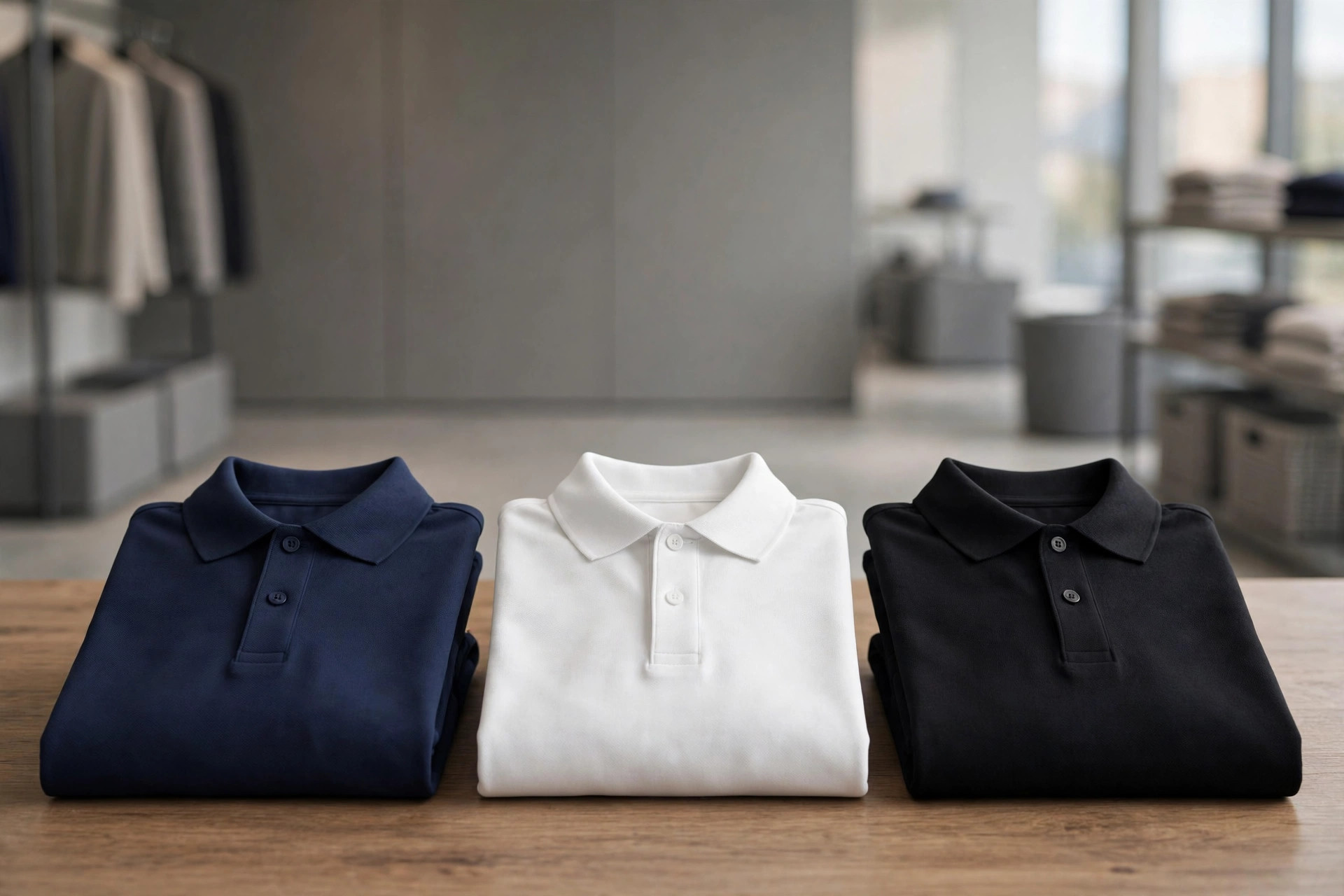
Few garments work as hard as the polo shirt. It is smart enough for a client meeting, comfortable enough for a full day on your feet, and — once your logo is on it — it turns every team member into a walking brand ambassador. From hotel front desks on Sheikh Zayed Road to exhibition stands at the World Trade Centre, from delivery crews to golf days, the branded polo is the default uniform of business in the UAE.
But ordering custom polo shirts in Dubai well is a skill. Fabric choice, decoration method, colour matching, and sizing can each make or break the result — and in Dubai’s heat, a wrong fabric choice is not a minor detail, it is a daily discomfort for your team. This guide covers everything a corporate buyer needs: piqué versus jersey, embroidery versus printing, how to match brand colours, how to size a whole team without chaos, realistic MOQs and timelines, and how to keep the shirts looking sharp wash after wash.
Why the Polo Is the Corporate Workhorse
Before the technical decisions, it is worth understanding why the polo dominates corporate apparel — because the reasons should shape your specification.
It sits in the sweet spot of formality. A polo is a step above a t-shirt without the stiffness of a button-down. That makes it the right call for the broad middle of corporate life: retail staff, hospitality teams, field engineers, event crews, office casual Fridays, and client-facing roles where a t-shirt would underdress and a shirt would overdress.
It carries a logo with dignity. The classic left-chest position — small, embroidered, over the heart — is the most flattering place a logo can live on apparel. It reads as professional rather than promotional, which is why executives will wear an embroidered polo that they would never wear as a printed tee.
It survives Dubai. A well-chosen polo in a breathable knit handles heat, air-conditioning swings, and long days better than most alternatives. The collar keeps its structure, the knit resists wrinkling far better than woven shirts, and the garment works from January cool to August furnace with the right fabric.
It scales. Whether you need twelve shirts for a startup team or two thousand for an event, polos are one of the most production-friendly branded garments: standardised blanks, well-understood decoration methods, and straightforward sizing. That is why bulk polo shirts in Dubai are a staple of every corporate gifting and uniform programme.
Fabric Deep Dive: Piqué vs Jersey — and Everything Else
Fabric is the single most consequential decision in a polo order. It determines comfort, appearance, decoration quality, durability, and how the shirt ages. Here is what each option actually means.
Piqué: the classic polo knit
Piqué is the textured knit most people picture when they hear “polo shirt” — the distinctive waffle-like weave. It is the traditional choice for good reasons: the texture hides minor wrinkles and wear, it holds embroidery beautifully (the structure grips stitches and resists puckering), and it has a naturally premium look and feel. For corporate uniforms and polo shirts with logo in Dubai that need to look sharp for years, piqué is the default recommendation.
What to look for: fabric weight, measured in GSM (grams per square metre). For corporate piqué, the sweet spot is roughly 180–220 GSM — substantial enough to drape well and support embroidery, light enough for Dubai’s climate. Below about 170 GSM the shirt can feel flimsy and show embroidery puckering; much above 230 GSM gets warm for all-day outdoor wear.
Jersey: the smooth alternative
Jersey is the smooth, flat knit used in t-shirts. Jersey polos feel softer against the skin and drape more casually, and they take printing exceptionally well since the surface is flat. The trade-offs: jersey shows wrinkles more readily, can cling when the fit is slim, and does not support heavy embroidery as gracefully as piqué — lightweight jersey under about 150 GSM will pucker under dense stitching.
Choose jersey when the priority is softness and print quality (for example, event shirts with large colourful graphics), and piqué when the priority is structure, embroidery, and long-term uniform wear.
Cotton, blends, and performance fabrics
- 100% cotton — the softest hand feel and the most natural breathability. The downside in uniform programmes: cotton shrinks slightly, wrinkles more, and fades faster with repeated washing than blends. Fine for premium short-run or executive polos; less ideal for hard-wearing daily uniforms.
- Cotton-polyester blends (typically 65/35 or 60/40) — the workhorse of corporate uniform polos. The polyester adds wrinkle resistance, colour retention, shape retention, and durability, while the cotton keeps the feel natural. For most branded polo shirts in the UAE destined for daily staff wear, a cotton-poly piqué blend is the balanced choice.
- Performance polyester (moisture-wicking) — engineered knits that pull sweat away from the skin and dry fast. Essential for outdoor teams, sports events, golf days, and delivery crews working through a Dubai summer. Modern performance polos look convincingly like classic piqué while behaving like sportswear. Note that decoration on 100% polyester needs care — more on that in the embroidery versus printing section.
- Organic and sustainable options — organic cotton and recycled-polyester polos are increasingly available for brands whose sustainability story matters. They cost more and the colour range can be narrower, but for ESG-conscious companies the story is worth it.
The Dubai climate test
Whatever fabric you shortlist, evaluate it against a Gulf summer: will your team wear this at noon in August? For outdoor or field roles, prioritise lighter weights, breathable knits, and moisture management over heavy premium-feel fabrics. For indoor office and hospitality roles, you can go slightly heavier for drape and perceived quality. When in doubt, request fabric swatches and wear-test them for a day — five minutes of handling in an air-conditioned showroom does not tell you how a shirt feels at 2pm.
Fit: Getting the Silhouette Right
A great fabric in a bad fit still looks bad. Polo fits have diversified well beyond the boxy classic, and choosing deliberately matters — especially when one order has to flatter a diverse team.
The main fit families
- Classic/regular fit — the traditional polo silhouette: comfortable through the body, standard sleeve. The safe choice for mixed teams and uniform programmes because it fits the widest range of body types acceptably. If you can only pick one fit for a whole company, pick this.
- Slim/tailored fit — narrower through the body and arms, shorter in length. Looks sharp on the right build; unforgiving on others. Best for fashion-forward teams, retail, and hospitality where appearance is part of the brand — but risky as a one-fit-fits-all uniform.
- Athletic fit — broader shoulders and chest tapering to the waist. Good for sporty teams and event crews; can look boxy on slimmer builds.
- Women’s cut — shaped through the waist with narrower shoulders and often a slightly shorter body. Offering a women’s cut alongside the men’s classic fit is the single biggest upgrade most uniform programmes can make — unisex polos on diverse teams inevitably fit half the team poorly.
Collar and placket details
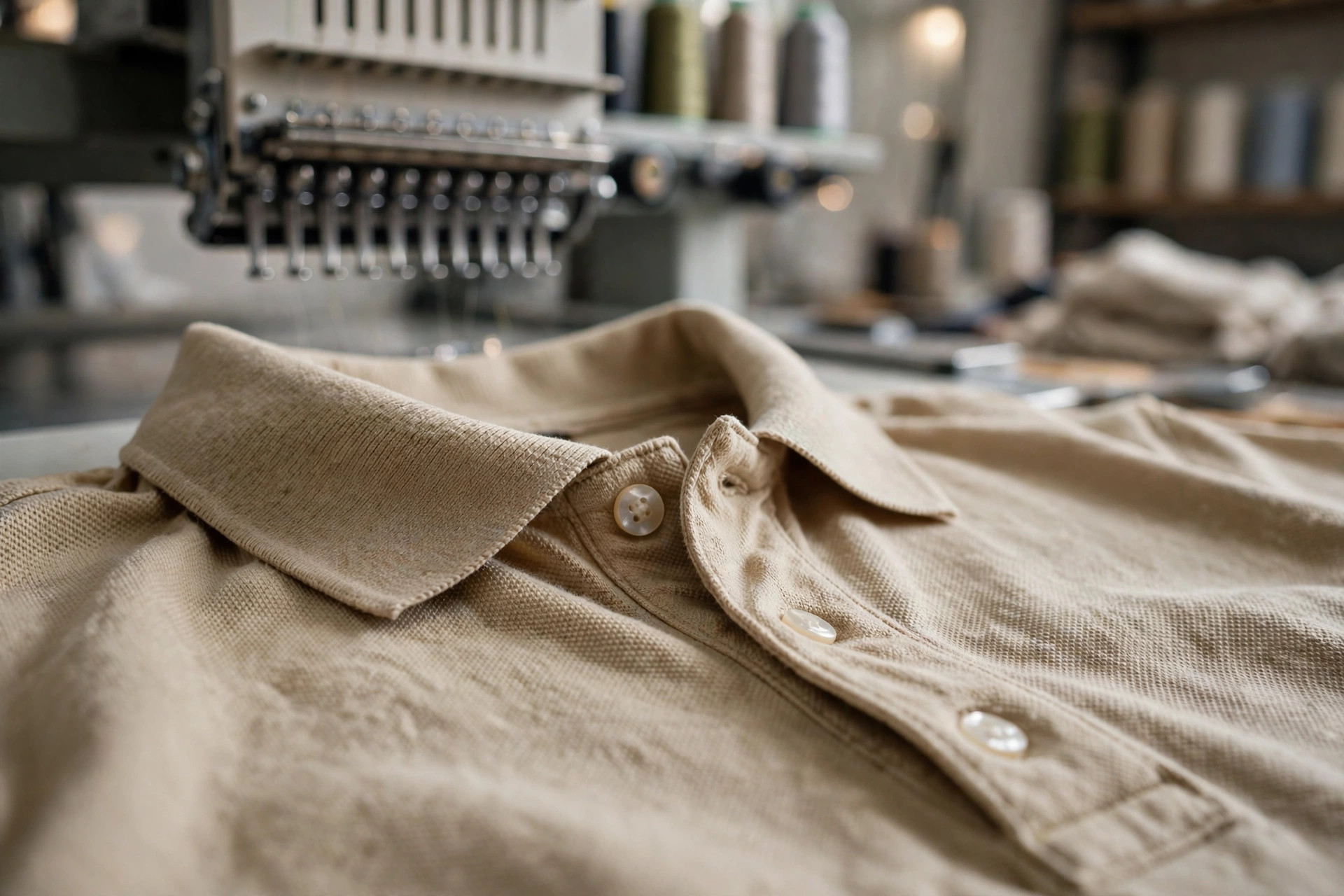
Small construction details signal quality: a reinforced collar that stands rather than flops, a clean placket with quality buttons (or a clean zip for sport styles), side vents at the hem for movement, and a taped neck seam for comfort. When comparing quotes, these details are often where cheaper shirts cut corners — ask to see them on the sample.
The sample wear-test
Never approve a fit from a size chart alone. Order fit samples in the actual sizes your team will wear, have real team members try them, and check three things: shoulder seam position (it should sit at the shoulder bone, not drooping down the arm), body length (it should stay tucked or sit cleanly untucked depending on your policy), and sleeve length (mid-bicep is classic). Photograph the samples on people — a photo reveals fit issues that a mirror hides.
Embroidery vs Printing: The Decision Framework
This is the decision buyers agonise over most, and the answer depends on your logo, your quantity, your fabric, and how long the shirts need to last. Here is the honest breakdown.
Embroidery: the corporate default
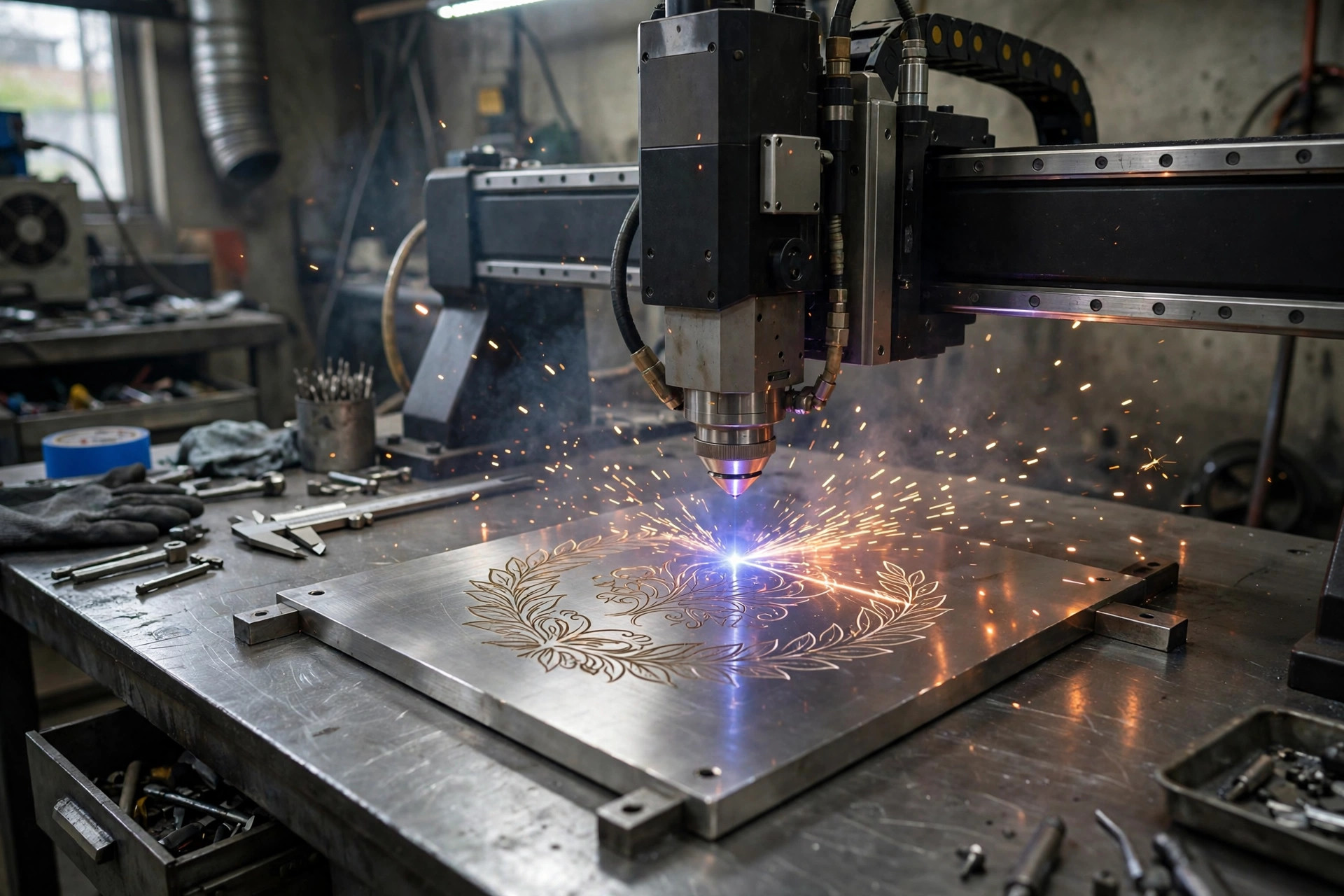
Embroidery stitches your logo in thread directly into the fabric. It is dimensional, tactile, and unmistakably premium — the reason the left-chest embroidered logo is the global standard for corporate polos.
Choose embroidery when: the logo is relatively simple (clean shapes, readable text, limited fine detail), the placement is the left chest or sleeve, the shirts are for long-term uniform use, and the impression you want is “professional.” Embroidery outlasts the garment itself — it will not crack, peel, or fade the way prints can.
Watch out for: very small text (below about 5mm letter height, threads blur together), photographic detail and gradients (thread cannot do photorealism), and very lightweight fabrics (dense stitching puckers thin knits). Embroidery pricing is driven by stitch count — larger and denser designs cost more — so a big back design in thread gets expensive fast.
Screen printing: the bold-workhorse
Screen printing lays ink on the fabric through screens, one per colour. It handles large designs, unlimited detail, and vibrant full-colour artwork that embroidery cannot touch.
Choose screen printing when: the design is large (back prints, event graphics), colourful or photographic, the shirts are for events or campaigns rather than multi-year uniforms, and the quantity justifies the per-colour setup. On polo shirts printing in Dubai for trade shows and conferences, screen print delivers maximum visibility per dirham.
Watch out for: piqué texture — print on piqué is less crisp than on smooth jersey because ink sits on the textured weave; fine detail softens. Also, prints age: with repeated washing, inks eventually crack or fade, especially with harsh laundering.
DTF (direct-to-film) transfers
The newer method worth knowing: your design is printed onto film and heat-pressed onto the garment. DTF handles full-colour, detailed, photographic designs with a softer hand feel than old-style vinyl transfers, works on cotton and blends, and has no per-colour setup cost — making it economical for small runs and complex art. For short-run company polo shirts in Dubai with detailed logos, DTF is often the pragmatic answer. Durability is good though generally a step below screen print and embroidery over very long service.
The decision matrix
| Your situation | Recommended method | Why | |—|—|—| | Daily staff uniform, simple logo | Embroidery, left chest | Premium look, lifetime durability | | Executive and client-facing polos | Embroidery, tonal or classic | Understated quality signal | | Trade show / event shirts, bold graphics | Screen print or DTF | Colour, scale, cost-efficiency | | Sports / performance polyester polos | DTF or sublimation-friendly print | Embroidery can perforate and stiffen performance knits; print keeps the hand light | | Small run, detailed full-colour logo | DTF | No screen setup costs, handles complexity | | School, club, or institutional crest | Embroidery | Traditional emblem appearance, wash durability |
The one-line rule: if the logo is small and the image is premium, start with embroidery; if the artwork is large, colourful, or cost-sensitive, start with print — then refine by fabric.
Placement guide
Standard corporate placements: left chest (the default — roughly 7–10cm wide), right chest (for a secondary mark or flag), sleeve (small and subtle), upper back below the collar (name or department), and centre back (event branding, larger scale). Keep the hierarchy clear: one primary placement plus at most one secondary. A chest logo plus a sleeve flag plus a back print is a billboard, not a uniform.

Matching Your Brand Colours
Nothing undermines a uniform programme faster than shirts that are almost — but not quite — your brand colour. Colour matching on apparel deserves its own process.
Start with Pantone references
Supply your Pantone (PMS) colour codes with the order, not just a logo JPEG. Reputable suppliers match garment and thread colours against Pantone references as the shared language between your brand guidelines and their production. Thread manufacturers and garment dyers both work to these standards, which is how you get the embroidered logo and the shirt body in predictable, repeatable colours.
Understand dye lots
Fabric is dyed in batches (“lots”), and tiny variations between lots are normal in textile manufacturing. For a single order this rarely matters; for reorders months apart, it can. Protect yourself by: approving a physical colour sample before bulk production, keeping a sealed reference swatch from each order, and — for critical brand colours — asking the supplier to confirm the reorder is matched against your approved swatch rather than produced blind.
Thread colour on embroidery
Embroidery thread comes in standardized colour ranges (Madeira, Coats, and similar systems), and your supplier will match the closest thread to your Pantone reference. For most brand colours the match is excellent; for unusual neons or metallics, discuss options early — specialty threads exist but affect cost and minimums. On dark shirts, confirm that light-coloured thread has enough density for full coverage; a good digitiser adjusts stitch density for the fabric colour.
Test on the actual fabric colour
A logo that looks perfect on white will behave differently on navy, black, or red. Always approve the embroidery or print proof on the actual shirt colour you are ordering — thread and ink interact with the base fabric, and small contrast issues only reveal themselves on the real thing.
Sizing Runs for Teams: The Practical System
Sizing is where bulk polo orders most often go wrong — and it is entirely preventable with a system.
Get real measurements, not guesses
Asking staff “what size are you?” produces unreliable data; people guess, vanity-size, or simply do not know how a particular brand fits. The reliable method: circulate the supplier’s actual size chart with garment measurements (chest width, body length), and better yet, bring in a fit sample set covering the size range and let people try shirts on. One afternoon of try-ons prevents a season of complaints and exchanges.
Plan the size curve
For a mixed adult team, a typical size curve clusters around the middle: the bulk of the order in M, L, and XL, with smaller quantities of S and XXL, and 3XL only where specifically needed. As a starting framework many buyers use something like 10% S, 25% M, 30% L, 25% XL, 10% XXL — then adjust to their actual team data. Always order a small buffer of the middle sizes; new joiners and exchanges will consume them.
Unisex vs gendered cuts
If your team includes a meaningful number of women, offer the women’s cut — it is the difference between a uniform people tolerate and one they actually like wearing. Collect size preferences separately for each cut. Where a supplier only offers unisex, size up the guidance honestly: a unisex M fits like a men’s M, and women who normally wear a women’s M often need a unisex S.
Document everything for reorders
Record the exact style, colour codes, size breakdown, decoration specs, and placement measurements from every order. The second order should be a copy-paste, not a reinvention. Suppliers change blanks and colour names over time; your spec sheet is what keeps year two’s shirts matching year one’s.
MOQs and Timelines in Dubai
Minimum order quantities
For custom polo shirts in Dubai, MOQs are generally friendly: embroidered polos from established local suppliers often start at a few dozen pieces, with better per-unit pricing as quantities climb into the hundreds. Screen printing has setup economics that favour larger runs but remains viable at modest quantities; DTF’s lack of per-colour setup makes it the economical choice for small, complex orders. Fully custom-manufactured polos (your own cut, Pantone-dyed fabric, private labels) are a different game with MOQs in the hundreds per colour — worth it for large uniform programmes, overkill for a team of twenty.
Production timeline
For decorated polos from a Dubai supplier, allow roughly one to three weeks from artwork approval depending on quantity, decoration method, and season — embroidery digitising and sampling add days at the front, and large event orders need scheduling. As with all corporate apparel, the artwork and sample approval stage is where timelines usually slip: clean vector artwork and fast sample sign-off keep everything on track. For date-locked events (exhibitions, tournaments, launches), brief your supplier with the event date first and let them confirm feasibility before you promise shirts to stakeholders.
What to approve before bulk
The pre-production checklist: fabric and colour (physical swatch), fit (wear-tested sample), logo artwork (vector, Pantone refs), decoration method and placement (measured positions), a decorated sample shirt (your final sign-off), size breakdown, and delivery schedule. This approval stage is the control point that prevents the classic failures — wrong shade, wrong position, puckered embroidery — from reaching hundreds of shirts.
Care Instructions That Protect Your Investment
A branded polo programme is an investment; laundering is where that investment is preserved or destroyed. Share care guidance with your team — ideally printed on a card with the first issue.
- Wash cold or warm (30°C), inside out. Inside-out washing protects embroidery and prints from abrasion against other garments and the machine drum.
- Skip the harsh stuff. Avoid bleach and strong detergents; they fade colours and weaken thread. In hard-water areas, a colour-protect detergent helps.
- Tumble dry low or line dry. High heat is the enemy of prints (cracking, peeling) and of cotton (shrinkage). Line drying in shade preserves colour best — direct Gulf sun bleaches fabric over time.
- Iron carefully. Never iron directly over embroidery or prints; iron inside-out or use a pressing cloth. Embroidered areas can be steamed rather than pressed.
- Treat stains promptly. Dab, do not rub — rubbing drives stains into knit fabric and can distort embroidery.
Embroidered logos will outlast the shirt under normal care; prints need the gentler regime above to reach their full lifespan. When a uniform programme’s shirts start looking tired, it is almost always the laundering, not the decoration, that aged them prematurely.
Where Polos Earn Their Keep: Use Cases
- Corporate uniforms — the core use: retail, hospitality, facilities, sales teams. Specify for durability (blend piqué, embroidery) and reorderability.
- Events and exhibitions — trade shows, conferences, product launches. Here visibility matters more than longevity: consider bolder prints, event-specific back designs, and colour choices that stand out on a crowded floor. Our guide to promotional apparel in Dubai covers the wider event-apparel picture.
- Sports and golf days — performance polos with moisture management; embroidery or print depending on the fabric.
- Hospitality and F&B — polos for front-of-house teams where a full uniform would be overdressed; dark colours hide stains, embroidery survives commercial laundering.
- Client and partner gifting — premium polos (heavier piqué or organic cotton, tonal embroidery) as executive gifts. Pair with our custom t-shirts in Dubai range for a complete branded apparel wardrobe.
The Corporate Buyer’s Ordering Checklist
- Define the use case and the impression you want (uniform authority vs event energy).
- Choose fabric: piqué for structure and embroidery, jersey for softness and print, blends for durability, performance knits for heat and activity.
- Choose fit: classic for mixed teams; add a women’s cut where relevant.
- Choose decoration: embroidery for premium longevity, print/DTF for bold or complex art — match the method to the fabric.
- Supply vector artwork with Pantone references.
- Approve a physical decorated sample on the actual shirt colour.
- Collect sizes by try-on, not by guesswork; plan the size curve with a buffer.
- Confirm MOQ, unit pricing at your quantity, and the delivery date in writing.
- Record the full spec for reorders.
- Issue care instructions with the shirts.
Conclusion
The perfect corporate polo order is not about finding the cheapest shirt — it is about matching fabric, fit, decoration, and colour to the job the shirt has to do, then executing the details (samples, sizing, approvals) with discipline. Buyers who work through that sequence end up with polos their teams actually wear with pride, wash after wash, event after event.
Vision Advertising supplies custom polo shirts in Dubai for corporate uniforms, events, and gifting programmes — from fabric and fit selection through embroidery and printing, team sizing, and delivery across the Emirates. Tell us your use case, quantity, and deadline at +971 50 970 9564 or [email protected], browse the custom polo shirts range, or visit us at 38A St, Hor Al Anz, Deira, Dubai, UAE. Good polos are a decision you make once and benefit from daily — let us help you make it well.
Frequently Asked Questions
Should our company polo logos be embroidered or printed?
For long-term uniforms, embroidery is the safer choice: it looks professional, survives repeated washing without cracking or fading, and gives consistent branding on the classic left-chest position. Choose printing (screen or DTF) when the artwork is large, highly detailed, or full-colour, or when the shirts are for a short-term event where cost-efficiency matters more than multi-year durability.
What fabric is best for polo shirts in Dubai’s climate?
For daily wear in the heat, a cotton-polyester blend piqué in the 180–220 GSM range is the balanced choice — breathable, wrinkle-resistant, and supportive of embroidery. For outdoor, field, or sports use, switch to a moisture-wicking performance polyester polo. Pure cotton feels softest but wrinkles and fades faster in a hard-wearing uniform rotation.
How do we get the sizes right for a whole team?
Do not rely on self-reported sizes. Circulate the supplier’s garment measurement chart and, ideally, run a try-on session with fit samples across the size range. Plan your size curve around the middle sizes (M–XL typically take the bulk), keep a small buffer of middle sizes for new joiners, and offer a women’s cut where relevant. Record the full spec for reorders.
Can you match our exact brand colours?
Yes, using Pantone references as the shared standard. Supply your PMS codes with vector artwork, approve a physical colour sample before bulk production, and keep a sealed reference swatch for future reorders. Exact matches across different materials are physically impossible, but a proper sampling process gets you to a consistent, approved result.
What is the minimum order for custom polo shirts in Dubai?
It depends on the decoration method and whether you use stock blanks or fully custom manufacturing. Decorated stock polos from a local supplier typically start at a few dozen pieces, with unit pricing improving significantly at higher quantities. Fully custom-manufactured polos (custom dye, cut, and labels) need hundreds per colour. Share your quantity and use case and your supplier can recommend the right route.
How should staff wash branded polos to keep them looking new?
Wash at 30°C inside out with colour-protect detergent, avoid bleach and high-heat tumble drying, and never iron directly over embroidery or prints. Line drying in shade preserves colour best under the Gulf sun. Embroidered logos will outlast the garment with normal care; printed designs need the gentler regime to reach their full lifespan.