

The first morning at a new job sets a tone that lingers for months. In Dubai’s fast-moving job market — where talented professionals often relocate from abroad and join teams of twenty nationalities at once — that tone matters even more. A thoughtful welcome gift set on the desk of a new hire says something a handbook never can: we planned for your arrival, and you already belong here.
Welcome gift sets Dubai employers use today go far beyond a branded mug and a handshake. Done well, they are a small but strategic part of onboarding: they introduce your brand culture, ease first-day nerves, and give people something genuinely useful from hour one. This guide walks you through everything involved in building welcome gift sets in Dubai that new hires actually love — what to include, how to brand them, what order quantities and timelines to expect, and the local cultural details that separate a polished kit from an awkward one.
Why Welcome Gift Sets Belong in Your Onboarding Process
Onboarding is expensive. Recruiting, visas, flights, accommodation support, and training hours add up quickly for every hire in the UAE. When an employee leaves within the first year, that investment evaporates. Research on employee experience consistently shows that a structured, warm onboarding process improves early engagement — and welcome gift sets Dubai HR teams hand out are one of the simplest, most visible parts of that process.
A welcome kit works on three levels at once:
- Practical: New joiners get the tools they need — a notebook, a pen, a bottle, a bag — instead of borrowing from colleagues or waiting for IT procurement.
- Emotional: Being greeted with a gift reduces the anxiety of a first day, especially for expatriates who may have just landed in the country and are navigating a new office, a new city, and sometimes a new continent simultaneously.
- Cultural: A branded kit is a quiet brand immersion. Your logo, your colours, your tone of voice — all of it communicates who the company is before anyone delivers a welcome speech.
Think of welcome gift sets with logo placement as brand ambassadors that live on desks and in commutes. A water bottle with your logo travels from the office to the gym to the beach at Kite Beach. A quality notebook sits in every meeting the new hire attends for a year. Every impression compounds.
What Goes Into a Great New Hire Welcome Kit
There is no single perfect kit, but the best employee onboarding gifts Dubai companies assemble share a structure: a mix of branded essentials, useful daily items, and one memorable touch. Here is a practical breakdown, item by item.
The branded essentials (your logo’s home turf)
These are the items most likely to carry your logo, and they set the visual tone of the kit.
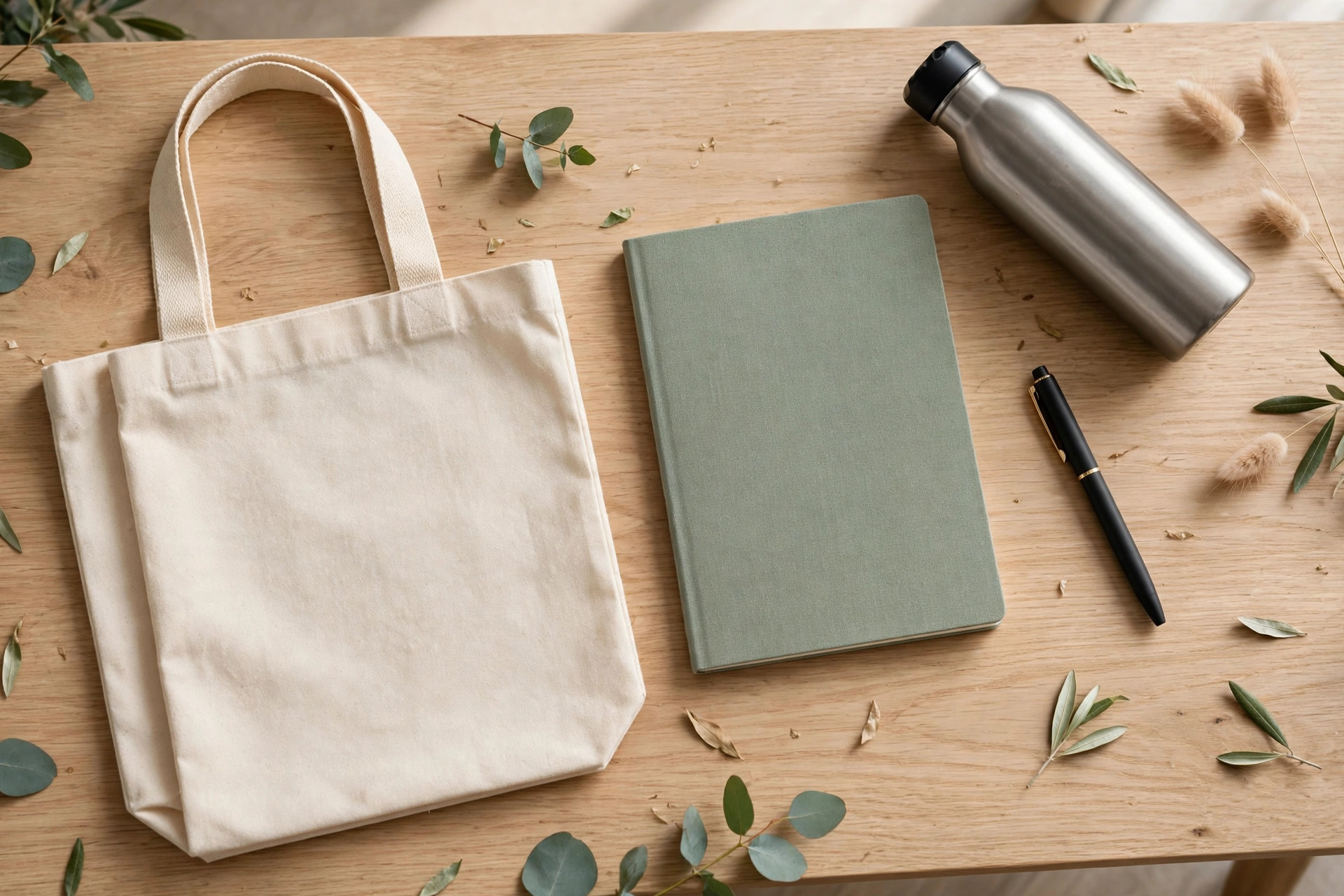
- A quality notebook or journal: A hardcover A5 notebook is the workhorse of the kit. It is used in meetings from day one and keeps your brand in front of the new hire for months.
- A metal or premium pen: A weighty pen feels like a gift rather than stationery. It pairs naturally with the notebook.
- A reusable water bottle: In the Dubai heat, hydration is not optional. A stainless steel bottle is genuinely useful and travels everywhere, giving your logo wide visibility.
- A tote bag or backpack: This doubles as the kit’s “packaging” — items presented inside a branded tote feel like a curated set rather than a pile of giveaways.
- A ceramic mug or travel cup: For the office kitchen or the commute. Pair with the bottle only if the budget allows; one drinkware item is usually enough.
The useful daily items
These earn their place through usefulness rather than branding potential:
- A welcome card or handwritten note: A short note from the line manager or CEO costs almost nothing and is consistently the item new hires mention with the most warmth. Include first-day logistics — Wi-Fi details, lunch arrangements, who to find for what.
- Company handbook or culture guide: Print a slim, well-designed booklet rather than a 60-page binder. New joiners will actually read ten pages.
- Lanyard and badge holder or access-card accessories: Practical in buildings with security gates across Business Bay, DIFC, and JLT offices.
- A small desk accessory: A desk calendar, a wireless charger, or a USB drive — one item that makes the new desk feel set up.
The memorable touch
One item that shows personality separates a memorable kit from a standard one:
- Local flavour: Dates with Arabic coffee sachets, a small box of Dubai-made chocolates, or a guide to the city for relocating employees. This is especially meaningful for new hire gift sets UAE companies give to staff arriving from overseas.
- A book: A short, relevant book chosen by the team signals investment in the person’s growth.
- A plant or succulent: A tiny desk plant is hard to throw away and easy to love — though check office policies first.
When selecting your mix, remember that custom welcome gift sets Dubai employers order work best when every item has a reason to exist. Five excellent items beat ten mediocre ones. If an item will end up in a drawer untouched, cut it and upgrade something else.
Custom Welcome Gift Sets Dubai: Tailoring Kits for the UAE Workforce
Dubai’s workforce is one of the most diverse in the world. Your onboarding kits will land in the hands of people from dozens of nationalities, faiths, and cultural backgrounds — often people who have been in the country for less than a week. That diversity is a strength, but it asks for a little thoughtfulness when you design employee onboarding gifts Dubai teams distribute.
Cultural sensitivity basics
- Avoid alcohol and pork-derived products entirely. Food items in kits should be vegetarian-safe or clearly labelled. Date-based sweets are a safe, well-received local classic.
- Keep branding respectful during religious occasions. If a start date falls during Ramadan, a kit is still appropriate, but consider pairing it with dates and a note acknowledging the holy month. Conversely, avoid scheduling loud, celebratory kit launches for fasting colleagues’ first days — a calm, private presentation works better.
- Mind gender-neutral design. In a mixed workforce, kits should be identical for everyone. Avoid “his and hers” variants or fragrances; if you include personal care items, choose unisex formulations.
- Think about modesty in apparel. If your kit includes a t-shirt or cap, choose relaxed, modest cuts rather than fitted styles, and offer size choice without fuss.
The expatriate factor
A large share of Dubai’s new hires are relocating. For them, a welcome kit can double as a soft landing:
- Include a short “Living in Dubai” insert — metro tips, weekend ideas, emergency numbers, and how Friday/Saturday or Saturday/Sunday weekends work depending on your sector.
- A Nol card with a small preloaded balance is a genuinely brilliant inclusion for someone who has never used the Dubai Metro.
- Keep one or two items non-branded and purely practical, like a universal travel adapter. Small kindnesses for new arrivals get remembered.
Language
English is the working language of most Dubai offices, and English-only kits are standard. If your company serves Arabic-speaking clients or has a strong Emiratisation programme, consider bilingual packaging or a bilingual welcome note — Arabic on one side, English on the other. It is a small printing decision that signals a lot.
Branding Methods: Laser Engraving, UV Printing, Sublimation and More
The branding method you choose determines how your logo looks, how long it lasts, and what it costs. For welcome gift sets with logo placement, these are the methods Dubai suppliers use most often, with honest guidance on where each one shines.
Laser engraving
A laser etches your logo directly into the material — metal pens, stainless steel bottles, wooden boxes, leather notebook covers. The result is precise, permanent, and premium-looking: no ink to fade, peel, or wash off.
- Best for: Metal drinkware, pens, keychains, wooden gift boxes, leather goods.
- Look: Subtle and elegant — tone-on-tone. One colour only (the material’s revealed surface), which suits minimalist brand identities.
- Considerations: Engraving cannot reproduce full-colour gradients. Fine detail needs a clean vector logo file. On dark powder-coated bottles, the engraved area reveals the metal beneath — striking, but confirm a sample first.
UV printing
UV printers cure ink directly onto surfaces with ultraviolet light, producing vivid full-colour prints on an enormous range of materials — including curved and textured ones.
- Best for: Notebooks, tote bags, boxes, tech accessories, mugs (flat or cylindrical jigs), full-colour logos.
- Look: Bright, photographic, high-resolution. Handles gradients, photos, and multi-colour designs that engraving cannot.
- Considerations: Ask about scratch resistance and whether a protective coating is applied, especially for items that live in bags and get daily handling.
Sublimation printing
Heat transfers dye into specially coated items — most famously mugs and polyester fabrics. The ink becomes part of the material rather than sitting on top.
- Best for: Ceramic mugs, polyester t-shirts, lanyards, mousepads.
- Look: Seamless full-colour coverage, including wraparound mug designs. Colours will not crack or peel because the dye is in the coating.
- Considerations: Only works on polymer-coated or polyester substrates. On white mugs the colours are most vivid; coloured bases shift the palette.
Screen printing
The classic method for fabric and flat surfaces — ink pushed through a mesh stencil, one colour at a time.
- Best for: Cotton tote bags, t-shirts, paper bags, large simple logos.
- Look: Bold, slightly textured, with a handmade feel many brands love.
- Considerations: Each colour needs its own screen, so multi-colour designs on small runs get expensive. Best value at higher quantities.
Embroidery and debossing
For soft goods and leather, embroidery (thread) and debossing (pressed, heat-set impression) give a tactile premium finish.
- Best for: Caps, polo shirts, backpacks (embroidery); leather notebooks, card holders, journals (debossing).
- Look: Understated luxury. Embroidery adds texture; debossing adds a quiet, confident brand mark.
Choosing the right method for your kit
A practical rule: match the method to the item, not the other way round. Engrave the bottle, UV-print the notebook, sublimate the mug, embroider the cap. A mixed-method kit looks intentional and high-end, while forcing one method onto every item produces compromises. Ask your supplier for a physical sample of each branded item before approving a full run — photos on a screen hide a multitude of sins, and this single step prevents most branding disappointments.
Order Quantities, MOQs and Timelines in Dubai
One of the most common questions HR teams ask is: how many kits should we order, and how far ahead? The answers depend on your hiring patterns, but there are useful industry norms for the UAE market.
Minimum order quantities (approximate norms)
Most Dubai gift suppliers structure pricing around minimum order quantities. As approximate industry norms — not any single supplier’s price list — expect roughly the following:
- Standard branded items (mugs, bottles, notebooks, pens): minimums often sit around 25–50 pieces per item when branding is involved. Unbranded stock items can sometimes be ordered in smaller numbers.
- Fully custom kits (custom box, multiple branded items, coordinated design): minimums tend to start higher, commonly around 50–100 sets, because of setup work on each branded component.
- Apparel (t-shirts, caps, polos): minimums of around 25–50 pieces per size run are typical for embroidered or screen-printed runs.
These are ballpark figures for planning; your supplier will confirm exact minimums per item. If your hiring is steady but low-volume — say two to four joiners a month — ask about building a “kit inventory”: order one larger run of branded core items once, then assemble kits as people join. This is usually far more economical than placing tiny bespoke orders every month.
Production and delivery timelines
Plan backwards from the start date, not forwards from the order date:
- Standard branded runs: Allow roughly 7–14 working days from artwork approval to delivery for most items. This is the most common window in the Dubai market.
- Complex or multi-item kits: Custom boxes, embroidery, or coordinated sets with several branded components often need 2–3 weeks.
- Rush orders: Many suppliers can expedite for urgent hires, sometimes in 3–5 working days, but rush production limits your item choices and usually costs more. Treat it as a backup plan, not a strategy.
The hidden time-eater is artwork approval, not production. Having your logo in clean vector format (AI, EPS, or high-resolution PDF) ready before you contact a supplier can shave days off the process. If your brand guidelines specify Pantone colours, share them upfront — colour matching is where delays and disputes most often start.
Staggering for continuous hiring
Companies with rolling recruitment do best with a two-tier system:
- A standing inventory of the core branded items (bottle, notebook, pen, tote), reordered quarterly or when stock runs low.
- Per-joiner assembly of the kit — box, welcome note, handbook — done in-house by HR or office management.
This keeps every new hire’s kit consistent while avoiding the chaos of ordering from scratch each time someone accepts an offer. Agree a reorder trigger point (for example, when stock drops below ten kits) so nobody discovers the cupboard is empty the Friday before a Monday start.
Budgeting: What Should a Welcome Kit Cost?
Budget is where many onboarding kit projects stall, usually because nobody set a per-kit figure early. Start with the number of expected hires per year, multiply by your per-kit budget, and you have a line item the finance team can approve once instead of per order.
For practical guidance on setting that per-employee figure, our detailed walkthrough on planning your per-employee gift budget breaks down how companies typically allocate spend across roles and occasions. The key principle applies directly to welcome kits: budget by tier. A graduate trainee’s kit and a C-suite hire’s kit do not need to cost the same — but they should feel equally considered.
As an approximate planning framework (industry norms, not a price list):
- Essential tier: A branded tote, notebook, pen, and bottle — the core kit. Suitable for high-volume hiring such as retail, hospitality, or BPO teams.
- Standard tier: Add a mug or travel cup, a welcome card, and a small local treat. This is the sweet spot for most office roles.
- Premium tier: Upgrade materials — leather notebook, engraved metal bottle, quality backpack — and add a personal note from leadership. Reserved for senior hires and leadership onboarding.
Whatever tier you choose, keep it consistent within the tier. Nothing undermines a kit faster than a new hire discovering a colleague who started a month earlier received a visibly better one.
Branded vs Unbranded: Striking the Right Balance
Should every item in the kit carry your logo? The instinct says yes; the better answer is: brand the items where branding adds value, and leave the rest clean.
Our analysis of branded vs unbranded corporate gifts and their ROI digs into when logo placement pays off and when it backfires. For welcome kits specifically, the logic is straightforward:
- Brand the keepers: Bottles, notebooks, bags, and pens — items used daily in visible settings — earn their logo. Each use is a micro-impression of your brand.
- Leave the personal items clean: The welcome note, the book, the local treats — these feel like gifts, not marketing. An unbranded dates box feels generous; a logo-stamped one feels promotional.
- One hero placement beats five small ones: A beautifully engraved bottle makes a stronger impression than a logo crammed onto every surface. Restraint reads as confidence.
The packaging itself is prime branding real estate. A custom rigid box or a well-designed kraft box with your logo, brand colours, and a welcome message turns the unboxing into an event — and it is the first thing the new hire sees. Invest in the box before you invest in branding a fifth small item.
Choosing the Right Items for Your Business in Dubai
A fintech startup in DIFC, a hospitality group on Sheikh Zayed Road, and a construction firm in Jebel Ali should not be handing out identical kits. Your industry, your brand personality, and your people’s daily reality should shape the contents.
Our guide to choosing the right corporate gifts for your business in Dubai covers the selection framework in depth. Applied to onboarding kits, the short version is:
- Match the work: Field teams value rugged bottles, caps, and durable bags. Office teams value desk accessories and quality stationery. Tech teams notice — and judge — the quality of any tech accessory you include, so only include tech items you would be proud of.
- Match the brand: A luxury brand’s kit should feel luxurious; a playful startup’s kit can be colourful and informal. The kit is a physical expression of your employer brand — inconsistency between the kit and the office culture is immediately obvious.
- Match the person where you can: You will not personalise every kit at scale, but small touches — the right t-shirt size, a note that references their role, a book relevant to their function — show the kit was assembled for them, not just ordered for “new hires.”
Avoid the trap of ordering whatever is cheapest in bulk and calling it a kit. New hires compare notes, and a kit that feels like an afterthought sends exactly that message about how the company treats its people.
Welcome Kits for Occasions Beyond Day One
The onboarding journey does not end after the first week, and the smartest companies extend gifting across the first year:
- End of probation: A small recognition gift when probation is confirmed — often a slightly upgraded item like an engraved pen set or a premium notebook — marks the transition from “new hire” to “team member.”
- First Ramadan or Eid with the company: A modest festive gift acknowledges the cultural calendar new expatriate hires are still learning.
- Work anniversaries: The one-year mark is a natural moment for a second, smaller gift — it closes the onboarding loop.
- Internal moves and promotions: When someone changes teams or gets promoted in their first year, a small congratulatory item reinforces that growth is noticed.
Each of these moments can reuse your branded core items, keeping costs manageable while multiplying the touchpoints. The unique corporate gifts range is a good place to browse distinctive pieces for these milestone moments — items that feel special rather than standard-issue.
The Practical Checklist: Ordering Welcome Gift Sets in Dubai
Use this checklist when you are ready to place an order. It distils everything above into the steps that keep projects on track:
- Fix the headcount: Confirm expected hires for the next 3–6 months. Add a 10–15% buffer for surprise hires — running out mid-quarter is the most common failure mode.
- Set the per-kit budget: Get finance sign-off on one number per tier before you start selecting items.
- Finalise the item list: Five to seven items, each with a reason. Cut ruthlessly.
- Prepare artwork: Vector logo, brand colour codes, and any welcome-note text, approved internally before you approach a supplier.
- Request physical samples: Of every branded item, with your actual logo applied. Check colours, placement, size, and finish in real light.
- Confirm the timeline in writing: Production days, delivery date, and who to call if it slips. Work backwards from the earliest start date in the batch.
- Plan storage and assembly: Branded items need clean, dry storage. Decide who assembles kits and where — a spare meeting room works fine.
- Brief the presenters: Whoever hands over the kit (line manager, HR, buddy) should know what is inside and why. A two-minute briefing prevents the awkward “here’s… some stuff” handover.
- Collect feedback: After the first batch, ask new hires what they actually used. Adjust the next order accordingly — the kit should evolve.
- Set a reorder trigger: A stock level or calendar date that prompts the next order automatically, so the system runs without heroics.

Common Mistakes to Avoid
- Ordering too late: The kit that arrives two weeks after the start date is worse than no kit — it advertises disorganisation. Build lead time into your recruitment workflow, not just your gifting workflow.
- Over-branding: A logo on every square centimetre cheapens the kit. Leave breathing room.
- Ignoring quality: A pen that stops working in week two or a bottle that leaks does active brand damage. Sample everything, and weight quality over quantity when budgets tighten.
- One-size-fits-all across seniority: Identical kits for interns and directors either waste money or undersell senior hires. Two or three tiers solve this.
- Forgetting the note: The most-remembered item in most kits is the cheapest — the personal welcome message. Never skip it.
- No reorder plan: The first batch is a project; every batch after that should be a process. Without a reorder trigger, the programme quietly dies after one quarter.
Working With a Dubai Corporate Gifting Supplier
A good supplier does more than print logos. For welcome kit programmes, look for a partner that can handle the full cycle: sourcing items, applying your branding across different methods, assembling kits, storing buffer stock, and delivering on the schedule your hiring plan needs.
When you evaluate suppliers, ask specifically about:
- Sample policy: Will they produce branded samples before the full run, and how quickly?
- Multi-method branding: Can they engrave, UV-print, sublimate, and embroider in-house or through reliable partners? Kits almost always need more than one method.
- Assembly and kitting: Will they pack the boxes, insert the welcome notes, and deliver ready-to-hand kits — or just ship loose items?
- Reorder responsiveness: For rolling programmes, how fast can they top up stock of individual items?
- Artwork support: Can their design team adapt your logo files for each method and flag problems before production?
Getting these answers upfront separates a transactional vendor from a programme partner. The cheapest quote is rarely the cheapest outcome once reprints, delays, and quality failures are factored in.
Why It Matters: The Bigger Picture for Dubai Employers
Dubai competes globally for talent. Professionals choosing between offers in Dubai, Singapore, London, or Riyadh weigh the whole package — and while no one accepts a job for a tote bag, the signals a company sends in its first week shape whether a new hire becomes an advocate or starts browsing job boards by month six.
Welcome gift sets Dubai companies invest in are a small line item with an outsized signalling effect. They tell new hires that the company is organised, generous, and proud of its brand. They give people useful tools on day one. And for the many employees who have just relocated their lives to the UAE, they say the most important thing of all: welcome — we are glad you are here.
If you are building or refreshing your onboarding kit programme, learn more about our corporate gifting team and how we support HR teams across the UAE with branded welcome kits, from single-item branding to complete multi-tier onboarding programmes.
Vision Advertising | 38A St, Hor Al Anz, Deira, Dubai, UAE | +971 50 970 9564 | [email protected]
Frequently Asked Questions
What is typically included in welcome gift sets in Dubai?
Most Dubai employers include a branded tote or backpack, a notebook and pen, a reusable water bottle, a mug or travel cup, a welcome card or note, and a company handbook or culture guide. Many add a local touch such as dates or Arabic coffee, and some include practical relocation items like a Nol card or travel adapter for expatriate hires. Five to seven well-chosen items generally make the strongest kit.
How far in advance should we order custom welcome gift sets in Dubai?
As a rule of thumb, allow 2–3 weeks from artwork approval to delivery for multi-item branded kits, and 7–14 working days for simpler branded runs. The most common cause of delay is artwork approval rather than production, so having your logo in vector format ready before you order saves the most time. For companies with continuous hiring, keeping a standing inventory of branded core items avoids last-minute rushes entirely.
What are typical minimum order quantities for branded welcome kits?
As approximate industry norms, expect minimums of around 25–50 pieces per item for standard branded products like mugs, bottles, and notebooks, and around 50–100 sets for fully custom coordinated kits. Exact minimums vary by supplier and item, so confirm per item when requesting a quote. Ordering one larger run and assembling kits as people join is usually the most economical approach for steady hiring.
Which branding method is best for welcome gift sets with logos?
It depends on the item. Laser engraving is ideal for metal bottles, pens, and leather goods, giving a permanent, premium finish. UV printing handles full-colour logos on notebooks, boxes, and tech accessories. Sublimation suits ceramic mugs and polyester fabrics. Most polished kits use a mix of methods matched to each item — engrave the bottle, UV-print the notebook, sublimate the mug — rather than forcing one method onto everything. Always approve a physical branded sample before the full run.
Are welcome gift sets appropriate during Ramadan?
Yes, with sensitivity. A welcome kit is still appropriate for someone joining during Ramadan, but present it calmly and consider including dates as a thoughtful touch. Avoid loud celebratory presentations during fasting hours, and make sure any food items in the kit are suitable — vegetarian-safe and clearly labelled. A brief acknowledgement of the holy month in the welcome note is a gracious detail.
How do we budget for employee onboarding gifts in Dubai?
Start by setting a per-kit budget per tier (for example, essential, standard, and premium tiers for different role levels), then multiply by your expected hires for the year. Getting one annual figure approved is far smoother than seeking approval per order. Our guide to planning your per-employee gift budget walks through how companies typically structure this spend across roles and occasions.




