
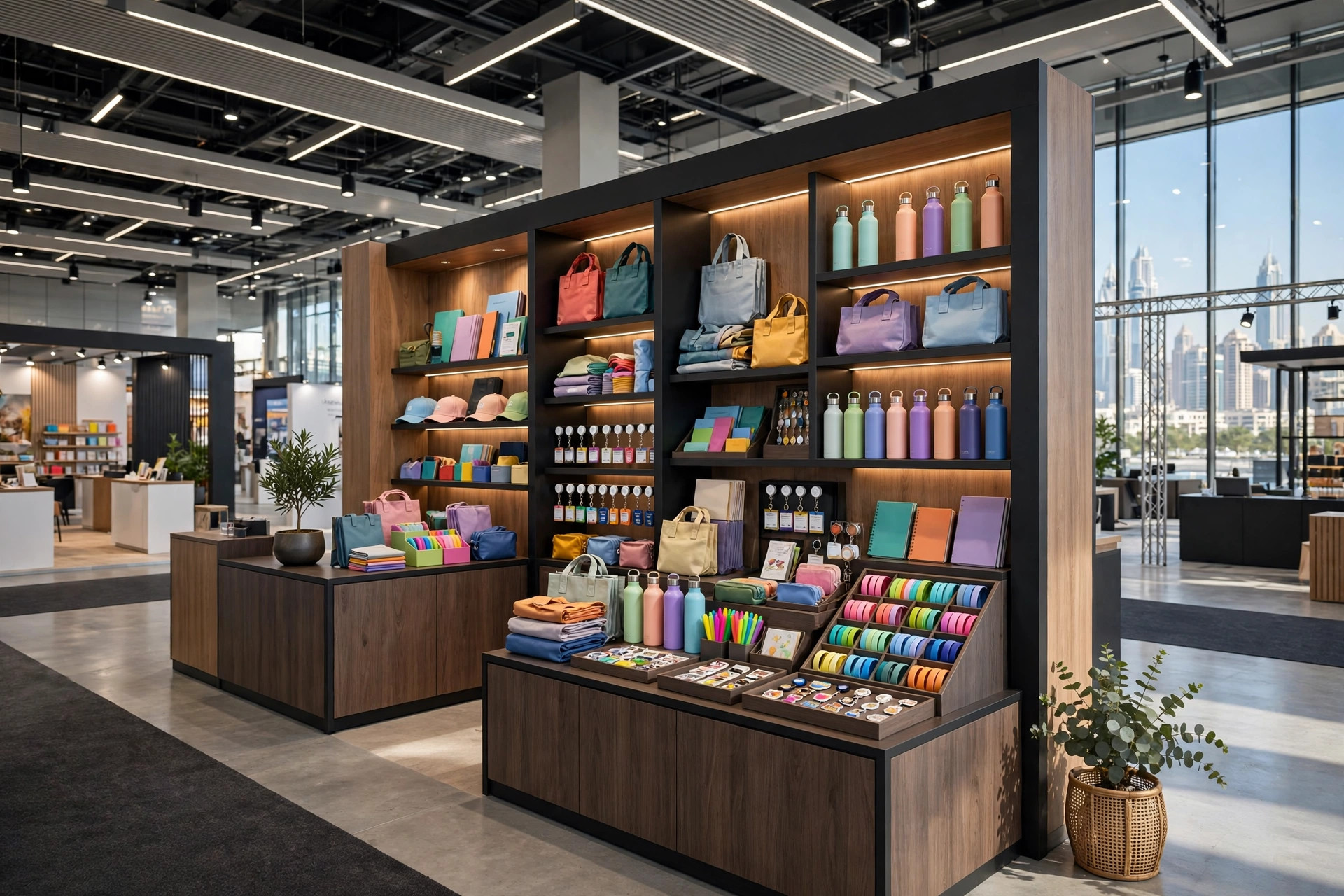
Walk through any exhibition hall in Dubai during a busy season and you will see thousands of branded items changing hands: tote bags at the registration desk, notebooks in delegate packs, power banks at lucky draws, water bottles on every table. Behind every one of those items sits a decision that someone in marketing or procurement had to make — which promotional products supplier to trust with the order.
That decision matters more than most buyers realise. The right supplier in Dubai becomes an extension of your team: they warn you when your artwork will not reproduce well on a small pen barrel, they hold buffer stock so a reprint does not take three weeks, and they deliver to the venue on the morning of your event without drama. The wrong supplier costs you far more than money — late deliveries before a product launch, logos that peel off after a week, and cartons of merchandise that end up in a storeroom because nobody wants to hand them out.
This guide walks you through choosing a promotional products supplier in Dubai with confidence. It covers the types of suppliers operating in the UAE market, a practical vetting checklist, the branding methods you will be offered, realistic expectations for minimum order quantities and timelines, Dubai-specific considerations, and the questions worth asking before you commit. Whether you are ordering five hundred branded mugs for a conference or planning a year-long merchandise programme, the principles are the same.
What Does a Promotional Products Supplier Actually Do?
The term gets used loosely, so it helps to start with a clear definition. A promotional products supplier sources, brands, and delivers merchandise carrying your logo or campaign artwork — items intended to promote a brand, reward customers, or mark an occasion. The catalogue typically spans drinkware, bags, tech accessories, writing instruments, apparel, desk items, and event giveaways.
What separates a genuine supplier from a simple reseller or print shop is the scope of service. A proper promotional products supplier in Dubai will:
- Source products from local stockists and overseas factories, matching the item to your budget, quality bar, and deadline.
- Brand the items using the right method for the material — screen printing, pad printing, laser engraving, embroidery, UV printing, sublimation, or heat transfer — either in-house or through vetted production partners.
- Manage artwork — checking your logo files, advising on size and placement, and producing digital proofs or physical samples before production.
- Handle logistics — consolidating the order, managing quality checks, packing, and delivering across the UAE (and often the wider GCC).
- Support reorders — keeping your artwork and specifications on file so the second order is faster and consistent with the first.
Some suppliers also act as consultants, helping you choose items that fit a campaign objective rather than simply selling what is in the catalogue. That advisory layer is one of the clearest markers of a supplier worth a long-term relationship.
The Three Types of Suppliers You Will Meet in Dubai
The Dubai market for custom promotional products is unusually diverse, and understanding the landscape helps you set the right expectations. Broadly, you will encounter three models.
1. Local stockists and distributors. These companies hold inventory in UAE warehouses — typically the most popular items such as mugs, pens, tote bags, notebooks, and basic tech accessories. Their strength is speed: because the blank product is already in the country, branding and delivery can often be completed in days rather than weeks. Their range is narrower than an importer’s, and truly unusual items may not be available, but for standard giveaways on tight timelines they are hard to beat.
2. Import-focused trading companies. These suppliers work primarily with factories in China, India, and Turkey, and they excel at custom or high-volume work: fully bespoke items, unusual materials, or orders in the thousands and tens of thousands. The trade-off is lead time — sea freight and production schedules mean planning several weeks ahead — and a heavier reliance on the supplier’s quality control, since you cannot easily inspect goods before they ship. The best of them maintain QC relationships with their factories and provide pre-shipment photos or inspection reports.
3. Full-service brand merchandise agencies. These are the one-stop shops: they combine local stock, import capability, in-house or partner branding, creative support, and fulfilment under one roof. They tend to cost more than a pure trader, but they absorb the coordination burden — artwork checks, sample management, multi-item kitting, event-day delivery — that otherwise falls on your team. For companies running recurring campaigns or multi-product gift sets, this model usually delivers the lowest total effort.
None of these models is inherently better; the right choice depends on your order size, timeline, and how much project management you want to handle yourself. Many experienced buyers in Dubai use a mix — a fast local supplier for event-season top-ups and an import partner for planned annual orders.
The 10-Point Vetting Checklist
When you are evaluating a promotional products supplier in Dubai, work through these ten points before placing a meaningful order. They are drawn from the mistakes buyers most often report after a bad experience.
1. Physical presence and trade licence. A legitimate supplier has a verifiable office or warehouse in the UAE and a valid trade licence. This matters for accountability: if something goes wrong with a large order, you want a company you can visit, not a PO box and a mobile number. Ask for the licence details and check that the company name matches.
2. In-house branding capability (or honest disclosure). Ask which branding methods they do themselves and which they outsource. In-house screen printing, pad printing, or laser engraving usually means faster turnaround and tighter quality control. Outsourcing is not a deal-breaker — most suppliers outsource something — but the supplier should be transparent about it and still take full responsibility for the result.
3. Sample policy. A serious supplier will always offer a pre-production sample (sometimes called a proof sample) for custom or large orders, and will usually have blank product samples available for standard items. Be cautious of any supplier that pushes you straight to bulk production without offering a sample stage, especially on orders above a few hundred units.
4. Artwork support. Your logo may arrive as a low-resolution file pulled from a website, and a good supplier will tell you plainly if it is not suitable for the chosen branding method rather than printing it badly. Ask whether they provide free basic artwork checks and digital mock-ups showing logo placement and size.
5. Transparent MOQs. Minimum order quantities should be stated clearly per product, not revealed halfway through the process. MOQs exist because factories and branding lines have setup costs, but they vary enormously by item and method — and a supplier should explain why a particular MOQ applies rather than hiding behind it.
6. Realistic lead times in writing. Get the production timeline and delivery date confirmed in writing — ideally on the quotation or proforma invoice. Vague promises like “as soon as possible” are a warning sign. A professional supplier breaks the timeline into stages: artwork approval, sample, production, branding, and delivery.
7. Quality assurance process. Ask how they check quality: do they inspect a percentage of units? What happens if items arrive damaged or misprinted — do they reprint, refund, or discount? The answer should be a clear policy, not a shrug. For imported goods, ask whether they conduct pre-shipment inspections.
8. Payment terms. Standard practice in the UAE promotional market is a deposit (commonly around half) with the balance on delivery or against delivery documents, though terms vary. What matters is that the terms are stated upfront, documented, and consistent. Be wary of demands for full payment upfront from a supplier you have never worked with.
9. References and track record. Ask which companies they have supplied and whether you can see examples of past work — photos of branded items, case notes, or client names they are permitted to share. Longevity in the Dubai market is itself a signal; the promotional business here is competitive, and weak suppliers do not survive many event seasons.
10. Communication and responsiveness. This is the soft factor that predicts everything else. If a supplier is slow, vague, or evasive during the quotation stage — when they are trying to win your business — imagine how communication will feel when a deadline is slipping. Fast, specific, written answers are a green flag.
Run every shortlisted supplier through this list and the differences become obvious quickly. The cheapest quote rarely survives the checklist intact — and that is usually the point.
Red Flags That Should Make You Walk Away
Alongside the positive checklist, watch for these warning signs, any one of which justifies looking elsewhere:
- No physical address or licence details shared when asked directly.
- Refusal to provide a pre-production sample on a custom or high-value order.
- Quotes far below every competitor without a clear explanation — this usually means thinner materials, weaker branding, or corners cut in QC.
- Unwillingness to put timelines in writing, or timelines that sound impossibly fast for custom imported goods.
- Pressure to pay 100% upfront before any sample or written confirmation.
- Vague answers about where products come from or which factory produces them.
- No policy for defective or misprinted items — “we will see” is not a policy.
Trust your instincts as well. Promotional products are a relationship business: you will likely reorder, adjust artwork, and rush the occasional urgent batch. Choose a supplier you would be comfortable calling with a problem, because eventually you will need to.
Matching Products to Campaign Goals
One of the most useful conversations you can have with a supplier is not “what do you sell?” but “what are we trying to achieve?” Different campaign goals point to different product strategies:
- Brand awareness at events and exhibitions. High-visibility, low-cost-per-unit items that people will carry around the venue: tote bags, lanyards, caps, and water bottles. The branding needs to be bold and readable at a distance.
- Lead generation. Items with enough perceived value that visitors will exchange contact details for them: quality notebooks, power banks, insulated bottles, or tech organisers. These justify a higher unit cost because each one is tied to a captured lead.
- Customer and partner retention. Premium-feeling gifts that reflect well on your brand: executive gift sets, leather goods, crystal awards, or curated hampers. Presentation — gift boxes, ribbon, personalised cards — matters as much as the item.
- Employee engagement and onboarding. Practical items people use daily: apparel, mugs, desk accessories, and welcome kits. Consistency across the set matters; a mismatched welcome kit undermines the impression.
- Seasonal and cultural occasions. In the UAE this includes Ramadan and Eid gifting, UAE National Day, Diwali, and year-end corporate gifting. Timing and cultural appropriateness are critical — more on this below.
A good promotional products supplier in Dubai will steer you toward the right tier for your goal rather than upselling you into premium items for a mass giveaway — or underselling you into flimsy items for a VIP audience.

Branding Methods, Plainly Explained
The method used to put your logo on a product determines how it looks, how long it lasts, and what it costs. Here is what the common options mean in practice:
- Screen printing. Ink pressed through a mesh screen onto the surface. Best for flat or gently curved items — t-shirts, tote bags, notebooks — and for bold single or multi-colour designs. Economical at volume; each colour typically needs its own screen.
- Pad printing. A silicone pad transfers ink from an etched plate onto the product. The go-to method for small, curved, or irregular surfaces: pens, keychains, USB drives, bottle openers. Excellent detail at small sizes.
- Laser engraving. A laser etches the design into metal, wood, or coated surfaces — pens, flasks, awards, tech items. The result is permanent and premium-feeling, usually in a single tone (the material showing through).
- Embroidery. Thread stitched into fabric — caps, polo shirts, bags, towels. Durable and high-perceived-value; best for simpler designs, as fine detail gets lost in thread.
- UV printing. Ultraviolet-cured ink printed directly onto the surface, capable of full-colour photographic detail on hard items like phone accessories, badges, and acrylic awards.
- Dye sublimation. Heat transfers dye into polyester-coated or polyester-fabric items — mugs, lanyards, sportswear. Produces vivid, all-over, edge-to-edge colour that will not crack or peel.
- Heat transfer / DTF. Designs printed onto film and heat-pressed onto textiles. Flexible for short runs and multi-colour artwork on t-shirts and apparel.
- Debossing / embossing. A die presses the design into leather or paper goods — notebooks, wallets, folders — with or without foil. Understated and executive.
Your supplier should recommend the method, not just take your instruction. A logo with fine gradients, for example, will reproduce beautifully in sublimation or UV print but poorly in single-colour screen print — and a knowledgeable supplier flags that before production, not after.
MOQs: What to Expect in the UAE Market
Minimum order quantities are one of the first practical questions buyers ask, and the honest answer is that they vary widely. As approximate industry norms in the Dubai promotional market — not any single supplier’s pricing — small branded items like pens, keychains, and basic mugs often start at runs of around a hundred units; mid-range items such as tote bags, notebooks, and caps commonly start in the low hundreds; and fully custom manufactured items (bespoke shapes, custom-moulded products) typically require runs in the thousands because of tooling and factory setup.
Several factors push MOQs up or down: the branding method (screen printing favours larger runs; digital methods and DTF handle smaller ones), whether the blank product is held locally or imported, and how customised the item is. If your quantity is small, ask the supplier what is achievable with locally stocked blanks and digital branding — the answer is often more flexible than the catalogue suggests. For a deeper explanation of how minimum quantities work across product types, see this guide to minimum order quantities for custom corporate gifts in the UAE.
One caution: an MOQ that seems unusually low for a custom imported item deserves scrutiny. Either the supplier is aggregating your order with others (fine, if disclosed) or the “custom” element is thinner than described.
Timelines: How Far Ahead to Plan
Timeline planning is where most promotional orders succeed or fail, and Dubai’s event calendar makes it unforgiving — GITEX, Gulfood, Arab Health, and the autumn conference season create predictable crunch periods when every supplier is at capacity.
As rough industry norms: locally stocked items with standard branding can often be turned around within a few working days once artwork is approved; customised local production typically needs one to two weeks; and imported custom goods generally need several weeks including production and freight, longer if sea freight is involved rather than air. Ramadan and Eid periods, Chinese New Year (which affects factory schedules in China), and the December holiday season can all extend these windows.
The practical rule: work backwards from the date you need goods in hand — not the event date, but a few days before it — and add buffer for artwork revisions and sample approval. A supplier who asks about your deadline early and builds the production plan around it is showing you how they operate under pressure. For occasion-based planning, this corporate gifting timeline guide for Dubai maps out how far in advance to order for major UAE occasions.
What Drives the Cost (Without the Guesswork)
Buyers naturally want price lists, but promotional pricing depends on so many variables that a flat list is usually misleading. Understanding the cost drivers helps you evaluate quotes intelligently:
- The blank product itself — material, weight, and finish quality. A heavyweight ceramic mug and a thin one can look similar in a photo and feel completely different in hand.
- Order quantity — unit costs fall as quantities rise because setup and tooling are spread across more units. This is the single biggest lever.
- Branding method and colours — single-colour pad print costs less than full-colour UV; embroidery pricing scales with stitch count.
- Customisation depth — an off-the-shelf item with your logo is far cheaper than a bespoke shape made to your specification.
- Packaging — individual gift boxes, sleeves, or kitting add cost but transform perceived value.
- Logistics — local delivery within Dubai versus air freight for urgent imports.
- Timeline — rush production almost always carries a premium.
When comparing quotes, make sure you are comparing like with like: same product specification, same branding method and print area, same packaging, same delivery terms. A quote that is dramatically cheaper usually differs on one of these dimensions — ask which one. And never evaluate on unit price alone; a slightly higher unit cost from a supplier with rigorous QC and on-time delivery is cheaper than a reprint.
The Ordering Process, Step by Step
A professional order follows a predictable sequence. Knowing it helps you spot when a supplier is skipping steps:
- Brief and quotation. You share the item type (or objective), quantity, deadline, and logo files. The supplier quotes with product specs, branding method, timeline, and terms.
- Artwork check and mock-up. The supplier reviews your files and sends a digital proof showing placement, size, and colours. You approve or request changes.
- Sample. For custom or significant orders, a pre-production sample is branded and sent for your approval. This is your last low-cost chance to catch problems.
- Deposit and production. You approve the sample in writing and pay the agreed deposit. Production and branding proceed.
- Quality check. The supplier inspects the finished goods — and for large orders, shares photos or allows inspection before dispatch.
- Balance, packing, and delivery. Final payment per agreed terms, goods packed to your specification, delivered to your office, warehouse, or directly to the event venue.
If a supplier proposes skipping the sample stage on a first order, or cannot describe their QC step, treat that as information about how they handle the orders you cannot watch.
Dubai-Specific Considerations
Ordering promotional products in Dubai comes with local factors that an out-of-market supplier will not navigate well:
- The event calendar. Major exhibitions create demand spikes. Suppliers book production slots weeks ahead of GITEX and similar events — ordering early is not just advisable, it is often the difference between availability and apology.
- Ramadan, Eid, and National Day. These are peak corporate gifting periods with specific cultural expectations. Ramadan gifts lean toward premium dates, oud, and elegant packaging; UAE National Day (2 December) favours flag colours and patriotic themes. A local supplier understands these rhythms instinctively.
- Climate. Dubai’s heat and humidity affect materials: cheap adhesives fail, some plastics warp in a hot car, and outdoor event giveaways need UV-stable branding. Ask how items perform in local conditions.
- Multilingual branding. Arabic/English dual branding is common and expected on many corporate items. Your supplier should handle Arabic typesetting correctly — reversed or broken Arabic text on a branded item is a costly and embarrassing error.
- Delivery logistics. Dubai’s traffic, venue access rules, and exhibition setup windows require a supplier experienced in event-day delivery — including delivering directly to exhibition stands during build-up days.
Questions to Ask Before You Commit
Keep this shortlist handy for your first serious conversation with any promotional products supplier in Dubai:
- Which branding methods do you do in-house, and which do you outsource?
- Can I see a physical sample before committing to the full run?
- What is the exact production timeline, in writing, from artwork approval to delivery?
- What happens if items arrive misprinted or damaged — reprint, refund, or discount?
- Are the quoted MOQs per design or per product, and can they flex for stocked items?
- How do you handle Arabic/English dual-logo artwork?
- Can you deliver directly to our event venue, and have you done venue deliveries before?
- Do you keep our artwork and specs on file for reorders?
The quality of the answers tells you most of what the checklist would. Specific, written, confident answers signal a supplier who has done this many times; hedging and vagueness signal the opposite.
Choosing Well Pays for Itself
A promotional products supplier in Dubai is not a commodity vendor — or at least, the good ones are not. The difference between a supplier who simply takes orders and one who manages the details (artwork viability, sample discipline, QC, event-day logistics) shows up in the moment your branded items land in recipients’ hands. Choose with the checklist, watch for the red flags, plan timelines honestly, and brief on objectives rather than just items.
If you are evaluating partners, start by browsing the range of promotional products available in Dubai to calibrate what is possible, read up on how to choose the right corporate gifts for your business, and weigh the ROI case for branded versus unbranded gifts before you brief. And if you want to understand the company behind the catalogue, the about page sets out who you would be working with.
Vision Advertising — 38A St, Hor Al Anz, Deira, Dubai, UAE | +971 50 970 9564 | [email protected]
Frequently Asked Questions
What should I look for in a promotional products supplier in Dubai?
Prioritise a verifiable UAE trade licence and physical presence, transparent MOQs and written timelines, a clear pre-production sample policy, in-house or well-managed branding capability, a stated quality and reprint policy, and responsive, specific communication. Ask for examples of past work and check how they handle Arabic/English artwork.
What are typical minimum order quantities for promotional products in Dubai?
As approximate industry norms, small branded items often start around a hundred units, mid-range items in the low hundreds, and fully custom manufactured goods in the thousands. Quantities flex with the branding method and whether blanks are stocked locally — always confirm the MOQ per product in writing.
How far in advance should I order custom promotional products in Dubai?
For locally stocked items with standard branding, a few working days after artwork approval is often enough. Customised local production typically needs one to two weeks, while imported custom goods need several weeks including freight. Major event seasons and holidays extend timelines, so work backwards from your in-hand date with buffer for samples and revisions.
Which branding method is best for promotional products with a logo?
It depends on the item and artwork: screen printing suits flat textiles and bold designs; pad printing handles small curved items like pens; laser engraving gives a permanent premium mark on metal; embroidery suits apparel; UV printing and sublimation deliver full-colour detail. A good supplier recommends the method based on your logo and product, not just your instruction.
Can a Dubai supplier deliver promotional items directly to an event venue?
Experienced suppliers routinely deliver to offices, warehouses, and exhibition venues — including stand deliveries during build-up days. Confirm venue delivery capability, access requirements, and timing in writing when you place the order, especially during peak exhibition seasons.
Do suppliers in Dubai handle Arabic and English logo branding?
Reputable local suppliers handle dual-language branding regularly, including correct Arabic typesetting. Always check the digital proof carefully for Arabic text rendering, and request a physical sample for any order where Arabic script is prominent — reversed or broken Arabic on a branded item is difficult and expensive to fix after production.




