
Every year, a few weeks before sports day season kicks off, the same phone call lands on our desk. A PE coordinator from a school in Jebel Ali needs 800 medals. The event is in three weeks. The design is “almost ready” — which usually means a logo in a Word document and a good intention. And every year, somehow, those medals make it to the podium on time. But it is rarely the smoothest three weeks of anyone’s life.
Ordering medals sounds simple. Pick a shape, pick gold, silver or bronze, hang it on a ribbon, done. In practice, the difference between a medal that looks like it belongs at a regional championship and one that looks like it came out of a party shop comes down to about six decisions most buyers have never been told about: the metal, the mould, the finish, the ribbon, the artwork file, and the date you actually confirm the order. This guide walks through all of them, with the real numbers we quote buyers across Dubai and the wider UAE.
Whether you’re organising a marathon on Sheikh Zayed Road, a school swimming gala in Abu Dhabi, or an employee recognition night in Business Bay, the process is the same. Get the decisions right early and medals are one of the easiest, cheapest-per-person awards you can buy. Get them wrong and you’re paying rush fees for something that still looks off in the photos.
Who Actually Orders Medals in the UAE — and for What?
Medals aren’t just for Olympic-style podiums. In the Dubai market, the orders we see fall into a handful of buckets, and knowing which bucket you’re in changes what you should buy.
Schools and sports academies
This is the biggest volume category by far. Annual sports days, inter-house competitions, swimming galas, football tournaments — a single mid-size school can hand out 600 to 1,200 medals in one academic year. School medals need to be tough (they get dropped, chewed and lost in school bags), bright, and cheap enough per piece that the activities budget survives. Most schools order a mix: gold, silver and bronze for podium places, plus a simpler finisher medal so no child goes home empty-handed.
Endurance and mass-participation events
Marathons, half marathons, cycling sportives, obstacle races, open-water swims. Here the finisher medal is part of the entry fee, and runners judge your event by it. Marathon medals tend to be bigger — 60mm or 70mm — with more design detail, because participants keep them for years and post them on social media. If you’re organising a run in the UAE, your medal is quite literally your event’s advertising.
Corporate recognition and company events
Corporate award medals show up at annual gala dinners, long-service celebrations, inter-company sports leagues and sales kick-offs. Companies usually order fewer pieces — 30 to 300 — but want them to feel premium: heavier metal, a printed ribbon in brand colours, sometimes a presentation box. A medal also pairs well with the wider recognition pieces a company hands out on the night; many of our clients plan medals alongside the trophies and crystal awards in Dubai that go to the headline winners, so the whole table of awards looks like one family rather than a mixed shopping trip.
Clubs, federations and community events
Martial arts academies, dance competitions, Quran recitation contests, chess tournaments, equestrian clubs, community fun runs in Sharjah or Al Ain — smaller orders, strong opinions about design. These buyers often reorder the same medal every year, which is worth remembering: once your mould exists, reorders get faster and cheaper.
The Three Metals Medals Are Actually Made From
When a supplier quotes you a price, the metal underneath is doing most of the talking. Here’s what you’re actually choosing between.
| Material | Feel & weight | Detail quality | Rough price level | Best for |
|---|---|---|---|---|
| Zinc alloy (die-cast) | Heavy, solid, premium in the hand | Excellent — holds 3D relief and fine lines | Mid to higher | Marathons, corporate awards, anything photographed |
| Iron (stamped) | Lighter, thinner | Good for flat, 2D designs | Lowest | School sports days, charity fun runs, very large volumes |
| Brass | Warm tone, traditional | Very good, classic engraved look | Higher | Prestigious or heritage-style awards, small runs |
Die-cast medals in zinc alloy are the workhorse of the industry, and for good reason. The die-casting process lets your design have raised and recessed levels — a runner figure standing proud of a skyline, lettering you can feel with a fingertip. If your event logo has depth to it, zinc alloy is almost always the right call.
Iron medals are stamped rather than cast, which makes them flatter and lighter — and noticeably cheaper at volume. For 1,000 school medals where the budget is fixed by the PTA, iron is a perfectly sensible choice. Just don’t expect the chunky, satisfying weight of a cast medal, and keep your artwork simple and bold.
One honest warning: if a quote comes in at half the price of everyone else’s, the medal is almost always thinner than standard. A normal custom medal is around 3mm thick. Drop that to 2mm or less and it feels like a token, not a medal. Ask for the thickness in writing before you compare quotes — it’s the oldest trick in this trade.
Finishes: Where Gold, Silver and Bronze Actually Come From
Here’s something most buyers don’t realise: a “gold” medal isn’t gold, and the finish is a plating and treatment applied over the base metal. The standard trio is shiny gold, silver and bronze plating. But the finish that makes medals look expensive is usually the antique version — antique gold, antique silver, antique bronze — where a darkening treatment settles into the recessed parts of the design and the raised areas are polished back. It gives the medal contrast and makes detail read clearly in photographs. For podium sets, antique finishes are what we recommend nine times out of ten.
Then there’s colour. Soft enamel fill lets you add your brand or school colours into the recessed areas of the design — a blue palm tree, a red crescent, green lettering. Enamel is baked into the design and sits slightly below the metal lines around it. If you want a flatter, printed look with gradients and fine detail (a full-colour event logo, for example), that’s done with an epoxy dome or a UV print over the medal face instead. Both work. Enamel looks more “medal-like”; printing handles complicated artwork better.
Mixing finishes in one order is completely normal. A typical sports day order might be 100 antique gold, 100 antique silver and 100 antique bronze medals from the same mould, plus 500 finisher medals in a single shiny finish. Because the mould is shared, the mixed order doesn’t cost what three separate orders would.
Size Isn’t Vanity — It Changes the Price and the Mould
The three sizes you’ll be offered most are 50mm, 60mm and 70mm in diameter. Fifty millimetres is the standard school and finisher size — respectable, affordable, and light enough for a six-year-old’s neck. Sixty is the sweet spot for races and corporate events. Seventy and above is statement territory: big marathons, championships, anything where the medal photo is the whole point.
Bigger isn’t automatically better, though. Cost climbs with size because there’s more metal in every piece and the mould costs more to cut. Weight climbs too — a 70mm zinc alloy medal on a thin ribbon can genuinely pull on a small child’s neck. And if your event hands medals to kids under ten, stick to 50mm. Save the big ones for the adult podium.
Shapes aren’t limited to circles, either. Medals can be die-cut to an outline — a palm, a boot, a skyline silhouette, your mascot. Shaped medals cost a bit more in mould terms and take slightly longer, but for a signature annual event they’re worth it. Runners in particular go home and hang shaped medals where people see them.
The Ribbon Is Half the Medal (and Half the Problems)
People forget the ribbon until the last minute, then panic. Don’t. The ribbon is what turns a metal disc into something that can actually be worn around a neck, and it’s the most visible branding surface you have.
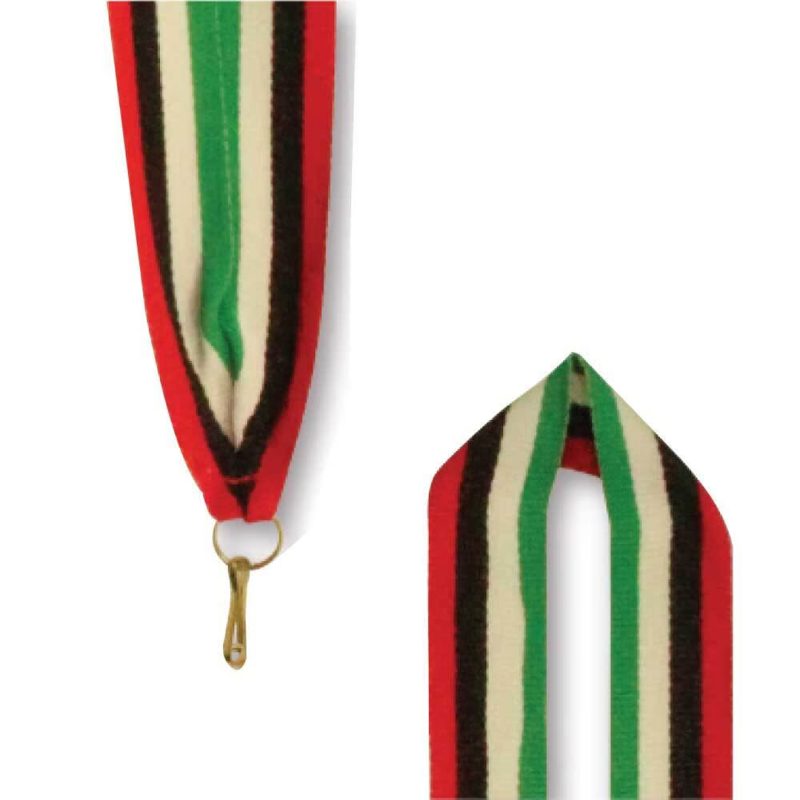
You’ve got three realistic options. Plain grosgrain ribbons in a solid colour — red, royal blue, or the classic red-white-green combinations schools love — are cheapest and always in stock locally. Sublimation-printed ribbons carry your full design: event name, year, sponsor logos, repeated along the length in full colour. These look superb and cost a little more. Woven ribbons sit in between, with the text woven into the fabric rather than printed on top.
Standard ribbon widths are 25mm and 30mm, and length matters more than people think — an adult finisher needs a longer drop than a child, or the medal ends up sitting awkwardly at the collarbone. When you order custom medals with ribbon printing, that print file is another artwork approval in your timeline, so it needs to be finalised the same day as the medal artwork, not a week later. We’ve seen an entire order sit finished in the warehouse, medals polished and boxed, waiting on a ribbon proof nobody had approved. It is a painful phone call to make, and an easy one to avoid.
From Your Logo to a Finished Medal: How the Design Process Works
If you’ve never ordered before, here’s the actual sequence, start to finish, so you can plan around it.
Step 1 — Send what you have. A vector file (AI, EPS or PDF) is ideal. A clean PNG or even a decent photo of last year’s medal can work — our design team redraws artwork into a production-ready vector as part of the process. What doesn’t work is a screenshot of a logo pulled off a website at thumbnail size. If that’s all you have, say so early; redrawing takes a day or two, not a week, as long as it’s in the schedule.
Step 2 — Get the digital proof. You’ll receive a flat design showing the medal face, the finish, the enamel colours (matched to Pantone references where it matters) and the ribbon. Read it like a contract, because it is one. Check every spelling, every date, every Arabic translation. A shocking number of medal disasters are a wrong year or a misspelled school name that sailed through three rounds of “looks fine” approvals.
Step 3 — The mould is cut. Once you approve the proof in writing, a steel mould (the die) is made from your design. This is a one-time cost, typically AED 350–750 depending on size and complexity, and it’s why your first order costs more per piece than your reorder will. Keep the same design next year and the mould fee disappears.
Step 4 — Optional physical sample. For large or high-stakes orders — a 5,000-piece marathon, a government entity’s awards — ask for a pre-production sample. It adds roughly a week and a modest fee, and it’s cheap insurance. For a 200-piece school order on a deadline, most buyers skip it and rely on photo samples during production, which is a reasonable trade-off.
Step 5 — Production and finishing. Casting or stamping, polishing, plating, enamel fill, ribbon stitching, individual polybagging. Each medal is usually bagged separately, which matters if they’re being handed out one by one at a finish line or stored between events.
What Do Custom Medals Cost in Dubai? Real Numbers
Let’s get to the part everyone scrolls for. Prices for custom medals in Dubai depend on size, metal, quantity and whether printing or enamel is involved, but these are the realistic bands we quote for a standard 50mm die-cast medal with a plain ribbon, as of 2026:
| Quantity | 50mm zinc alloy, single finish | With enamel colours / printed ribbon |
|---|---|---|
| 100 pieces | AED 14–19 per medal | AED 17–23 per medal |
| 300 pieces | AED 11–15 per medal | AED 14–19 per medal |
| 500 pieces | AED 9–12 per medal | AED 12–16 per medal |
| 1,000 pieces | AED 7.5–10 per medal | AED 10–14 per medal |
| 3,000+ pieces | AED 6–8.5 per medal | AED 8.5–12 per medal |
On top of that, budget for the one-time mould fee (AED 350–750), and remember that going up to 60mm or 70mm adds roughly 15–30% per piece. Iron medals at high volume can undercut the zinc alloy figures by 20–35%, which is why they dominate school orders above 1,000 pieces.
What pushes a quote up, in order of how often it surprises people: small quantity (the per-piece maths is brutal under 100 pieces, which is why the typical medal MOQ sits at 50–100 pieces), a second design in the same order (a new mould each time), printed ribbons, presentation boxes, and rush production. What brings it down: volume, reusing an existing mould, a single finish across the whole order, and ordering in the quiet months rather than in the September-to-November school rush or the winter race season.
One more thing worth knowing: personalised medals — individual names engraved or printed per piece, like a champions’ wall or a graduating class — are absolutely doable, but they change the workflow. Names go on with laser engraving or a printed plate after production, adding a few dirhams per medal and a couple of extra days. Send the name list as a spreadsheet, exactly as names should appear. Your list is what gets engraved; a typo in row 43 is not something anyone catches at our end.
How Long Does It All Take? An Honest Timeline
Standard production for a custom medal order runs 10 to 15 working days from written proof approval — not from your first enquiry, and that distinction is where most timelines die. Add a day or two for artwork if your logo needs redrawing, a week if you want a physical sample, and delivery time if the event is outside Dubai: Abu Dhabi is a day, the Northern Emirates a day or two, all routine.
So, working backwards from a sports day on, say, 20 November: artwork should be approved by late October, and your first call should happen by mid-October at the latest. Can it be done faster? Sometimes. Rush production exists — 7 to 9 working days is achievable on straightforward designs for a surcharge — but it evaporates the moment your design needs a sample or a complex shaped mould. If your event date is fixed and close, tell your supplier the date in the first conversation, not the fifth. A good supplier will tell you honestly if the date is impossible rather than take the order and apologise later.
Medals also tend to be ordered alongside other event material — certificates, trophies for the overall winners, sometimes full event kits that sit within a company’s wider corporate gifts programme for the year. Ordering them together isn’t just tidier; one delivery, one invoice and one artwork approval round saves more time than any rush fee buys back.
Presentation: Boxes, Pouches and the Handing-Over Moment
How a medal is handed over changes how it’s valued. A finisher medal draped around a runner’s neck straight off a volunteer’s arm needs no packaging at all — the moment does the work. But a corporate award medal loose in a polybag on a gala dinner table looks like an afterthought, no matter how good the casting is.
For formal presentations, the standard options are a velvet pouch (cheap, tidy, a dirham or two per piece), a simple plastic display case, or a proper velvet-lined presentation box for the medals that mark twenty years of service rather than a 10K finish. Boxes also solve a storage problem nobody thinks about until the following year: medals stored loose in a carton scratch against each other, and enamel chips. Medals stored bagged or boxed come out next season looking like they were made yesterday.
And keep your mould. Seriously. If your school, race or company runs the event annually, that mould is an asset — it means next year’s order skips the design fee, skips the sampling debate, and can be turned around days faster because the tooling already exists and has already produced a medal you’ve held in your hand. When you change supplier, ask for a photo of your mould and its reference number for your records. You paid for it; treat it like you own it, because in every way that matters, you do.
Mistakes We See Every Season (So You Can Skip Them)
Approving the proof on a phone screen. Enamel colours and fine lettering look different at arm’s length. Open the proof on a proper screen, zoom in, and read every word out loud. Especially the Arabic, especially the year.
Ordering exactly the number you need. If you need 500 finisher medals, order 530. Someone always loses one, a sponsor’s child always appears, and a handful will have minor defects in any production run on earth. Reordering 30 medals later costs nearly what 300 did, because the setup maths resets.
Forgetting the adults-versus-kids ribbon length. One ribbon length for a mixed event means medals riding too high on adults or swinging at children’s knees. Mention your audience mix when you order; it’s a two-minute fix at quote stage and a permanent annoyance afterwards.
Leaving the design until the venue is booked. Venues get booked months ahead; medals get remembered weeks ahead. The design-and-mould stage is the part that can’t be compressed without cost, so it’s the part to start first.
Chasing the cheapest quote without asking about thickness and weight. Ask three questions: What metal? What thickness? What does one finished medal weigh? A supplier who can’t answer those quickly is telling you something.
Questions Buyers Ask Us Before Ordering
What is the minimum order for custom medals?
For die-cast custom designs, the practical minimum is 50 to 100 pieces. Below that, the mould and setup costs spread across so few medals that the per-piece price stops making sense. If you only need 20 pieces — a single team’s end-of-season awards, for instance — a stock medal design with an engraved plate or printed insert is the smarter route, and we’ll tell you so rather than sell you a mould you’ll use once.
Can I mix gold, silver and bronze in one order?
Yes, and most event orders do. Because all three come from the same mould, splitting an order across antique gold, silver and bronze finishes is routine and doesn’t multiply your costs. Just give the exact split when you confirm — 100/100/100, say — because finishes are applied during production, not sorted out afterwards.
How much do sports medals in the UAE cost for a school sports day?
For a typical order of 800 to 1,000 pieces in a 50mm size, budget roughly AED 7.5–12 per medal depending on metal and enamel, plus the one-time mould fee. That’s the range most schools in Dubai land in. Iron medals at that volume sit at the lower end; zinc alloy with two or three enamel colours sits at the higher end and looks noticeably better in the class photo.
Can you print our event logo in full colour on the medal?
Yes — either as enamel fill within the cast design, which gives you solid blocks of colour with a classic medal feel, or as a full-colour print with an epoxy dome for logos with gradients and fine detail. If your logo is a simple two- or three-colour mark, enamel usually looks better and lasts longer. Send the artwork and we’ll recommend which route suits it; there’s no price difference worth distorting the design over.
How long before my event should I order?
Three to four weeks before the event date is comfortable. Two weeks is doable for standard designs. Inside ten working days you’re in rush territory, where options narrow and surcharges appear. Annual events should reorder the moment dates are confirmed — if your mould already exists from last year, you’re only paying for production, and it’s the easiest order you’ll place all year.
Do you deliver outside Dubai?
Yes, across the UAE — Abu Dhabi, Sharjah, Ajman, Ras Al Khaimah, Fujairah and Al Ain are all routine deliveries, typically one to two working days once production finishes. For events in the other Gulf countries, talk to us early; shipping medals regionally is straightforward but customs adds days you need to plan around.
Can each medal carry a different name?
It can. Individual names are added by laser engraving or a small printed plate after the medals are produced, which keeps the main production run efficient. Allow a few extra dirhams per medal and two to three extra working days, and send the names in a clean spreadsheet — spelled exactly as they should appear, because that’s exactly how they’ll appear.
Ready When You Are
A medal is a small thing that people keep for a strangely long time. It sits in desk drawers, hangs off bedroom mirrors, turns up in photos decades later. That’s exactly why the details in this guide are worth the twenty minutes they take to get right — and why the cheapest quote so often turns out to be the expensive one.
If you’re planning an event anywhere in the UAE and want a straight answer on what your medals would cost and whether your date is realistic, send us your logo and a rough quantity through Vision Advertising and we’ll come back with a proper quote, a proof timeline, and honest advice if a stock design would serve you better. No obligation, no inflated numbers — just the same guidance we’d want if we were the ones standing at the finish line.




