
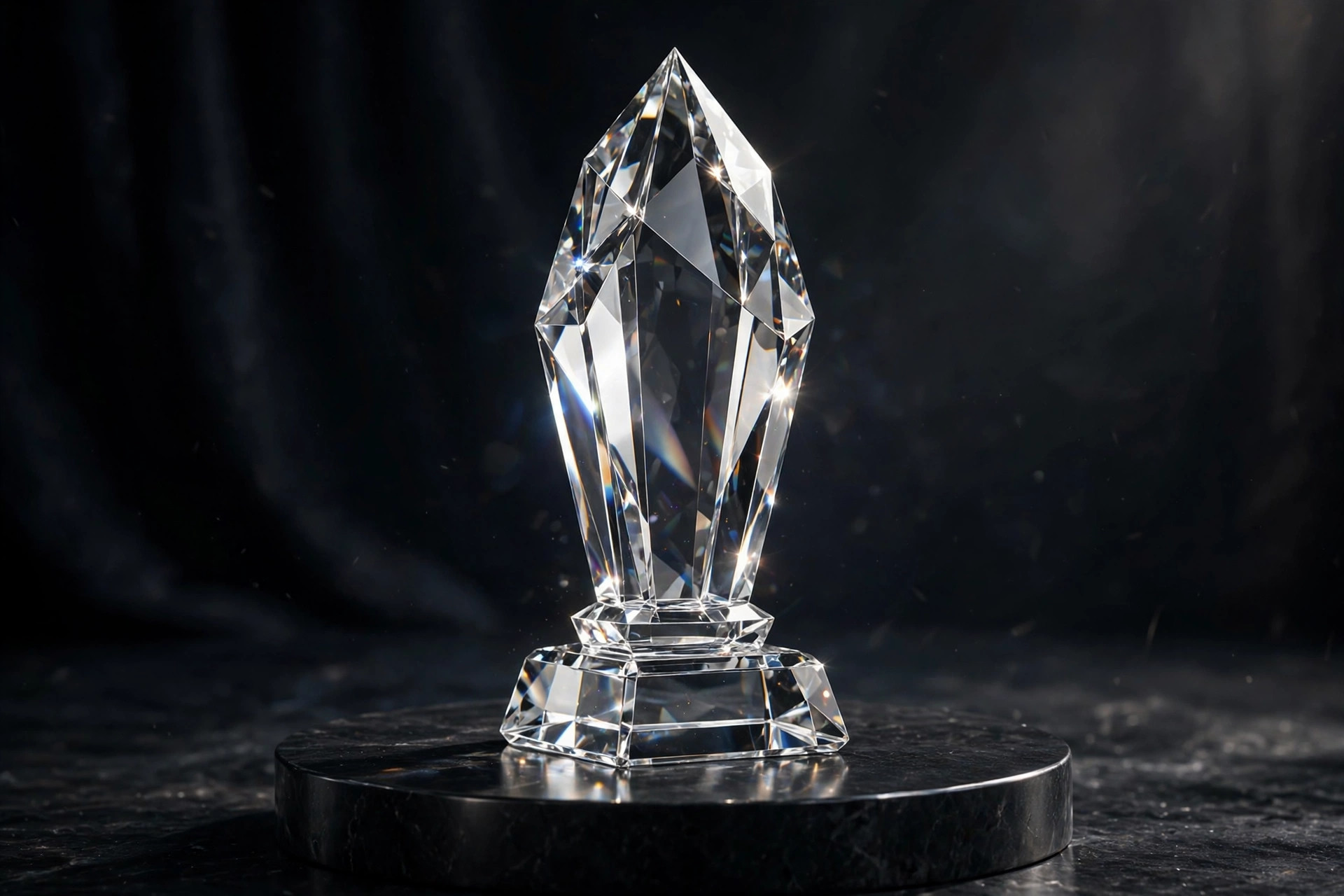
Few corporate purchases carry as much quiet pressure as an awards order. The trophies arrive a day or two before the ceremony, the names are already printed in the event programme, and there is no second chance if something is misspelled, late, or simply looks cheaper than the occasion deserves. If you are the person responsible for getting it right — a procurement officer comparing quotes, an HR manager planning a long-service night, or a marketing manager protecting a brand at a gala dinner — this buyer’s guide is for you.
Dubai has one of the busiest corporate awards calendars in the region. Between year-end galas, government excellence programmes, dealer conferences, real-estate award nights and the steady rhythm of employee recognition events, custom crystal awards in Dubai are ordered in serious volume every month. Crystal remains the material of choice when the moment matters: it photographs beautifully under stage lighting, it feels substantial in the recipient’s hands, and it sits on a desk or reception shelf for years as a silent ambassador for your brand.
This guide walks you through the purchase the way an experienced buyer thinks about it. You will learn how to define what you actually need, how crystal compares with other award materials, which customisation methods suit which designs, how ordering and production really work in the UAE, what minimum order quantities and budgets look like as rough industry norms, when to place your order around Dubai’s event seasons, how to vet a crystal awards supplier in Dubai before you commit, and which cultural details matter when awards are presented in the Emirates. Along the way you will find practical checklists you can hand straight to your supplier.
Why Dubai Organisations Keep Choosing Crystal
There is a reason crystal has survived every trend in corporate recognition. When a recipient lifts a crystal award, the first impression is physical: the weight, the cool surface, the way light moves through it. No photograph or product description quite prepares a first-time buyer for the difference between holding a solid optical-crystal tower and holding a hollow acrylic lookalike. That physical impression is exactly what you are paying for, and it is why crystal dominates the premium end of corporate awards in the UAE.
Dubai’s event culture amplifies the effect. Awards here are rarely handed over quietly. They are presented on stages, under spotlights, in front of photographers and — increasingly — in front of live social-media audiences. A crystal piece catches that light in a way that reads clearly even in a wide-angle gala photograph taken from the back of a ballroom. For companies that invite clients, dealers or government partners to their ceremonies, that photogenic quality is not vanity; it is brand exposure that keeps working every time the image is shared or reposted.
There is also a practical longevity argument. A well-made crystal award does not fade, peel or date itself the way printed certificates and branded merchandise can. Recipients display them — on office desks, in home studies, in company reception areas — for a decade or more. Each one carries your logo or your event name into spaces your marketing budget could never otherwise reach. When finance asks why the awards line item costs what it does, “a decade of brand presence on forty executives’ desks” is a stronger answer than most.
Finally, crystal suits the formality of the region’s recognition culture. The UAE hosts prestigious excellence awards across government, education, healthcare and business, and the visual language of those programmes is unmistakably premium. Even for internal company awards, matching that standard signals to employees that their achievement is being taken seriously. A crystal award says the organisation invested thought, not just budget.
Start With the Purpose: What the Award Is Really For
The single most common mistake buyers make is choosing the trophy before defining the programme. A supplier can show you fifty beautiful designs, but none of them is “right” until you know what behaviour you are recognising, who is receiving it, and how often the programme repeats. Spend twenty minutes on these questions before you request a single quote, and every decision downstream becomes easier.
Map the programme first. Common corporate award programmes in Dubai include:
- Employee recognition: monthly or quarterly performers, values champions, innovation awards
- Long service: 5, 10, 15 and 20-year milestones, retirement honours
- Sales and performance: top revenue, top growth, best new business, regional champions
- Dealer and partner awards: annual conferences honouring distributors, agents and franchisees
- Corporate milestones: anniversaries, IPO or listing celebrations, project completions
- Community and CSR: sustainability champions, charity partners, volunteer recognition
Each programme implies different design decisions. A quarterly employee award that repeats forever should be a standard, reorderable design in a consistent size — you will thank yourself in year three when the twentieth batch needs to match the first. A one-off 25th-anniversary piece can be fully bespoke, because it will never be repeated. Tiered programmes (gold, silver, bronze levels, or regional vs national winners) usually work best with one design family in graduated sizes, so the hierarchy reads instantly on stage.
Decide how branded the award should be. This deserves deliberate thought, because an award sits in a strange middle ground between a gift and a marketing asset. Heavy company branding suits dealer and partner awards, where the trophy doubles as a relationship marker. For employee long-service awards, many organisations prefer the recipient’s name and achievement to dominate, with the company logo present but secondary — the award is about the person, after all. If you are weighing this trade-off, our breakdown of branded vs unbranded corporate gifts walks through the ROI logic in detail and will help you make the call with confidence.
Think about personalisation depth. At minimum, every award should carry the recipient’s name and the occasion — generic, unnamed trophies feel like afterthoughts. Beyond that, consider individual citations (a line about what the person achieved), dates, and for senior or external recipients, their full title. Personalisation is where crystal awards earn their keep: laser engraving makes each piece feel made for one person, which is precisely the feeling recognition is supposed to create.
Crystal Against Other Award Materials: An Honest Comparison
Crystal is not automatically the right answer for every award, and an honest supplier will tell you so. Here is how the common materials compare from a buyer’s perspective:
Crystal (optical/K9): The premium standard. Exceptional clarity, weight and light refraction; engraves beautifully; photographs superbly. Downsides: genuinely fragile (it will chip or shatter if dropped on tile), heavier to ship, and the most expensive option per piece. Best for: client-facing awards, executive recognition, gala ceremonies, anything photographed.
Ordinary glass / jade glass: The budget lookalike. Visually similar at a glance, noticeably greener at the edges and lighter in hand. Engraves acceptably. Best for: large-volume internal awards where budget dominates, or as a deliberate cost tier below crystal in a graduated programme. Watch out for suppliers presenting jade glass as crystal — more on how to spot the difference below.
Acrylic: Lightweight, shatter-resistant and inexpensive, with modern design possibilities (embedded prints, bold colours). But it scratches easily, feels insubstantial, and reads as “budget” in formal settings. Best for: fun internal awards, children’s or sports events, situations where pieces will be handled roughly or shipped cheaply.
Metal (pewter, brass, aluminium): Traditional and weighty, with engraving usually done on an attached plate rather than the body itself. Can look dated unless the design is contemporary. Best for: heritage-style institutions, golf and sporting trophies, perpetual shields.
Wood: Warm, natural and increasingly popular for sustainability-themed awards. Laser-marks well but lacks the “wow” factor of crystal under stage lighting. Best for: eco-positioned brands, rustic or artisanal event themes.
The honest buyer’s rule: match the material to the audience and the camera. If the award will be photographed on a gala stage and displayed in a CEO’s office, crystal justifies its cost. If it is a light-hearted monthly team prize that lives in a desk drawer, acrylic is the smarter buy. Many Dubai companies run both — crystal for the annual gala, simpler materials for monthly recognition — and there is nothing inconsistent about that.
Reading a Crystal Quote: Types and Quality Signals
When suppliers quote for custom crystal awards in Dubai, they may use terms like “optical crystal,” “K9 crystal,” “lead crystal” or simply “crystal glass” — and these are not interchangeable. You do not need a materials-science degree, but you do need to know what you are paying for.
Optical crystal (often labelled K9) is the workhorse of the corporate awards industry. It is a high-clarity, lead-free crystal with excellent light transmission, and it is what most quality suppliers mean when they quote a “crystal award.” It engraves crisply, polishes to a flawless finish, and offers the best balance of appearance, durability and cost for corporate buyers.
Lead crystal contains lead oxide, which gives it extra brilliance, weight and that distinctive ring when tapped. It is genuinely premium — and priced accordingly — but it is less common in the corporate awards market today, partly for cost reasons and partly because optical crystal has become so good.
Jade glass and ordinary glass are sometimes quoted ambiguously as “crystal” by less scrupulous sellers. They are heavier on green tint (look at the thickest edge), lighter in weight for the same size, and less brilliant. There is nothing wrong with glass awards at glass prices — the problem is only when you pay crystal prices for them.
As a buyer, you can run three quick quality checks on a sample before committing to a bulk order:
- The edge test: Hold the thickest part of the piece up to light. True optical crystal stays clear or shows only a whisper of blue-grey at the edge; jade glass shows an obvious green tint.
- The weight test: Crystal is dense. If a tower that looks substantial feels surprisingly light, question the material.
- The finish test: Run your eye along every bevel and edge. Quality pieces have uniformly polished, mirror-smooth edges with no cloudy patches, and the base sits perfectly flat without rocking.
Also ask two direct questions: which crystal grade is quoted, and is the piece cut from a single block or bonded from sections? Bonded pieces (for example, a crystal shape fused to a base) are common and perfectly fine, but the join should be invisible and the bond strong. A supplier who answers these questions precisely is usually a supplier who knows their production — which is exactly what you want.
Shapes and Sizes: Matching the Award to the Moment
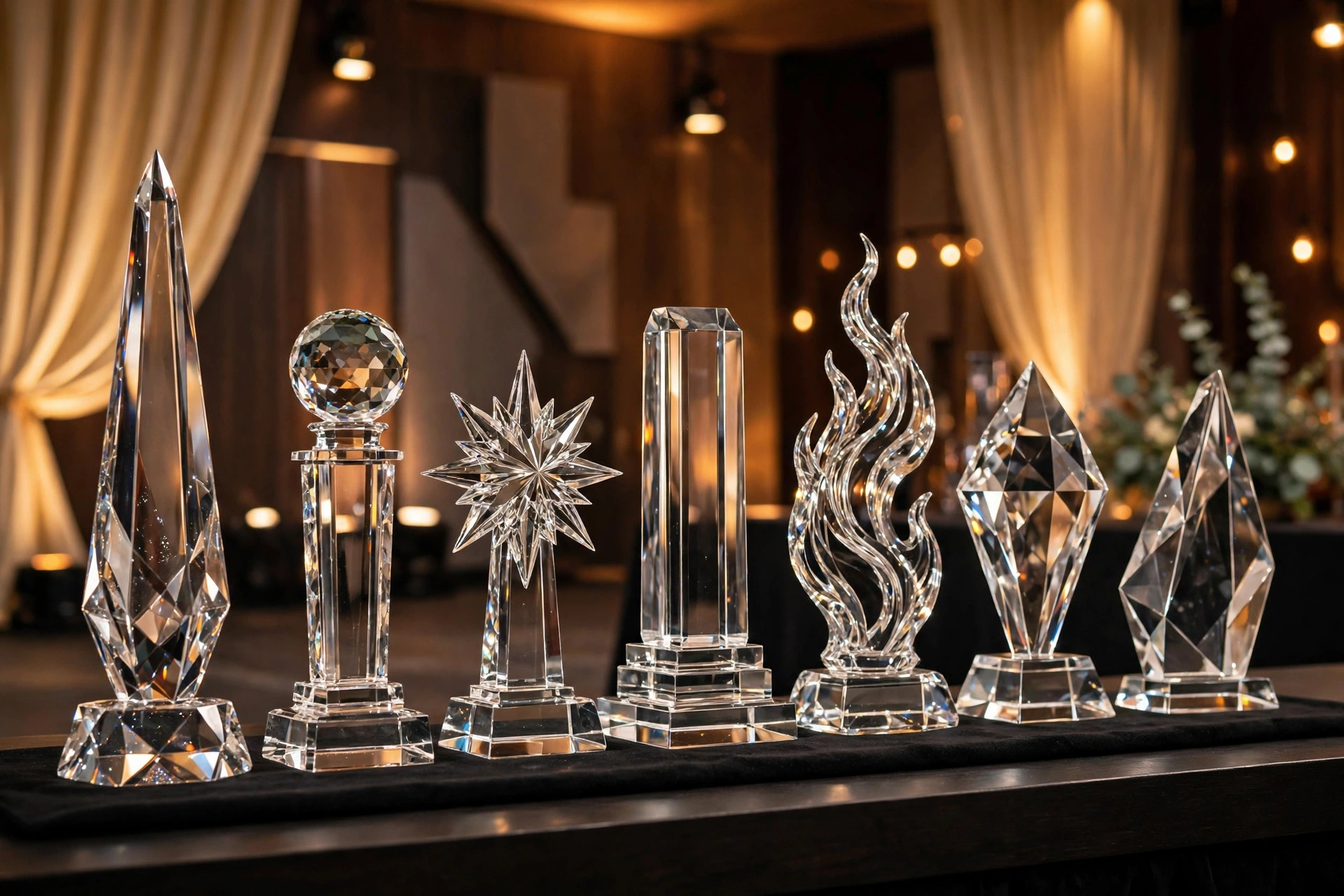
Crystal awards come in a visual vocabulary that regular buyers learn to read at a glance. The shape you choose quietly communicates what the award is for, so it is worth choosing deliberately rather than defaulting to whatever the catalogue opens on.
Towers and obelisks are the classic corporate choice — tall, architectural, dignified. They suit formal recognition: long service, leadership awards, institutional honours. Their vertical faces offer generous engraving space for longer citations.
Flames, peaks and sails suggest dynamism and upward movement, which is why they dominate sales kick-offs, “top performer” categories and growth awards. They photograph dramatically but offer less flat engraving area, so keep the wording tight.
Stars and diamonds are unambiguous “winner” shapes — ideal for competitions, employee-of-the-year programmes and championship categories. They tend to be smaller statement pieces rather than large-format awards.
Plaques and bevelled rectangles are the practical choice when the citation is long or bilingual. If you need English and Arabic text plus a logo plus a paragraph of citation, a plaque gives you the canvas; a slim tower does not.
Custom and logo-shaped crystal — awards cut or moulded into a company logo, product silhouette or national motif — deliver maximum brand impact and are increasingly requested in Dubai for milestone anniversaries and flagship galas. Expect longer lead times and higher minimums, since these are made to order rather than pulled from stock.
On size, buyers consistently make two errors: choosing by price alone (the smallest option to save budget, which can look apologetic on a gala stage) and choosing the largest available (impressive on stage, impractical on a crowded desk). The practical approach:
- Stage visibility: If the award is presented on a large stage to a big audience, it needs enough height (as a rough norm, think 20 cm and above) to read from the back rows and in photographs.
- Desk reality: Most recipients display awards on desks or shelves. Very tall, top-heavy pieces can be awkward in a standard office.
- Tiered programmes: Use one design family in graduated sizes so gold/silver/bronze — or national/regional — levels are instantly distinguishable.
- Shipping weight: Crystal is heavy, and courier costs within the UAE scale with weight. For very large orders, factor delivery into the budget conversation early.
When in doubt, ask your supplier for the dimensions and weight of each shortlisted design, and mock up the shortlist against the actual stage or presentation setting. Ten minutes with a tape measure prevents the most common size regrets.
Customisation Methods Compared: Laser Engraving, Sandblasting and UV Printing
This is the section that separates informed buyers from everyone else. The customisation method determines how your logo and wording will look, how long production takes, what artwork you need to supply, and — in rough terms — where the job sits on the cost spectrum. For crystal awards with logo engraving, there are four methods you will encounter in Dubai. Here is what each one actually does.
Surface laser engraving
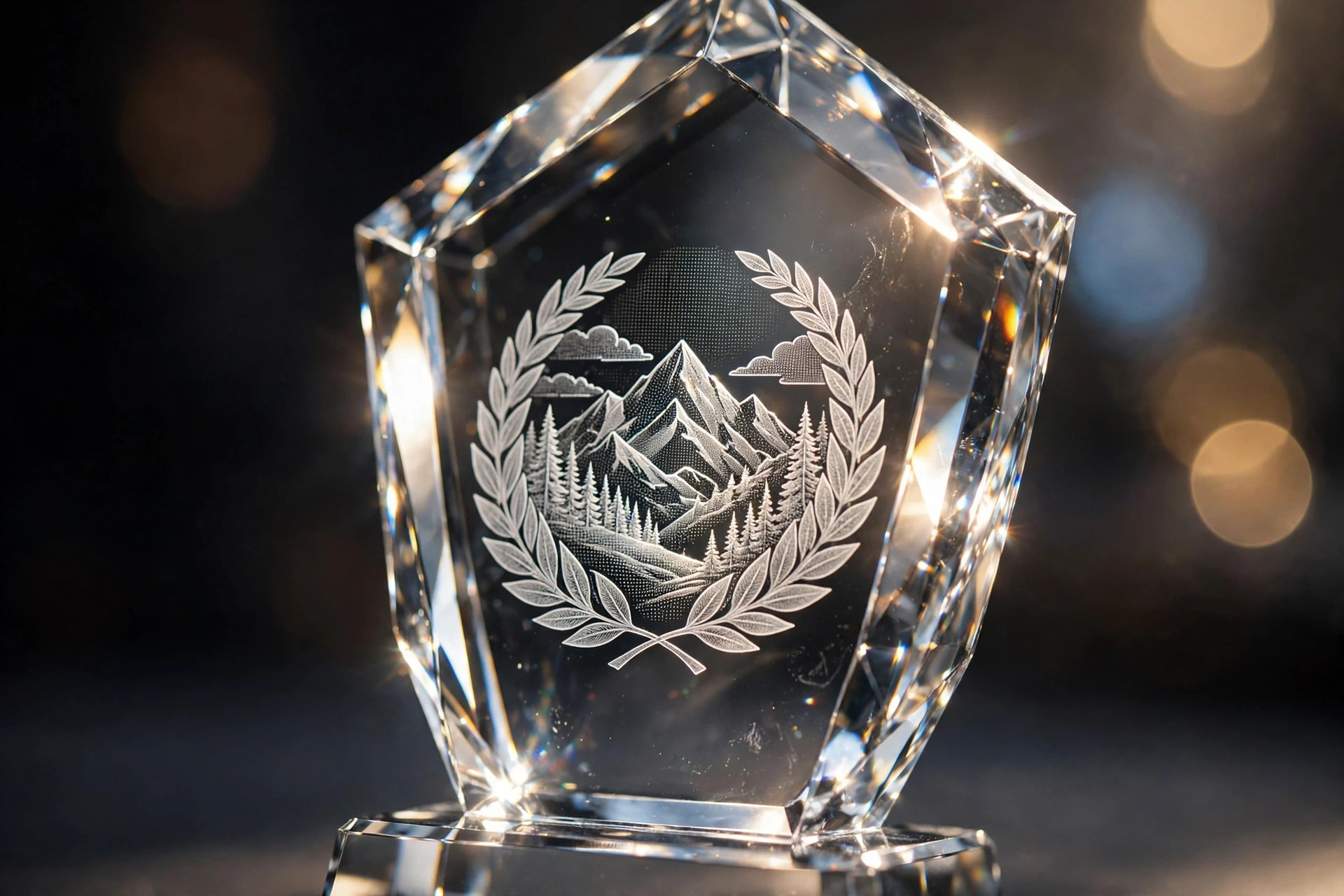
The industry standard. A laser beam vaporises a microscopic layer of the crystal surface, leaving a crisp, frosted-white mark. It is precise enough for fine text, small logos and detailed line work, and it is the default choice for names, citations and dates. Because the mark is part of the crystal itself, it cannot peel, fade or wash off. As a rough industry norm, surface laser engraving is also the fastest and most economical customisation method, which is why it suits everything from single pieces to runs of hundreds.
Best for: recipient names, award titles, citations, line-art logos. Artwork needed: vector files (AI, EPS, SVG or high-resolution PDF) give the cleanest results.
3D sub-surface laser engraving
The showstopper. Instead of marking the surface, computer-controlled lasers focus inside the crystal block, creating thousands of tiny points that form a three-dimensional image suspended within the glass — a logo, a building, a portrait, even a product model. Viewed from any angle, the image floats inside the award. It is the method behind those “how did they do that?” pieces at gala dinners.
The trade-off is preparation: the design must be converted into a 3D-ready file, which takes specialist work and adds lead time. Fine text does not reproduce well in 3D, so most buyers combine methods — a 3D logo inside the crystal with the recipient’s name surface-engraved on the front face or base. Expect this to sit at the premium end of pricing and to need the longest production window of the standard methods.
Best for: flagship awards, milestone pieces, VIP and lifetime-achievement honours. Artwork needed: 3D model or high-quality 2D artwork the supplier’s studio converts to 3D.
Sandblasting (deep etch / sand carving)
The traditional craftsman’s method. Fine abrasive is blasted through a stencil mask, carving into the crystal to create a deep, velvety frosted effect with genuine tactile depth. On crystal, a deep etch has a luxurious, hand-finished character that lasers cannot quite replicate, and it takes colour fill beautifully — many buyers have the etched logo hand-filled with silver or gold paint for extra presence.
It is slower and more labour-intensive than laser work, which is reflected in both cost and lead time as rough norms. But for prestigious, low-volume awards — think chairman’s awards or 25th-anniversary pieces — the depth and feel justify it.
Best for: prestige pieces, deep single-colour logos, awards where tactile quality matters. Artwork needed: bold, clean vector artwork; very fine detail can be lost in the blasting process.
UV printing (full-colour printing)
The colour option. UV-cured inks print full-colour logos, gradients and even photographic images directly onto the crystal surface. If your brand guidelines demand exact Pantone colours or your award design includes a photographic element, UV printing is the only method that delivers it on crystal.
The honest caveat: UV print sits on the surface rather than in the material, so it does not have the permanence of an engraved mark. On a display piece that is handled gently, it lasts well; on an award that will be handled frequently, discuss durability and protective options with your supplier. Many buyers use a hybrid approach — engraved text and citation for permanence, UV-printed logo for colour impact.
Best for: full-colour logos, photographic elements, brand-guideline-critical colour matching. Artwork needed: high-resolution colour files (300 dpi at print size, CMYK or specified Pantones).
Getting the logo right
Whatever method you choose, crystal awards with logo engraving succeed or fail on artwork quality. A few buyer-side rules that prevent the most common disappointments:
- Supply vector artwork from the start. A JPEG pulled from your website will engrave as a blurry approximation of your logo. Ask your marketing team for the vector master file — it takes them two minutes and saves everyone a week of back-and-forth.
- Respect the engraving area. Every design has a maximum engraving zone. Cramming a complex logo plus four lines of text into a small face produces a cluttered, hard-to-read result. Ask the supplier for the engraving dimensions and lay your content out to fit before approving anything.
- Simplify for the medium. Very thin lines, tiny text and subtle gradients that look fine on screen can disappear in frosted engraving. Bold, clean versions of logos engrave best; your supplier’s artwork team should flag problem details at the proof stage.
- Always approve a digital proof. Reputable suppliers send a proof showing exactly how the engraving will sit on the piece. Check every letter of every name, the Arabic text direction if applicable, and the logo proportions. The proof is your last free chance to catch errors — after engraving, corrections mean remaking the piece.
You can browse typical shapes, sizes and customisation options for inspiration on our crystal awards in Dubai page, which shows the range most buyers start from before requesting a tailored quote.
How an Order Actually Works, Step by Step
Understanding the production workflow helps you plan realistically and spot suppliers who cut corners. Here is how a well-run crystal awards order typically progresses in Dubai, from first enquiry to delivery day.
Step 1 — The enquiry. Send your supplier the essentials in one message: quantities (or a range), your shortlisted designs or sizes, the event date, the engraving content (names list, citations, logo files), and any budget guidance. The more complete your brief, the faster and more accurate the quotation. Vague enquiries (“we need some awards for December”) generate vague quotes and wasted days.
Step 2 — Quotation and options. A good supplier responds with itemised pricing: unit cost per design, engraving charges (per piece or per method), presentation boxes, and delivery. They should also flag anything your brief missed — for example, that your chosen design cannot fit the full Arabic citation, or that 3D engraving will not meet your date. Treat the quotation conversation as free consultancy; the quality of questions you get asked predicts the quality of the finished awards.
Step 3 — Digital proof. Before anything is engraved, you approve a proof for each design variant. This is your moment of maximum leverage and your moment of maximum responsibility. Check spelling character by character — especially recipient names, which are the single most common source of expensive remakes. Verify Arabic text with a native reader, confirm dates and titles, and make sure the logo matches your brand guidelines. Approve in writing.
Step 4 — Sample or pre-production piece. For significant orders, always request a sample before bulk production — this is standard practice among experienced buyers, and our guide on why smart buyers always order samples first explains the full reasoning, from catching material substitutions to testing how the engraving photographs. Even a single finished piece lets you check the crystal quality, the engraving depth and the box presentation with your own eyes.
Step 5 — Production and quality control. Engraving runs piece by piece, and each award should be inspected: engraving accuracy against the approved proof, consistent depth and clarity, polished edges free of chips, and stable bases. Ask your supplier what their QC process covers — the question alone signals that you will check, which improves the care your order receives.
Step 6 — Packing. Crystal is fragile, and proper packing is non-negotiable. Each piece should travel in its own presentation box with protective inserts, and boxes should be cushioned within the outer carton. Confirm that individual gift boxes are included in your quote rather than assumed — it is a common source of last-minute cost surprises.
Step 7 — Delivery and venue coordination. Within Dubai, courier delivery is typically straightforward, but awards for gala events often need delivery directly to a hotel or venue on a specific day, sometimes to an event manager rather than your office. Share the venue contact, the delivery window and any access requirements with your supplier well in advance, and keep a buffer day before the event for the just-in-case. If you would like to see the broader corporate gift catalogue that awards are often ordered alongside, you can browse everything in our shop.
MOQs and Budgets: What Dubai Buyers Should Expect
One of the pleasant surprises of the crystal awards market is how accessible it is. Unlike many promotional products that require hundreds of units, crystal awards are routinely produced as single pieces — a one-off retirement award or a prototype for board approval is completely normal. That said, understanding how quantity affects pricing helps you plan and negotiate intelligently.
Minimum order quantities as industry norms. Most Dubai suppliers will happily produce a single engraved crystal award; the concept of a “minimum order” barely applies the way it does to printed merchandise. Where quantity matters is in unit economics: as rough industry norms, you will typically see meaningful price breaks at volume tiers (often around 10, 25, 50 and 100+ pieces), because setup, artwork preparation and proofing costs are spread across the run. If your programme needs 40 awards this year and another 40 next year, it is worth asking whether committing to the combined volume — or at least a consistent repeat design — unlocks better pricing.
What actually drives the cost. When you compare quotes, make sure you are comparing the same things. The main cost components of a custom crystal award are:
- Crystal grade and size: optical crystal costs more than jade glass; larger, heavier pieces cost more than small ones — the material is literally sold by weight in production.
- Customisation method: as a rough norm, surface laser engraving is the most economical; 3D sub-surface work, deep sandblasting and colour fill sit progressively higher; full-colour UV printing depends on coverage and setup.
- Personalisation: individually engraved names add per-piece handling versus one repeated design, but the difference is usually modest — and the perceived value is enormous.
- Presentation boxes: individual gift boxes are standard for corporate awards; confirm whether they are included or itemised.
- Artwork and setup: 3D conversion, complex stencil work or rush artwork turnaround may carry setup fees.
- Delivery: local Dubai courier is typically modest; venue delivery, timed slots and fragile-handling requirements can add cost.
- Rush fees: express production is usually possible from local stock but commands a premium — another reason to order early.
Budgeting honestly. Build your budget per recipient, not per catalogue price. The number that matters is the fully landed cost: unit + engraving + personalisation + box + delivery, multiplied by headcount, plus a small contingency (as a practical norm, experienced buyers hold back a few percent) for remakes or last-minute additions — because there is always a last-minute addition. Presenting this fully loaded figure to finance upfront is far better than returning for “unexpected” engraving charges later.
The sample question. For any order that matters, budget for a pre-production sample. It is a tiny fraction of the order value and it is the only way to verify material, engraving quality and presentation before committing. This is standard practice among professional buyers, not paranoia.
Timelines: How Far Ahead to Order in Dubai
Lead time is where awards orders most often go wrong, because the buyer’s deadline is immovable — the gala happens on the gala’s date — while production time is consumed silently by proofs, artwork fixes and queues. Plan backwards from your event and protect the buffer.
Typical production windows as rough norms. For standard designs held in local stock with surface laser engraving, many Dubai suppliers work to production windows measured in days rather than weeks once artwork is approved — but “once artwork is approved” is doing heavy lifting in that sentence. In practice, the full cycle from first enquiry to delivered awards more often spans one to three weeks, depending on proof rounds, personalisation complexity and order size. Custom shapes, 3D engraving and deep sandblasting extend the window further, sometimes significantly. Treat any supplier promise as starting from the day you approve the final proof, not the day you first called.
Dubai’s peak seasons. The awards calendar is not evenly spread. Demand — and therefore production queues — peaks during the year-end gala season (roughly October to December), around major conference and exhibition periods, and around UAE National Day in early December, when patriotic-themed recognition surges. Ramadan and Eid periods bring their own rhythm: working hours shift, and many organisations schedule recognition events around the holy month, compressing demand into specific weeks. Ordering during these peaks without extra lead time is the single most common cause of rush fees and quality compromises.
The planning rule that works. Take your event date, subtract the supplier’s quoted production window, then subtract another full week for proof rounds, artwork revisions and the inevitable internal approval delay on your side. That is your order date. For a December gala, this arithmetic usually lands you in October or early November — which feels absurdly early until you have lived through a December remake with no buffer. Our detailed guide to corporate gifting timelines in Dubai maps these calculations across product categories and seasons, and it is worth reading alongside this guide if you manage gifting calendars.
Rush orders: possible, but costly. A supplier with local stock and in-house engraving can often turn around urgent orders in a handful of days. Expect express fees, reduced customisation options (surface engraving only, standard designs only), and a compressed proof window that raises error risk. Rush is a safety net, not a strategy — use it when plans change, not as your default timeline.
Vetting a Crystal Awards Supplier in Dubai: A Practical Checklist
The difference between a smooth awards order and a stressful one is almost always the supplier, not the product. Crystal awards are widely available in Dubai, but engraving quality, reliability and honesty vary enormously. Use this checklist before you commit — it takes one phone call and a showroom visit to work through, and it will save you from the most common disappointments.
Production capability:
- Do they engrave in-house in the UAE, or outsource to a third party? In-house laser and sandblasting capacity means faster turnarounds, better quality control and genuine rush capability.
- Do they hold physical stock of standard designs locally? Local stock is what makes short timelines possible; pure importers add weeks you may not have.
- Can they show you finished, engraved samples — not just catalogue photos? The proof of engraving quality is in finished pieces you can hold.
Process and professionalism:
- Will they provide a digital proof for every design variant before production, and do they require your written approval? Any supplier who wants to engrave without a signed proof is a supplier to avoid.
- What is their sample policy for bulk orders? Serious suppliers expect and encourage pre-production samples.
- How do they handle errors — a misspelled name, a chipped piece on arrival? Ask directly; the answer reveals their aftercare culture.
Business legitimacy:
- Do they have a physical premises you can visit — a showroom, office or workshop — with a verifiable address? A supplier who welcomes visits has nothing to hide.
- Are they a registered business with a trade licence? In Dubai’s corporate market, this is a basic expectation.
- Can they share references, reviews or examples of corporate clients? Established corporate suppliers can point to a track record.
Commercial clarity:
- Is the quotation itemised — unit, engraving, personalisation, boxes, delivery — or a single opaque figure? Itemisation lets you compare quotes fairly and adjust scope intelligently.
- Are presentation boxes included, and what does delivery cover? Confirm venue delivery, timing and fragile handling explicitly.
Red flags to walk away from: no physical address or refusal of visits; reluctance to provide proofs; vague answers about which crystal grade is quoted; prices dramatically below every other quote (the saving usually comes from material substitution or skipped QC); and pressure to skip the sample “to save time.”
A note on where we stand: Vision Advertising is a Dubai-based corporate gifts and awards supplier at 38A St, Hor Al Anz, Deira, Dubai, UAE, and we work through exactly the process described in this guide — itemised quotes, digital proofs, pre-production samples and in-house customisation. If you would like to discuss an upcoming awards programme, you can reach us on +971 50 970 9564 or at [email protected]. Whether you buy from us or use this checklist elsewhere, choosing a crystal awards supplier Dubai businesses already trust — one that meets every item on this checklist — is the surest path to awards that arrive right, on time, and ready for the stage.
UAE Cultural and Occasion Notes Worth Knowing
Awards presented in the Emirates carry cultural expectations that buyers from elsewhere sometimes miss. Getting these details right costs nothing and is noticed immediately by recipients and audiences.
Bilingual engraving. English-only awards are common in multinational companies, but for government-linked, semi-government and many local-organisation ceremonies, Arabic text — or fully bilingual English/Arabic engraving — is expected and appreciated. Two practical rules: always have Arabic wording checked by a native reader before approving the proof (machine translation errors on a permanent award are painfully public), and remember that Arabic reads right-to-left, which affects layout — a good artwork team will mirror the design logic rather than simply pasting translated text into an English layout.
Titles and honorifics. The UAE takes titles seriously. Confirm the exact styling of every recipient’s title with their office or your protocol contact: H.E. (His/Her Excellency), Dr., Professor, Sheikh/Sheikha, and military or judicial ranks all have correct forms, and guessing wrong on an engraved award is a significant faux pas. When in doubt, use the full formal name exactly as the recipient’s organisation styles it.
Religious and cultural neutrality. For mixed audiences, keep award wording and motifs culturally neutral unless the occasion is specifically themed. Avoid imagery or language tied to any single faith tradition on general corporate awards. During Ramadan, many organisations shift recognition events to evening timings — if your ceremony falls in this period, confirm the schedule with your supplier early, as working hours and delivery patterns adjust.
National Day and patriotic themes. Early December brings UAE National Day, and awards with flag colours, falcon motifs or “Year of” themes are perennially popular. These designs typically use UV colour printing for the flag elements combined with engraved text — discuss the combination with your supplier at the briefing stage, not after the proof arrives in single colour.
Formal tone for institutional awards. Government excellence programmes and academic honours favour formal, complete citations over marketing-style slogans. “In recognition of outstanding contribution to…” will always be safer than a clever tagline on an institutional award. Match the register of the awarding body, not your brand campaign.
Common Buying Mistakes — and How to Avoid Them
Across hundreds of awards orders, the same errors recur. Here is the shortlist, with the fix for each:
- Ordering too late. The fix: plan backwards from the event date with a full buffer week, as described in the timelines section. Late orders force rushed proofs, and rushed proofs cause misspellings.
- Skipping the sample. The fix: always approve a physical sample for significant orders. Catalogue photos do not show engraving depth, edge finish or true scale.
- Supplying a low-resolution logo. The fix: get the vector master file from marketing before you brief the supplier. “Can you just pull it from our website?” is how blurry logos happen.
- Cramming in too much text. The fix: respect the engraving area. A short citation in large, legible lettering beats a paragraph nobody can read from two metres away.
- Forgetting Arabic proofreading. The fix: a native reader checks every Arabic word on the proof. Every time, no exceptions.
- Choosing size by price alone. The fix: consider stage visibility and desk reality together. The cheapest small option can look lost at a gala; the largest can be impractical.
- Assuming “crystal” means the same thing everywhere. The fix: ask which grade is quoted and run the edge, weight and finish checks on a sample.
- Not confirming name spellings. The fix: source the recipient list from HR or the awarding committee in writing, and cross-check the proof against it character by character. Never retype names from memory.
- Ignoring the presentation box. The fix: confirm boxes are included, inspect the sample’s box, and remember the unboxing is part of the recipient’s experience.
Frequently Asked Questions About Buying Crystal Awards in Dubai
Can I order a single custom crystal award, or is there a minimum quantity? As a rough industry norm, most Dubai suppliers produce single pieces — there is effectively no minimum order for standard designs with laser engraving. Minimums typically only appear for fully custom shapes or 3D work, where setup costs need spreading. Volume discounts usually begin at tiers of around 10 to 25 pieces, so it is always worth quoting your full programme quantity even if delivery is staggered.
How long does it take to produce custom crystal awards in Dubai? From final artwork approval, standard laser-engraved designs from local stock are often produced within days as a rough norm; the full cycle from enquiry to delivery more commonly spans one to three weeks once you include proof rounds and personalisation. Custom shapes, 3D sub-surface engraving and deep sandblasting take longer. During peak gala season (October to December), add extra buffer. Always measure the timeline from the date you approve the proof, not the date you first enquire.
Can my company logo be engraved in full colour on crystal? Yes — full-colour logos are applied with UV printing, which reproduces exact brand colours, gradients and photographic elements on the crystal surface. For maximum permanence, many buyers combine methods: the logo in UV colour with names and citations laser-engraved into the crystal. Discuss durability expectations with your supplier, since printed colour sits on the surface while engraving is part of the material.
What is the difference between crystal awards and glass awards? True optical crystal is clearer, heavier, more brilliant and engraves more crisply than ordinary or jade glass, which shows a green tint at thick edges. Both have their place — glass awards at glass prices are a legitimate budget option — but confirm which material your quote covers, and verify it on a sample using the edge, weight and finish checks described earlier in this guide.
Do suppliers deliver crystal awards directly to event venues in Dubai? Established corporate suppliers routinely deliver to hotels, conference centres and event venues across the UAE, coordinated with your event manager and timed to your schedule. Because crystal is fragile, confirm that each piece travels in its own presentation box with protective packing, and build a buffer day between delivery and the ceremony for the unexpected.
Can each award be engraved with a different recipient name? Absolutely — individual personalisation is standard practice and one of the main reasons buyers choose crystal. You supply the name list (sourced in writing from HR or the committee, never retyped from memory), the supplier engraves each piece individually, and every award is checked against the approved list before packing. For large programmes, ask how names are tracked through production to prevent mix-ups.
Ordering custom crystal awards Dubai companies present on gala stages is one of those purchases where preparation matters more than budget. Define the programme, choose the material and method that fit the occasion, brief your supplier completely, approve proofs meticulously, and give production the time it deserves. Do that, and the moment the name is read out and the award catches the stage light, everything else takes care of itself.
If you are planning an awards programme in Dubai and would like itemised pricing, digital proofs and a pre-production sample before you commit, Vision Advertising — 38A St, Hor Al Anz, Deira, Dubai, UAE — is ready to help. Call +971 50 970 9564 or email [email protected], and we will take it from the brief to the ballroom.




