
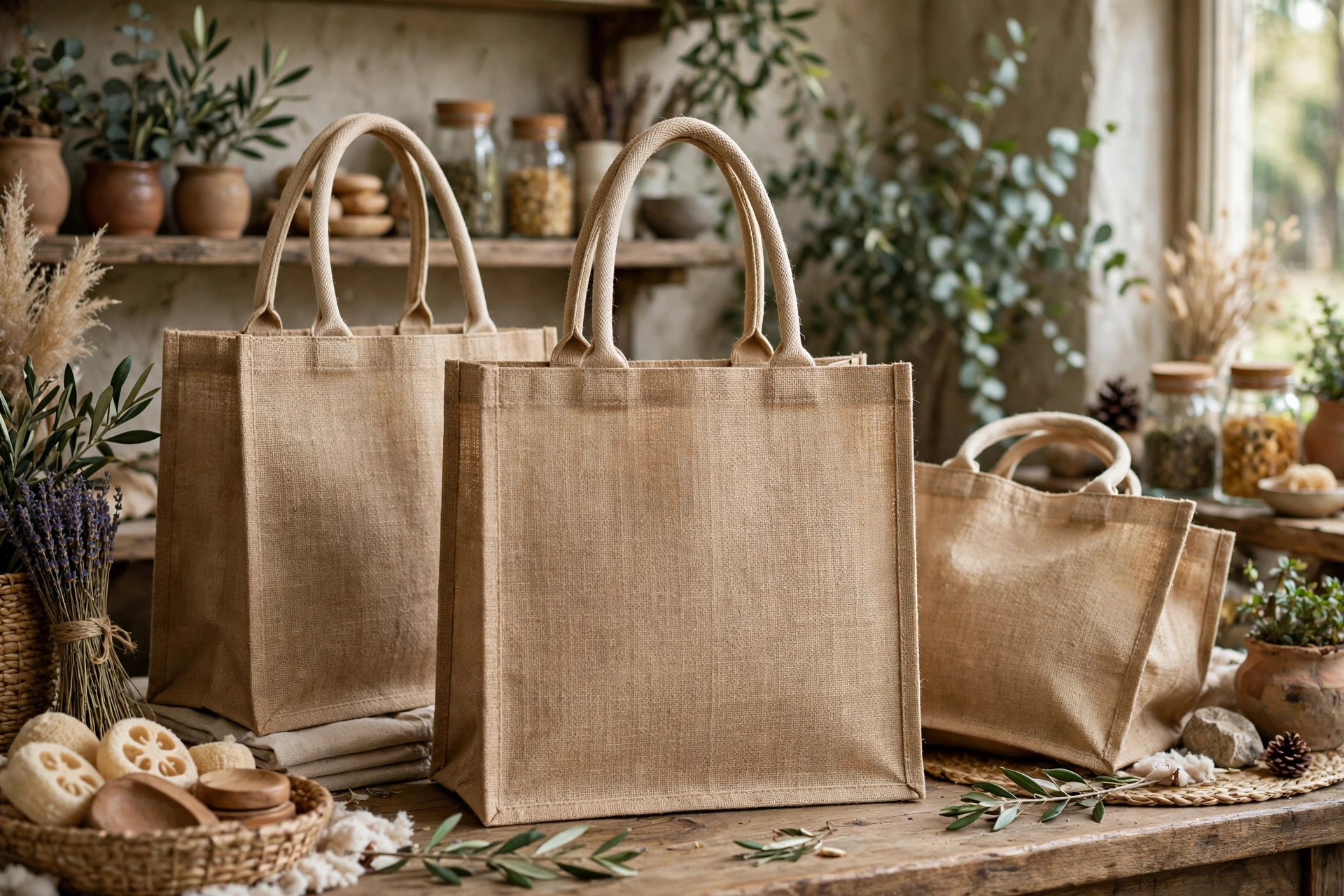
Walk through any busy street in Dubai — from the Marina promenade to the shops of Deira — and you will notice something quietly changing about what people carry. Alongside the usual paper carrier bags and reusable synthetics, natural-fibre jute bags are appearing more and more often: at supermarket checkouts, at exhibition entrances, slung over the shoulders of commuters, and stacked behind the counters of boutiques. For companies in the UAE, this is not just a fashion detail. It is a branding opportunity with genuine staying power. A custom jute bag does something few promotional items can do: it keeps carrying your logo through the city, year after year, on a product people actually reuse.
Jute has earned its nickname — “the golden fibre” — for good reason. It is a long, soft, naturally shiny vegetable fibre grown primarily in the river deltas of South Asia. It is fully biodegradable, compostable, and renewable, and it requires far fewer chemical inputs to cultivate than cotton. In a market like Dubai, where corporate social responsibility reporting is now mainstream, where government-led sustainability initiatives run year-round, and where audiences are increasingly alert to greenwashing, jute sits in a sweet spot: authentically sustainable without being austere, affordable without looking cheap, and distinctive enough that a well-designed bag gets noticed.
This guide covers everything a buyer in Dubai needs to know before ordering branded jute bags: the material itself and how to judge its quality, the bag styles and sizes that work best for different campaigns, how logo printing on jute actually works (and where designs go wrong), realistic timelines and order quantities in the UAE, how to write honest eco-messaging around your campaign, and how to keep the bags looking good for years. By the end, you will know exactly what to ask your supplier — and what a good answer sounds like.
What Jute Is — and Why It Fits Dubai’s Corporate Culture
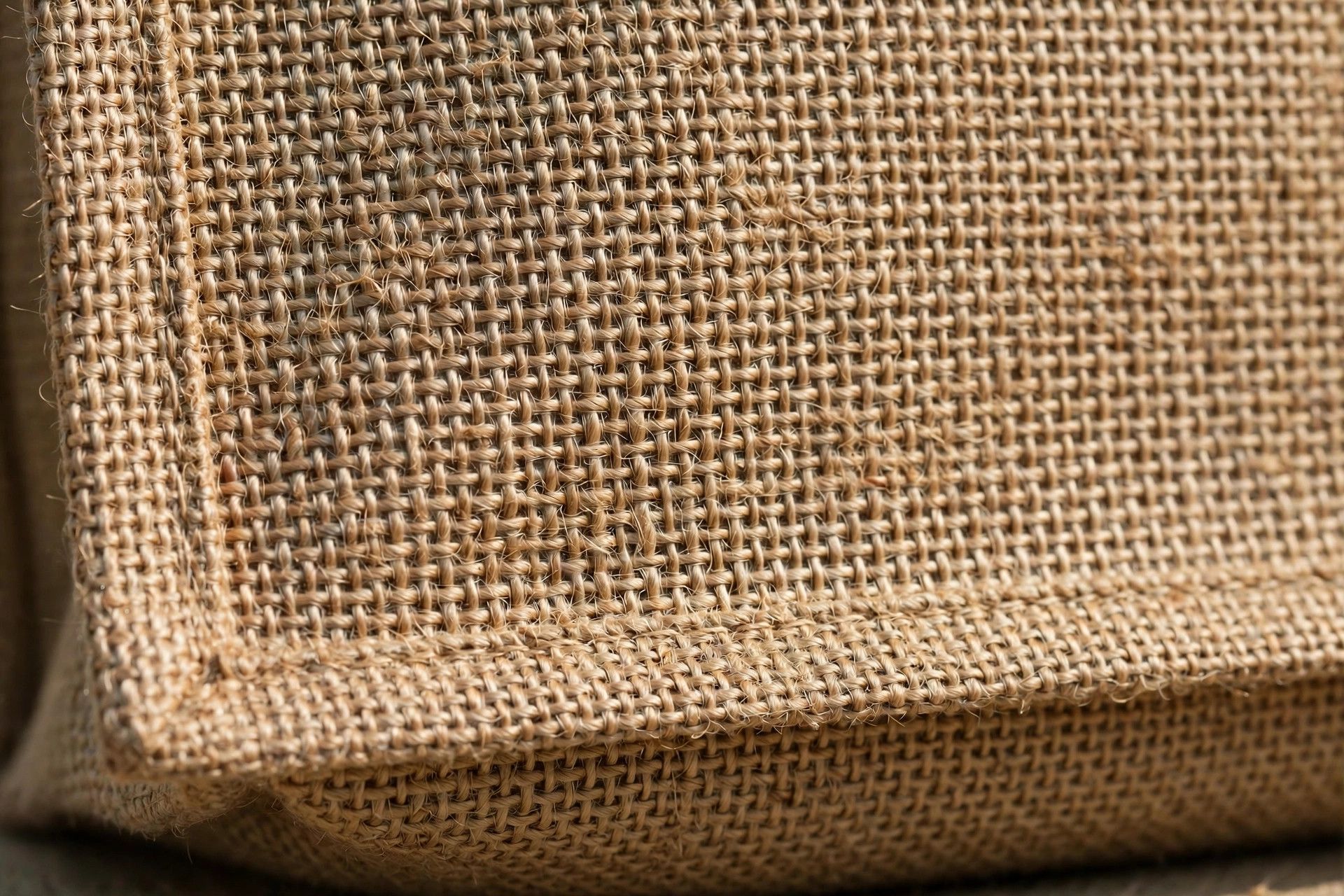
Jute is one of the oldest natural fibres in commercial use, spun from the stems of the Corchorus plant. The fibre is coarse, strong, and naturally textured, with a warm golden-brown colour in its undyed state. It has been used for centuries for sacks, ropes, and cordage precisely because it is tough — and that toughness is exactly what makes it such a good bag material.
Several forces are pushing jute into the UAE’s promotional mainstream. Single-use plastic bag charges and restrictions have made shoppers far more willing to accept and reuse durable carry bags. Dubai’s large exhibition and conference calendar — GITEX, Gulfood, the Big 5, Arab Health and dozens more — creates constant demand for delegate bags that feel premium but stay within realistic event budgets. And corporate buyers, especially in government-linked entities, banks, and multinationals with regional HQs, increasingly ask suppliers for the sustainability credentials of the merchandise they buy. A jute bag answers all of these briefs at once: it is visibly natural, genuinely reusable, and it prints beautifully.
There is also a simple aesthetic argument. Jute has a craft, artisanal texture that polyester and non-woven polypropylene bags cannot imitate. The natural weave reads as honest and grounded. When a company prints its logo on jute, the bag signals that the brand cares about substance — a message that lands particularly well in the UAE, where audiences see a lot of polished, high-gloss marketing and respond to things that feel real.
Understanding Jute Quality: Grades, Weave, and Weight
Not all jute bags are equal, and the difference shows in durability, print quality, and how the bag holds its shape. When a supplier talks about jute quality, they are usually referring to a combination of three things: the grade of the raw fibre, the tightness of the weave, and the fabric weight.
Fibre grade and weave
Jute fibre comes in commercial grades. The finer, softer, more uniform fibres produce smoother fabric with a more even surface — better for crisp logo printing and a more premium feel. Coarser grades have a more rustic, open weave with visible slubs (thicker, irregular threads). There is nothing wrong with a rustic look; many brands deliberately choose it for an artisanal aesthetic. But you should know which one you are getting, because a coarse weave limits how fine your printed detail can be. Tiny text and intricate line work can get lost in an open weave, while bold, simple graphics shine.
Fabric weight is usually quoted in grams per square metre (GSM). Promotional jute bags in the UAE market commonly range from light shopping-bag weights up to heavy, rigid fabrics used for structured gift bags. A heavier fabric holds its shape, stands upright on its own, and resists stretching at the handles — worth specifying if your bags will carry heavier items like bottles or catalogues. A lighter fabric drapes more, costs less in material, and works well for simple shopping-style bags.
Laminated vs unlaminated jute
One of the most important quality decisions is whether the jute is laminated. Laminated jute has a thin inner lining — typically a natural or food-safe lining — bonded to the inside of the fabric. Lamination does several useful things: it adds stiffness and structure, protects the contents from dust and moisture passing through the open weave, and gives the bag a cleaner interior finish. Laminated bags feel more premium and photograph better for retail-style giveaways.
Unlaminated jute is the more natural, breathable option: lighter, fully flexible, and compostable through and through. It is the honest choice for the most sustainability-purist campaigns. The trade-off is that contents can peek through a loose weave, and the bag will not hold a crisp shape on its own. Neither option is objectively better; the right one depends on what the bag will carry and how premium it needs to look. A good supplier will explain the trade-offs rather than pushing one option.
Handles, stitching, and finishing details
Handles deserve more attention than most buyers give them. On jute bags you will typically see cotton webbing handles, jute rope handles, or padded/cotton-look handles. Rope handles look the most “natural” and are strong, but they can be uncomfortable over long distances; wide cotton webbing distributes weight better and feels more comfortable for a shopping bag that gets carried for hours. Check how handles are attached: cross-stitched (box-stitched) handle attachments with reinforcement are far stronger than a single straight stitch. For bags that will carry real weight, ask about reinforced stitching at the stress points.
Other finishing details that separate a good bag from a mediocre one: bound or hemmed top edges (so the weave does not fray), a flat or gusseted base that lets the bag stand open for packing, interior pockets if needed, and zipped or Velcro closures for bags meant to secure contents. None of these are expensive upgrades, but they have to be specified — they rarely appear on the cheapest standard stock.
Jute Bag Styles That Work for Corporate Campaigns
“Jute bag” covers a surprising range of shapes. Matching the style to the campaign is half the battle.
The classic jute shopping bag
The workhorse. A rectangular bag with side and bottom gussets, comfortable handles, and a generous print area on both faces. This is the style you see at supermarkets and exhibitions, and it is the most popular choice for brands ordering bulk jute bags Dubai events demand in the thousands — because it is versatile: it works as a delegate bag, a retail shopping bag, a staff welcome-kit bag, or a community giveaway. If you are unsure which style to pick, start here.
Jute tote bags
Slightly more fashion-oriented: a flatter profile, often with longer handles designed to be carried over the shoulder. Jute tote bags are a favourite for lifestyle brands, wellness campaigns, book fairs, and university orientation kits. They suit portrait-oriented logo lockups and minimalist designs, and they photograph beautifully for social media — a real consideration when the bag doubles as organic marketing.
Jute gift and wine bags
Smaller, structured bags designed around a single purpose: carrying a bottle, a gift box, or a curated hamper. These are the premium end of the jute range and are popular for festive corporate gifting — think Ramadan and Eid hampers, Diwali gifts, National Day giveaways, and year-end client gifts. Because the bag is part of the gift presentation, lamination, a rigid base, and a neat closure matter more here. Pair the bag with the contents and it becomes packaging the recipient keeps rather than discards.
Jute drawstring pouches and small bags
Compact pouches for jewellery, cosmetics samples, conference swag, or hotel welcome amenities. These are excellent for events where a full-size bag would be overkill but you still want the eco message. They also work as the inner packaging inside a larger gift set — a small branded jute pouch inside a rigid box elevates the unboxing experience.
Large jute holdalls and beach bags
Bigger formats with sturdy handles, sometimes with zipped tops and interior pockets. These suit staff appreciation gifts, gym and wellness programmes, and hospitality amenities. Because they are genuinely useful as everyday bags, they earn more repeat use — and more repeat logo impressions — than almost any other promotional bag format.
For buyers comparing the broader landscape of custom bags Dubai suppliers offer, jute occupies the sustainable-natural corner of the range. If your brief leans more toward structured laptop-friendly formats, look at the backpack and travel categories; if the brief is pure eco messaging, jute is usually the strongest answer.
Sizing: How to Specify Dimensions That Actually Work
Bag sizes are usually quoted as width × height × gusset (depth), in centimetres. A “40 × 35 × 15 cm” bag is 40 cm wide, 35 cm tall, with 15 cm side gussets. Before choosing, think about what the bag must carry:
- Delegate and exhibition bags: must comfortably fit A4 documents, a notebook, a water bottle, and small swag. Err on the generous side — a bag that is slightly too big still looks fine, while one that cannot close over a brochure looks like a planning failure.
- Shopping bags: should handle a realistic grocery or retail load without the handles digging in. Depth (gusset) matters more than most buyers expect — a deeper gusset makes packing dramatically easier.
- Gift bags: size to the contents. Measure the hamper box or bottle first, then add a few centimetres of clearance on each side. A bag that fits its contents exactly looks tailored; a bag swimming with empty space looks careless.
- Pouches: size to the single item they will hold, plus finger clearance for easy removal.
One practical tip: request a physical sample or at least an exact-size paper mockup before approving bulk production. Dimensions on a spec sheet are abstract; holding the real thing (or a full-size paper dummy) instantly reveals whether the proportions feel right. Reputable suppliers in Dubai will provide samples — treat reluctance to do so as a warning sign.
Printing Your Logo on Jute: Methods, Limits, and Design Rules
This is where campaigns succeed or fail. Jute’s textured weave is forgiving in some ways and demanding in others, and the printing method has to match both the fabric and the artwork.
Screen printing: the standard for a reason
Screen printing is the most common method behind jute bags with logo Dubai companies order for exhibitions, retail, and CSR campaigns — and for most orders it is the right choice. Ink is pushed through a mesh screen directly onto the fabric, producing bold, opaque, durable prints. It handles the texture of jute well, it is cost-effective at volume, and the inks bond firmly to the fibres.
Key points to understand:
- Colours: screen printing lays down one colour per screen. Each additional colour adds a screen and a production step, so single- and two-colour designs are the most economical. Full-colour photographic images are not a natural fit for screen printing on jute — if your artwork is photographic, discuss alternatives with your supplier rather than forcing it.
- Detail limits: because the fabric surface is textured, very fine lines and small text can break up. As a rule of thumb, keep essential text and line work bold and reasonably sized. Your supplier’s artwork team should flag anything too fine before production — this pre-press check is one of the most valuable services a good supplier provides.
- Ink coverage on natural vs dyed jute: printing dark ink on natural golden jute gives strong contrast with minimal ink. Printing light colours (especially white) on dark-dyed jute needs a heavier ink deposit or an under-base layer to stay opaque. Both are doable; the latter just needs to be planned for.
- Placement: the two large faces are the primary branding real estate. Side gussets can carry secondary elements (a URL, a hashtag, a small icon), and some buyers add a small print near the top edge. Keep the main logo clear of seams and handle attachments.
Heat transfer and other methods
Heat transfer (applying a pre-printed design with heat and pressure) can reproduce finer detail and more colours than screen printing, and it is sometimes used for complex logos on jute. The trade-off is durability: on a coarse, flexible fabric that gets stuffed, folded, and washed, transfers can crack or peel over time, and the heat process needs careful calibration so it does not scorch natural fibres. For bags meant to last years, screen printing is usually the safer long-term bet. Embroidery is possible on heavier jute but is slow and expensive at volume, and fine embroidered detail fights the coarse weave — it is rarely the right choice for promotional quantities.
Design rules for jute
A few rules that consistently produce better results:
- Simplify. Your logo’s full-colour, gradient, fine-detail master version was designed for screens and coated paper. Create a simplified one- or two-colour version for jute. Bold shapes and strong silhouettes win on texture.
- Respect the texture. The weave is part of the aesthetic — do not fight it. Designs that incorporate the natural background colour (leaving jute showing through as a “colour” in the design) often look more premium than designs that try to cover the whole surface in ink.
- Mind the contrast. Dark ink on natural jute is the classic high-contrast combination for a reason. If your brand colours are pastels, test them on the actual fabric colour before committing — some light inks sink visually into golden jute.
- Use the space. A timid, tiny logo centred on a huge bag looks apologetic. Jute bags offer generous print areas — use them confidently, with good margins from the edges and seams.
- Proof on the real thing. Always approve a physical pre-production sample with your actual artwork printed on the actual fabric. Screen colours on a monitor lie; ink on jute tells the truth.
Eco and CSR Messaging: How Dubai Companies Should Talk About Jute
A jute bag is only as sustainable as the story around it is honest. UAE audiences — and increasingly UAE regulators and procurement departments — are alert to greenwashing, so the messaging on and around your bags should be accurate, specific, and modest.
What you can truthfully say
Jute is a renewable natural fibre. It is biodegradable and compostable at end of life. It generally requires fewer synthetic pesticides and fertilisers to grow than conventional cotton, and processing it uses comparatively little energy. A reusable jute bag, used repeatedly, displaces single-use carrier bags. These are all defensible claims.
What to avoid
Avoid absolute claims you cannot verify: “100% carbon neutral,” “zero waste,” or “saves the planet” style language invites scepticism and, in formal procurement contexts, requests for evidence you may not have. Also avoid implying the bag alone makes your company sustainable — one honest line about the bag beats a paragraph of grand claims. And be careful with recycling claims: jute is compostable/biodegradable rather than conventionally recyclable in most municipal streams, so “recyclable” is the wrong word; “reusable” and “biodegradable” are the right ones.
Making the campaign real
The strongest eco campaigns pair the bag with an action: a beach clean-up where volunteers receive the bags, an office programme replacing disposable carriers, a retail “bring your bag” incentive, or a school and community distribution tied to an environmental awareness day. When the bag is part of a genuine initiative, the CSR story writes itself — and the bag becomes a souvenir of participation rather than just another freebie. For companies building a wider sustainable gifting programme, jute bags sit naturally alongside other eco-friendly gifts in Dubai, from bamboo drinkware to recycled notebooks, letting you build a coherent, credible green gifting range rather than a one-off gesture.
Cultural and occasion notes for the UAE
Timing and context matter. Jute gift bags are a natural fit for Ramadan and Eid corporate hampers, where the natural, modest aesthetic suits the spirit of the season. They work for UAE National Day community giveaways, for back-to-school distributions, and for the winter “outdoor season” when beach clean-ups and desert conservation events peak. During the hotter months, plan distributions around indoor venues — malls, exhibitions, conferences — where the bags will actually be carried rather than left in a hot car. If your campaign targets government entities, keep the design dignified and the messaging factual; understated branding tends to perform better in that context than loud promotional graphics.
Ordering in Dubai: MOQs, Timelines, and the Production Process
Understanding how an order flows helps you plan backwards from your event date — the single most common cause of jute-bag stress is starting too late.
Minimum order quantities
Custom-printed jute bags are a manufactured product: fabric is cut, stitched, and printed to your specification. Because of the setup involved (screens, cutting, stitching runs), suppliers work to minimum order quantities. Entry-level minimums for simple custom prints are typically in the low hundreds of pieces, with better per-unit economics as quantities rise into the thousands. Very small runs (a few dozen) are sometimes possible on plain stock bags with simple printing, but expect the per-unit cost to be notably higher and the style choice to be limited to what is already in stock. If your need is genuinely small — say, fifty gift bags for a board dinner — say so upfront so the supplier can quote the realistic route rather than the bulk route.
Production timelines
A realistic timeline has four stages: artwork finalisation and approval, sampling, bulk production, and delivery. Sampling alone can take several working days, since a proper pre-production sample is printed on the actual fabric. Bulk production time scales with quantity and complexity — more colours, special sizes, and added features (zips, pockets, lamination) all add time. As a planning rule, allow several weeks from artwork approval to delivery for a standard custom order, and longer for large or complex runs. Exhibition deadlines are immovable, so the professional move is to lock artwork early and treat the event date minus one full week as your real deadline (that buffer covers courier delays, reprints of any defective pieces, and the chaos of event-week logistics).
The process, step by step
- Brief: bag style, size, fabric weight, laminated or unlaminated, handle type, quantity, colours, and your artwork files (vector formats like AI, EPS, or PDF are strongly preferred over JPGs).
- Quotation and specification sheet: the supplier confirms every detail in writing. Read it carefully — this document is what production will follow.
- Artwork check: the supplier’s pre-press team reviews your files for print suitability on jute and flags issues (fine detail, colour separations, sizing).
- Pre-production sample: one finished bag, printed with your artwork. Check print quality, colour, placement, size, stitching, and handles. Approve in writing or request changes.
- Bulk production and quality control: the run is produced, with checks during and after printing and stitching.
- Packing and delivery: bags are packed (usually in bulk cartons; individual poly-packing is available if needed) and delivered across Dubai and the other Emirates.
Delivery across the Emirates
If you are based in Dubai but distributing in Abu Dhabi, Sharjah, or the Northern Emirates, coordinate delivery addresses early. Bulk cartons are heavy, and splitting a shipment across multiple locations needs to be planned before packing, not after. For event deliveries, confirm the venue’s goods-receiving hours and any requirement for deliveries to arrive a day early — exhibition halls in particular have strict receiving windows.
Judging a Supplier: Questions That Reveal Quality
Whether you are buying branded jute bags UAE suppliers customise for corporate clients, or switching suppliers, these questions quickly separate professional operations from order-takers:
- Can I see and handle a physical sample of the exact fabric and construction before I commit?
- Will you do a printed pre-production sample with my artwork for approval?
- What fabric weight and weave are you quoting, and is it laminated or unlaminated?
- How are the handles attached and reinforced?
- What is your process if printed pieces arrive defective — reprint, credit, or replacement, and on what timeline?
- What are the exact dimensions, and can you provide a size mockup?
- What file formats do you need, and will your team check my artwork for print suitability?
- What is the realistic delivery date for my quantity, working backwards from my event?
A supplier who answers these clearly, in writing, is one you can plan an event around. Vague answers, reluctance to sample, or pressure to skip the pre-production proof are reasons to keep looking.
Care, Durability, and Getting Years Out of a Jute Bag
One of jute’s genuine selling points is longevity — a well-made jute bag can serve for years, which is exactly what makes it such good branding value. Each year of use is another year of logo impressions. A little care guidance, shared with recipients (a small care card tucked into gift bags is a nice touch), extends that life considerably.
Jute and water have a complicated relationship. The fibre can handle light moisture, but soaking and machine washing will shrink, distort, and weaken it. For cleaning, a soft brush or dry cloth removes most dust; for spots, a lightly damp cloth with mild soap, followed by thorough air-drying, is the safe approach. Bags should be dried fully before storage — storing jute damp invites mildew, especially in humid months. Kept dry and out of prolonged direct sunlight (which fades both fibre and print over time), a quality jute bag stays handsome for years. This is also worth stating plainly in your campaign: a jute bag is a long-life reusable product, not a disposable one, and treating it that way is part of the sustainability story.
Jute vs the Alternatives: An Honest Comparison
Buyers often weigh jute against cotton canvas, non-woven polypropylene (NWPP), and recycled PET bags. Each has a place:
- Cotton canvas prints with finer detail than jute and feels softer, but quality canvas costs more, and conventional cotton has a heavier agricultural footprint. Choose cotton when fine artwork reproduction is the top priority.
- Non-woven polypropylene is the cheapest reusable option and prints in full colour easily, but it is still plastic — it frays, it does not biodegrade, and it undermines a genuine eco message. Choose it only when budget is the overriding constraint and sustainability is not part of the brief.
- Recycled PET (rPET) bags have a good story (made from recycled bottles) and print well, but they are still synthetic. They suit sporty, modern brand aesthetics.
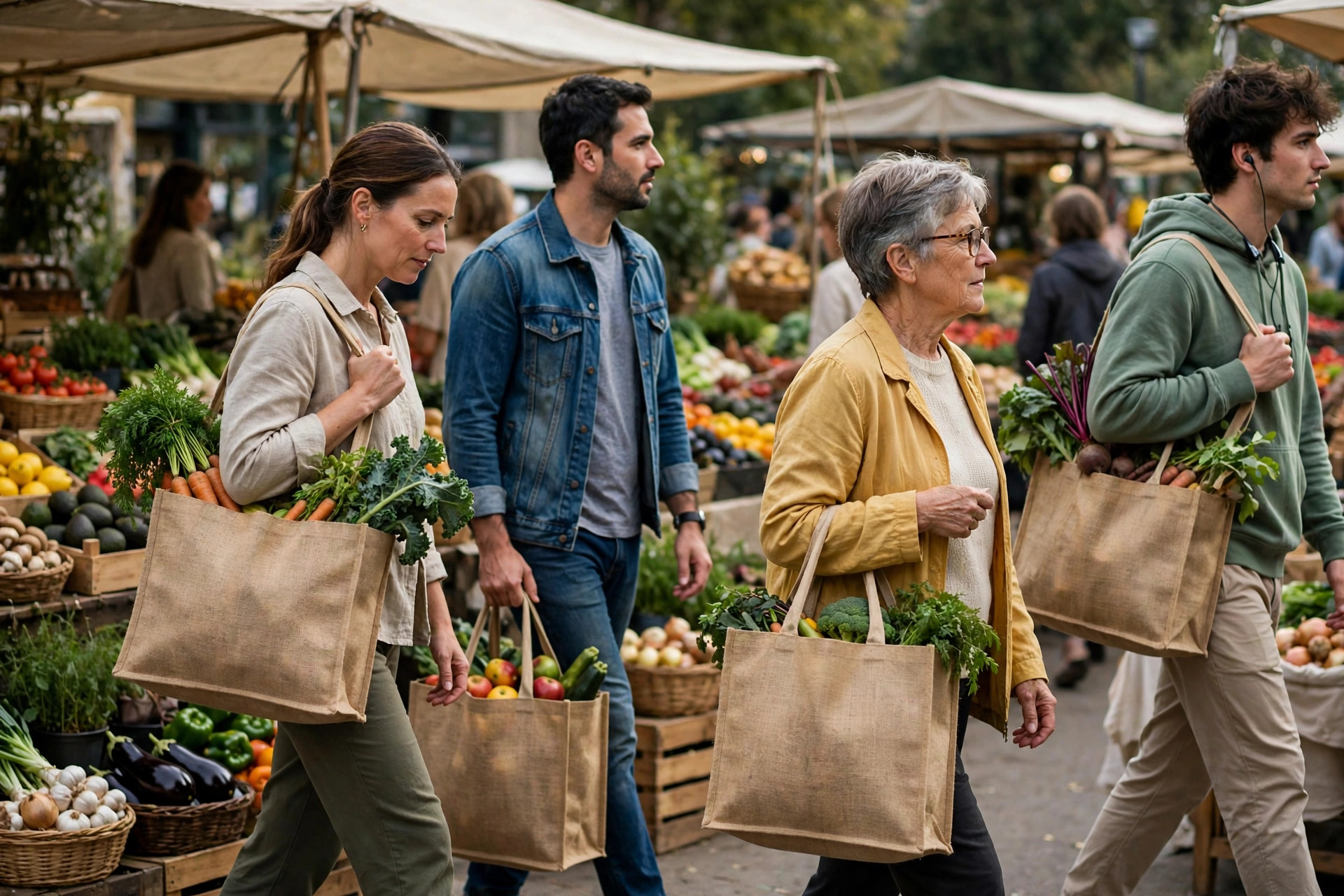
- Jute wins on authentic natural sustainability, texture and craft appeal, durability per dirham, and end-of-life biodegradability. Its constraints are coarser print detail and a rustic look that does not suit every brand.
For a company whose brief genuinely includes sustainability, jute is usually the most defensible choice in this set — the material story is simple, visible, and true.
Getting the Most Branding Value From Your Bags
A bag order is a marketing asset, not just a procurement line. A few practices multiply the return:
- Design for the street, not the shelf. The bag will be seen at arm’s length and in motion. Big, bold, legible branding beats intricate detail every time.
- Put the essentials on both faces. People carry bags facing both directions; branding one side only halves your impressions.
- Add a reason to keep it. A genuinely useful bag in the right size gets kept. A flimsy, awkward bag gets discarded — taking your eco credibility with it. Spend the small premium for proper weight and stitching.
- Coordinate with the campaign. Match the bag to event signage, social templates, and any bags with logo Dubai suppliers print for staff or retail, so the whole brand presence feels intentional.
- Photograph it well. Good product photography of your finished bags — styled naturally, in real Dubai settings — gives you social content and a portfolio piece for the next campaign’s business case.
Conclusion: A Bag That Keeps Working After the Event Ends
Most promotional items have a short half-life: the pen runs out, the USB stick gets lost, the flyer gets recycled by evening. A custom jute bag is different. It goes home with the recipient, gets used for the weekly shop, the gym, the beach, the office — and every one of those trips puts your logo back on the street. It does this while telling an honest sustainability story that fits where the UAE is heading, not where it has been.
The buyers who get the best results are the ones who treat the bag as a product, not a freebie: they specify the fabric, approve a real printed sample, simplify their artwork for the weave, and plan their timeline backwards from the event. Do that, and your jute bags will not just be carried — they will be kept.
If you are planning an order of custom jute bags Dubai businesses use for exhibitions, CSR programmes, festive gifting, or retail — including bulk jute bags in Dubai produced to your exact specification — talk to the team at Vision Advertising. Based at 38A St, Hor Al Anz, Deira, Dubai, UAE, we supply custom-printed jute bags with your logo, from sampling and artwork checks through bulk production and delivery across all seven Emirates. Call or WhatsApp +971 50 970 9564 or email [email protected] with your quantity, timeline, and artwork, and we will guide you to the right bag, the right print, and a delivery date you can plan around.
Frequently Asked Questions
How long does it take to produce custom jute bags in Dubai?
For a standard custom order, allow several weeks from artwork approval to delivery. The timeline covers artwork checking, a printed pre-production sample for your approval, bulk production (which scales with quantity and the number of print colours), quality control, and delivery. Complex bags — special sizes, lamination, zips, or pockets — take longer. If you are ordering for an exhibition or event, start the process early and treat one full week before the event as your real deadline, keeping a buffer for any reprints or delivery delays.
What is the minimum order quantity for branded jute bags?
Because custom jute bags are manufactured to order — fabric cut, stitched, and printed to your specification — suppliers work to minimum quantities, typically starting in the low hundreds of pieces for printed custom bags, with better per-unit value at higher volumes. Very small runs are sometimes possible on ready stock with simple printing, but the per-unit cost is higher and style choices are limited. Share your exact quantity when requesting a quote so you are quoted the realistic production route.
Will my full-colour logo print well on jute?
It depends on the logo. Jute’s textured weave suits bold, simplified artwork in one or two colours — the standard approach is screen printing, which produces durable, opaque prints. Full-colour photographic detail does not reproduce crisply on coarse natural fibre, so most suppliers will recommend creating a simplified one- or two-colour version of your logo for the bag. Always approve a physical printed sample before bulk production so you can see exactly how your artwork looks on the real fabric.
Are jute bags genuinely eco-friendly?
Jute itself is a renewable natural fibre that is biodegradable and compostable, and it is grown with comparatively low chemical and energy inputs — so the material credentials are genuine. The honest framing is “reusable and biodegradable,” not “recyclable” (jute is not processed through conventional recycling streams). The sustainability case is strongest when the bag is well-made enough to be reused for years, displacing single-use carriers trip after trip — which is also why specifying decent fabric weight and stitching matters.
How should recipients care for a jute bag?
Keep it dry, brush off dust with a soft brush or dry cloth, and spot-clean with a lightly damp cloth and mild soap if needed — then air-dry fully. Avoid machine washing and soaking, which shrink and weaken the fibre, and avoid storing the bag damp. Kept dry and out of prolonged direct sun, a quality jute bag will look good and carry strong for years.
Can jute bags be used for food or grocery shopping?
Yes — jute shopping bags are widely used for groceries, and laminated jute bags with a food-safe inner lining are the better choice for this purpose, since the lining protects contents and wipes clean. Unlaminated jute is breathable and fine for dry goods and produce. As with any reusable shopping bag, it is good practice to keep grocery bags clean and dry between uses.




