
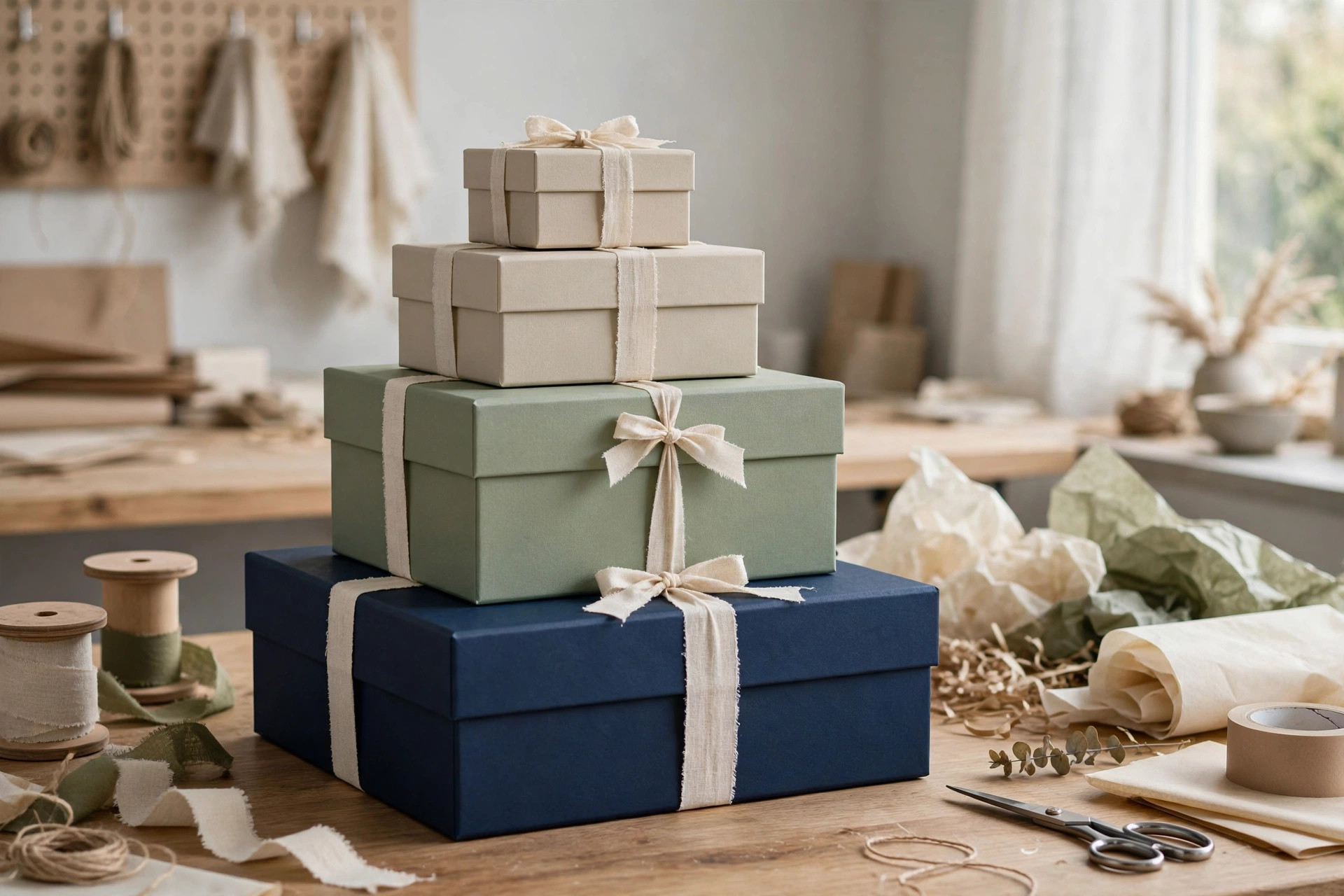
Hand someone a gift in a plain plastic bag and it feels like an errand. Hand them the same gift in a rigid box with a magnetic closure, your logo foiled in gold on the lid, tissue folded just so — and it feels like an occasion. That difference is not decoration. In Dubai’s corporate gifting culture, where Eid gifts, onboarding kits, and VIP welcome packs are handed over in person as often as they are shipped, the box does real work: it signals the value of what’s inside, carries your brand into the recipient’s office or home, and survives the journey there looking the part.
This guide covers everything a buyer needs to know about custom gift boxes in Dubai — the box types, the inserts, the branding methods, sizing, MOQs and production timelines with a local gift boxes supplier Dubai buyers can actually reach, eco-friendly options, and how to match the box to the occasion. Whether you’re ordering empty boxes to fill yourself or running a full-service gift-box programme, you’ll finish this article knowing exactly what to ask for.
Why the Box Matters as Much as the Gift
Dubai’s business culture takes gifting seriously. During Ramadan and Eid, companies distribute thousands of gift boxes to clients, partners, and employees. Most of those are corporate gift boxes in the true sense: ordered in volume, branded carefully, and expected to arrive looking flawless. New-hire welcome kits land on desks in DIFC towers and Dubai Media City offices every week. Real estate developers hand over completion gifts in Jumeirah; hotels in Deira and along Sheikh Zayed Road prepare VIP arrival boxes for returning guests. In every one of these moments, the recipient’s first physical contact with your gesture is not the gift — it’s the packaging.
A well-made box changes behaviour. Recipients keep it. A rigid box with a good finish gets reused on the desk — for stationery, for documents, for small items — which means your logo keeps working for you for months after the chocolates or dates are long gone. A flimsy box gets flattened and binned, and your brand leaves with the recycling. If you’re investing in premium contents — dates from a premium farm, a branded notebook, a tech gadget — putting them in a weak box is like booking business-class seats and serving the meal in a paper sack. The packaging and the gift are one product in the recipient’s mind.
There is a practical side too. Dubai’s climate is hard on packaging. A box sitting in a car boot in August heat, or stacked in a warehouse near Al Quoz without climate control, needs to hold its shape, keep its glue lines sealed, and not warp or discolour. Cheap board, weak adhesives, and thin lamination fail here in ways they wouldn’t in a temperate climate. A supplier who works in the Emirates knows this and specs materials accordingly — one more reason to work locally rather than ordering generic boxes from an overseas marketplace and hoping for the best.
Types of Custom Gift Boxes
Not all boxes are the same tool. Choosing the right construction is the single biggest decision in a gift-box project, because it drives cost, timeline, and the unboxing experience. Here’s how the main types compare.
Rigid Boxes (Setup Boxes)
The classic luxury gift box. Rigid boxes are made from thick chipboard — the greyboard core is typically several millimetres thick — wrapped in printed or coloured paper. They don’t fold flat, they don’t collapse, and they feel substantial the moment someone picks them up. This is the construction behind premium perfume packaging, watch boxes, and high-end corporate gift sets.
Rigid boxes are the go-to choice when perception matters most: VIP client gifts, executive onboarding kits, awards and recognition packs, and Eid gifts for key accounts. The downside is cost and logistics — they’re more expensive per unit than folding cartons, and because they ship assembled, they take up warehouse space. In Dubai, most corporate buyers use rigid boxes for their top tier of recipients and a lighter construction for volume gifting.
Magnetic Closure Boxes
A rigid box with concealed magnets in the lid and base, so the box snaps shut with a soft, satisfying click. The magnetic closure adds a tactile moment to the unboxing that people remember — that little “snap” reads as quality even before the lid is lifted. Magnetic boxes are enormously popular for corporate gift sets in the UAE because they photograph beautifully and feel premium without the complexity of ribbon ties.
One practical note: magnets add weight and a little cost, and very small boxes with magnets can feel fiddly. They’re at their best in medium sizes — roughly the footprint of a hardcover book up to a shoebox. For Eid gifting programmes, where the same design is produced in the hundreds or thousands, magnetic rigid boxes are the workhorse of the premium tier.
Drawer / Slide Boxes (Matchbox Style)
The box opens like a drawer sliding out of a sleeve — think of a matchbox, scaled up. This construction is brilliant for unboxing theatre: the recipient pulls the tray and the contents are revealed in one motion. Drawer boxes work especially well for flat or layered contents — dates arranged in rows, stationery sets, or a curated selection of small items.
They’re also efficient for shipping, since the tray nests inside the sleeve and the whole thing is compact. For product launches and PR mailers in Dubai, where the box often has to survive a courier trip to Abu Dhabi or Sharjah and still open perfectly on camera, drawer boxes are a strong choice.
Folding Cartons
The lighter, fold-flat option — printed board that folds into shape, like a cereal box but heavier and better finished. Folding cartons cost less per unit than rigid boxes, ship flat (which cuts freight and storage costs dramatically), and are assembled in seconds. They’re the right answer for high-volume programmes where budget per recipient is tight but the box still needs to look branded and intentional.
The trade-off is feel. A folding carton will never have the heft of a rigid box. But with good print, a clean structural design, and a well-placed sleeve or belly band, a folding carton can look far more premium than its cost suggests. For staff gifting at scale — a thousand Eid boxes for employees, for example — folding cartons or rigid mailers often win the value argument.
Rigid Mailers / Corrugated Gift Shippers
When the box has to travel — couriered across the Emirates, shipped to Riyadh or Doha, or sent to multiple office locations — protection matters as much as presentation. Rigid mailers are corrugated boxes with a premium printed exterior, designed to be both the shipping container and the gift presentation. The recipient opens the courier box and finds… the gift box, with no inner packaging to discard.
This two-in-one approach is increasingly popular for corporate programmes because it cuts waste and cost. The exterior can carry full branding — your logo, a pattern, a seasonal design — so the unboxing starts at the doorstep. For companies running gifting across the GCC from a Dubai base, a well-designed mailer eliminates the “box inside a box inside a box” problem.
Choosing Between Them
A simple rule of thumb: if the box is handed over in person and the recipient count is modest, go rigid — the feel justifies the cost. If you’re shipping at volume or the recipient count runs into the hundreds, folding cartons or branded mailers give you the best balance. And for the classic Dubai corporate programme, the winning combination is often two tiers — a rigid magnetic box for VIPs and a well-designed folding or mailer box for the wider list, both carrying the same branding so the programme looks coherent.
Inserts and Fitments: What Holds the Gift Holds the Attention
An empty box is a container. A box with a proper insert is a presentation. Inserts — the fitted trays, dividers, and holders inside the box — do three jobs: they protect the contents in transit, they arrange them for the reveal, and they make the gift look deliberate rather than tossed in.
Foam and EVA inserts are the precision option. Cut to the exact shape of each item — a bottle, a power bank, a set of pens — foam holds everything immobile and presents it like a museum display. EVA (a dense, smooth foam) takes colour well and looks clean; it’s the standard for tech gift sets and premium kits. The catch is tooling: each custom foam shape needs a cutting die or CNC path, so foam makes sense from moderate quantities upward, not for ten boxes.
Moulded pulp and card dividers are the economical workhorses. Simple cardboard dividers create compartments for dates, chocolates, or mixed items at a fraction of foam’s cost, and they can be printed or foiled to carry branding. For food gifting — and a huge share of Dubai corporate gifting is food — card dividers with food-safe coatings are the practical standard.
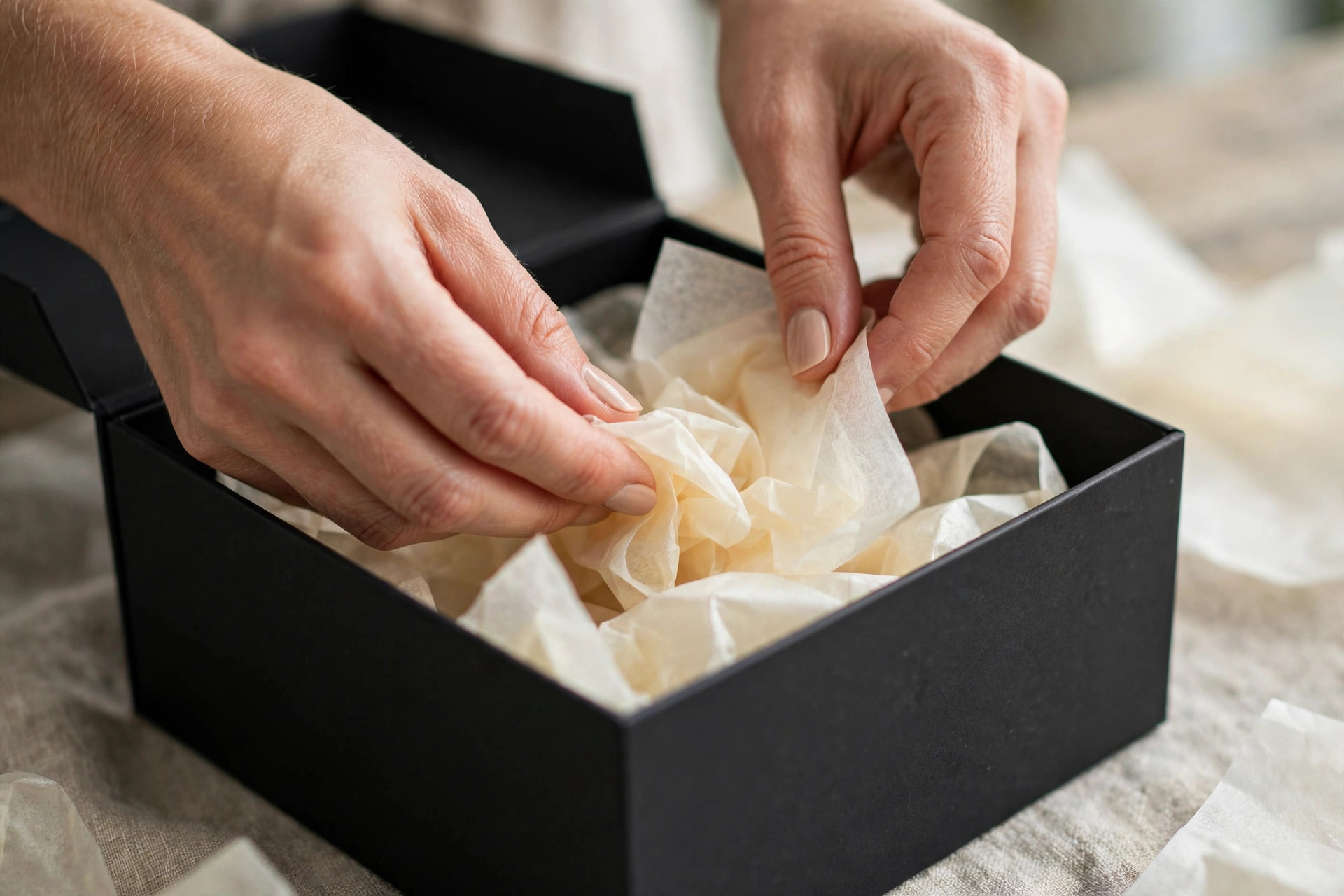
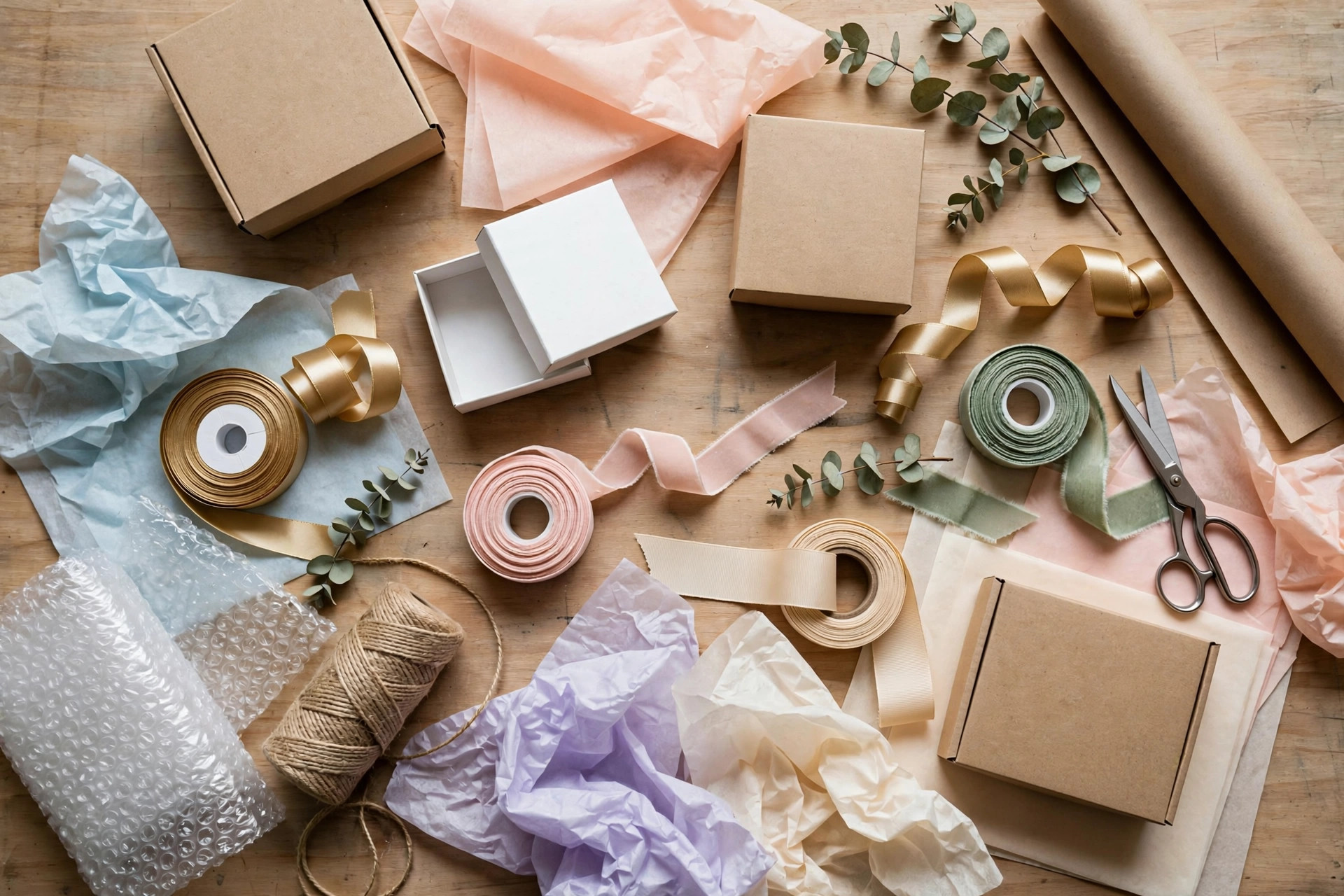
Ribbon and tissue are the finishing layer. A ribbon pull-tab on a drawer box, tissue paper folded over the contents, a wax-seal style sticker holding the tissue closed — these are small touches with outsized effect on perceived value. They cost little and photograph beautifully, which matters when recipients share unboxings on social media (and in Dubai, they do).
Sleeves within sleeves: for multi-item kits, consider a two-level insert — a top tray that lifts out to reveal a second layer beneath. This “discovery” structure doubles the unboxing moment and is a favourite for welcome gift sets where the kit tells a story: company values on top, practical items below.
When briefing a supplier, specify the exact contents — dimensions and weight of each item — before the insert is designed. An insert designed around real products fits; an insert designed around guesses gets remade. If your contents aren’t final yet, ask for an adjustable insert (foam with removable layers, or a divider grid) rather than a precision-cut one.
Branding Methods on Packaging
A plain box with your logo applied well beats a busy box applied badly. These are the main ways branding goes onto gift packaging, and when each makes sense.
Foil Stamping
Metallic foil — gold, silver, copper, rose gold, holographic — pressed onto the box with heat and a metal die. Foil is the signature finish of luxury packaging in the UAE, and for good reason: it catches light, it reads as premium instantly, and a single-colour foil logo on a deep-coloured box (navy, black, emerald, burgundy) is one of the most elegant looks in corporate gifting. Foil stamping needs a die per design, so it’s best for logos and marks you’ll reuse across a programme. It works beautifully on rigid boxes, sleeves, and belly bands.
Embossing and Debossing
Raised (embossed) or recessed (debossed) impressions of your logo or a pattern, with or without ink or foil. Blind embossing — no ink, just the impression — is the quietest luxury move in packaging: subtle, tactile, unmistakable up close. A blind-embossed logo on a matte rigid box lid is a favourite for law firms, private banks, and luxury brands in Dubai that want presence without flash. Embossing can be combined with foil in a single pass for a registered foil-and-emboss effect.
Spot UV and Lamination Finishes
The overall finish of the box sets the baseline. Matte lamination gives a soft, modern, fingerprint-resistant surface — the current default for premium corporate packaging. Gloss lamination is bolder and more traditional. Spot UV adds a glossy raised varnish on selected areas (typically the logo) over a matte background, creating contrast you can see and feel. For custom gift boxes with logo Dubai buyers ordering at volume, spot UV over matte lamination is one of the best value-to-impact finishes available.
Sleeves and Belly Bands
A sleeve is a printed band that wraps the whole box; a belly band is a narrower strip around the middle. Both are brilliant tools because they separate the branding from the box itself. Print a run of plain, high-quality boxes, then produce different sleeves for different occasions — Eid, National Day, a product launch, a client-specific version — without re-manufacturing boxes. Sleeves also let you personalise: the recipient’s name or company on the band, over a standard box. For programmes that repeat quarterly, the sleeve strategy saves serious money.
Stickers, Seals, and Labels
The humblest branding method and sometimes the smartest. A well-designed seal sticker closing a tissue wrap, or a label on the box base with contents and handling notes, adds a finished feel for very little cost. Stickers are also the fastest branding method — no dies, no setup — which makes them the answer when timelines are brutal. A plain rigid box plus a beautiful foil seal sticker can look remarkably premium.
Which Method for Which Box?
Rigid boxes take every method well — foil, emboss, UV, sleeves all sing on a rigid surface. Folding cartons are best with print-forward approaches: full-colour print, spot UV, and sleeves. Mailers usually carry bold exterior print since they’re seen from across the room. And whatever you choose, keep the branding restrained: one strong logo placement beats five weak ones. The box is the stage, not the billboard.
Sizing and Structural Design
Getting the size right sounds trivial until you’ve seen a beautiful box ruined by contents rattling around inside — or worse, contents that don’t fit and a lid that won’t close. Structural design deserves the same attention as graphic design.
Size to the contents, not the catalogue. Start from the actual items: measure the largest piece, add clearance for the insert and for fingers to lift things out, and size the box from there. A box that’s 10–15% larger than its contents in each dimension usually gives room for a proper insert without looking empty. Oversized boxes feel cheap — the gift swims — and they waste material and shipping volume.
Mind the proportions. Very tall narrow boxes tip over; very flat wide boxes feel insubstantial unless the construction is rigid. For most corporate gift sets, a box roughly the proportions of a hardcover book or a small shoebox is the sweet spot — stable, stackable, and comfortable to hold.
Test with a prototype. Before committing to a production run, get a physical sample — a “dummy” in the actual board, even unprinted — and put the real contents in it. Check the lid closes cleanly, the magnets align, the drawer slides smoothly, and the box survives being carried by its lid (recipients will do this). Catching a structural problem at the prototype stage costs almost nothing; catching it across a thousand finished boxes is a disaster.
Think about storage. Rigid boxes ship assembled and eat warehouse space fast. If you’re ordering bulk gift boxes Dubai wide for a December programme, confirm where they’ll live between production and distribution. Folding cartons and flat-packed sleeves store in a fraction of the space — another quiet argument for the sleeve strategy on large programmes.
Dubai-specific sizing note: if boxes will be couriered, check standard courier volumetric weight bands before finalising dimensions. A box that’s a centimetre over a band threshold can jump a shipping tier across hundreds of units. Design just under the threshold and the savings compound.
MOQs and Production Timelines in Dubai
This is where working with a local supplier pays for itself in honesty. Here’s how minimum order quantities and timelines typically work for custom gift boxes in the Emirates.
MOQs by construction. Fully custom rigid boxes — custom size, custom print — generally need a meaningful production run to be economical, often starting in the low hundreds of units with a local manufacturer. That’s because rigid box production involves die-cutting, wrapping, and hand or semi-automatic assembly; the setup effort is the same whether you make 100 or 1,000. Folding cartons, being a print-and-fold process, can run economically at lower quantities. Semi-custom approaches — a standard box size with your branding via sleeve, belly band, or sticker — can go lower still, since the box itself is an existing stock item.
The stock-box shortcut. If your quantity is small (say, under 100 units) or your timeline is days rather than weeks, ask about quality stock boxes branded with sleeves, stickers, or foil. Many Dubai suppliers keep premium rigid and PU-leather style boxes in standard sizes that take branding beautifully. You lose the fully-custom structure, but you gain speed and a per-unit cost that makes small runs viable. For empty gift boxes Dubai buyers who fill boxes in-house, stock boxes with custom sleeves are often the smartest route.
Production timelines. As a rough guide: stock boxes with simple branding (stickers, sleeves) can often be turned around in days. Custom printed sleeves or belly bands typically need one to two weeks including design approval. Fully custom rigid boxes with foil and inserts usually need several weeks from artwork approval to delivery — the die-making, printing, wrapping, and assembly steps can’t be rushed without quality suffering. Add buffer for Ramadan and the year-end gifting season (November–December), when every packaging supplier in the UAE is at capacity and lead times stretch. If your Eid or Christmas programme has a hard distribution date, brief your supplier eight to twelve weeks out. It sounds early; it isn’t.
Artwork and approvals. The most common cause of delay isn’t production — it’s artwork ping-pong. Have your logo in vector format (AI, EPS, or PDF) ready before you brief. Confirm dielines — the flat template showing folds, glue flaps, and safe areas — with the supplier before the designer starts. And nominate one decision-maker for approvals; nothing stalls a packaging run like three stakeholders marking up the same proof in rotation.
Delivery across the Emirates. A Dubai-based supplier can deliver finished boxes to offices in Dubai same-day or next-day, and to Abu Dhabi, Sharjah, Ajman, Ras Al Khaimah, Fujairah, and Umm Al Quwain within the standard courier network. If your programme distributes from a single point — say, your Deira office — plan the delivery a few working days before your packing day, and keep a small overage (a few percent extra) for last-minute additions and damaged units.
Eco-Friendly Packaging Options
Sustainability has moved from nice-to-have to expectation in UAE corporate gifting, especially among multinationals and government-adjacent entities. The good news: eco-friendly gift packaging no longer means a brown box with a twine bow (though done well, that’s charming). Here’s what’s genuinely available.
Recycled and FSC-certified boards. Rigid boxes and folding cartons can be produced on recycled-content or responsibly-sourced boards without any visible difference in quality. Ask your supplier what board stocks they carry — many now offer certified options as standard.
Plastic-free finishes. Traditional lamination is a thin plastic film; plastic-free alternatives include aqueous coatings and uncoated boards with a natural texture. If your brand messaging leans sustainable, a plastic-free finish lets you say so honestly on the box itself.
Reusable design. The most sustainable box is one the recipient keeps. A sturdy rigid box designed for reuse — sized for desk storage, with a timeless rather than seasonal design — stays in use for years. Some companies in Dubai now design their annual gift box as a keepsake deliberately, which also keeps the brand visible long after the occasion.
Right-sizing and minimal void fill. The greenest packaging decision is using less of it. A box sized correctly to its contents, with a card divider instead of plastic blister or shredded fill, cuts material dramatically across a large programme. Avoid the temptation to make the box big to look generous — recipients read oversized packaging as wasteful, not lavish.
Honest claims. If you put “eco-friendly” or “recyclable” on the box, make sure it’s true of the whole construction — foil stamping and certain laminations can complicate recycling claims. A good supplier will tell you straight what can and can’t be claimed. Vague green claims on packaging are increasingly scrutinised; specific, truthful ones build trust.
Matching Boxes to Occasions
Different moments in Dubai’s corporate calendar call for different packaging. Here’s a practical mapping.
Eid (Ramadan and Eid Al Fitr / Eid Al Adha). The biggest corporate gifting season in the UAE. Designs lean toward deep greens, golds, and geometric Islamic patterns; Arabic calligraphy or bilingual greetings on the sleeve are standard and appreciated. Because volumes are high, the two-tier approach shines: a premium rigid magnetic box for key clients, a well-designed folding box for the wider list. Brief early — the entire market moves at once.
UAE National Day (December 2). Patriotic colour palettes — red, green, white, black — and flag motifs. Programmes are usually internal (employees) or citizen-focused, so quantities can be large and timelines collide with the year-end rush. Sleeves over stock boxes are a pragmatic answer when the calendar is tight.
Employee onboarding. Welcome gift sets work best in drawer boxes or rigid mailers — something the new hire opens at their desk on day one. Branding should be company-forward rather than occasion-specific, since the same box design gets reused year-round. Include a personal touch: a name card or a handwritten-style welcome note on top of the insert.
Product launches and PR mailers. Theatre matters most here. Drawer boxes, double-layer inserts, bold exterior print — the box may be photographed more than the product. Design for the camera: strong colour contrast, a clear logo moment on opening, and contents arranged for a top-down shot.
VIP and C-suite gifting. This is rigid-box territory, full stop. Magnetic closure, foil or blind emboss, a fitted insert, ribbon and tissue. The box should feel like it belongs in a boardroom. Personalisation — the recipient’s name foiled on the lid or the sleeve — elevates it further and is very well received in relationship-driven Gulf business culture.
Weddings and personal celebrations. Dubai’s wedding and private-event market uses gift boxes heavily — for guests, for bridal parties, for newborn celebrations. Pastel palettes, monogram foiling, and delicate finishes like soft-touch lamination dominate. Quantities are moderate but expectations are sky-high; this is precision work.
Exhibitions and conferences. Think GITEX, Gulfood, and the dozens of trade shows across the Dubai World Trade Centre calendar. Boxes here double as brand ambassadors handed to hundreds of booth visitors. Folding cartons or mailers with bold print win — they need to survive a tote bag, look good in a crowded hall, and cost little enough per unit for high volumes.
Cost Drivers Explained Honestly
Nobody likes vague “it depends” answers, so here’s a straight explanation of what actually moves the price of custom gift boxes — no fake price lists, just the levers.
Construction is the biggest lever. Rigid boxes cost more than folding cartons, which cost more than sleeves over stock boxes. Every step up in construction buys you perceived value; whether it’s worth it depends on the recipient tier.
Size and material. Bigger boxes use more board, and thicker board costs more than thinner. Specialty stocks — soft-touch, textured, metallic — carry a premium over standard art board. But material is rarely the dominant cost; structure and finishing usually matter more.
Print complexity. A single-colour foil logo needs one die and one pass. Full-colour photographic print plus foil plus emboss plus spot UV needs multiple passes and multiple setups. Each additional finishing process adds setup cost and production time. The elegant single-foil-on-colour look isn’t just tasteful — it’s economical.
Inserts. A simple card divider is inexpensive; a precision-cut foam insert with multiple cavities is a real cost line, especially with tooling. Ribbon, tissue, and seal stickers sit at the affordable end and punch above their weight visually.
Quantity. Packaging follows classic economies of scale: setup costs (dies, plates, cutting formes) are fixed, so the per-unit price falls as quantity rises. This is why the jump from 100 to 500 units often changes the per-box economics dramatically, while the jump from 5,000 to 10,000 moves it less.
Timeline. Rush production costs more — overtime, prioritised machine time, expedited freight for materials. The cheapest timeline is the one you planned for. Booking your Eid programme in the quiet months rather than in the Ramadan rush doesn’t just reduce stress; it typically reduces cost.
What to ask your supplier. Rather than asking “how much is a gift box,” brief the essentials — construction type, approximate size, quantity, finishing, insert needs, and delivery date — and ask for two or three options at different price points. A good supplier will show you where the money goes and where you can save without the box looking cheaper. That’s the conversation worth having.
Quality Checks Before Approving a Batch
Before you sign off on a production run — especially your first run with a new design — run through these checks on the physical proof or the first articles off the line.
Structure and assembly. Open and close the box repeatedly. The lid should sit square, magnets should align and hold, drawers should slide without catching, and glue flaps should be clean with no visible adhesive squeeze-out. Pick the box up by the lid with contents inside — if the base drops, the construction or the magnet strength is wrong.
Print and colour. Check your brand colours against an approved reference under natural light, not just office fluorescents. Look for scuffing on dark matte finishes (a known weakness — ask about scuff-resistant lamination if your design is dark). Verify that small text is legible and that nothing important sits on a fold line.
Foil and emboss registration. Foil should be crisp with no feathered edges; embossing should be even across the sheet. Check the alignment of foil over print — misregistration of even a millimetre is visible on a logo.
Insert fit. Place every actual item in the insert. Each piece should sit snug without forcing, lift out without a struggle, and stay put when the box is tilted. If anything rattles, the cavities need tightening.
Consistency across the batch. Pull samples from the start, middle, and end of the run. Colour can drift and cutting can wander over a long production run; spot-checking catches it before the boxes ship.
The Dubai climate test. Leave a finished sample somewhere warm — a car boot for an afternoon, honestly — and check the glue lines, lamination, and shape afterward. If anything warps, bubbles, or peels, better to know now than after a thousand boxes have been distributed in August.
A supplier who welcomes this scrutiny is a supplier worth keeping. Quality checking isn’t distrust — it’s the part of the process that protects both sides.
Corporate Gift Box Ideas Worth Stealing
The corporate gift box ideas that work hardest in Dubai share one trait: the box is designed around a moment, not around a product list. A coffee-and-dates box built for Ramadan evenings, a desk-reset box for the first week back in January, a small celebration box that marks a signed contract — each one gives the recipient a reason the combination makes sense.
Chocolate deserves a special mention because it anchors so many orders: corporate chocolate gift boxes pair a rigid branded outer with portioned pieces inside, which makes them the safest premium option for mixed audiences. Whatever the theme, prototype the full box — contents, fill, sleeve and card — before approving volume. More corporate gift box ideas, with the sets that fill them, are in our corporate gift sets guide, and the seasonal version of this thinking is in our corporate Christmas gifts guide.
Frequently Asked Questions
What is the minimum order for custom gift boxes in Dubai?
It depends on the construction. Fully custom rigid boxes typically start in the low hundreds of units with a local manufacturer, because setup (dies, cutting, assembly) is the same effort at any quantity. Folding cartons can run at lower quantities, and stock boxes with custom sleeves, belly bands, or stickers can go lower still — making them the practical choice for small runs or tight timelines. If you need gift boxes with logo Dubai buyers often start with a branded stock box and move to fully custom construction as volumes grow.
How long does it take to produce custom gift boxes?
Stock boxes with simple branding can often be ready in days. Custom sleeves or belly bands usually need one to two weeks from artwork approval. Fully custom rigid boxes with foil stamping and fitted inserts typically need several weeks. Always add buffer during Ramadan and the November–December gifting season, when UAE packaging suppliers run at full capacity. For date-critical programmes like Eid distribution, briefing eight to twelve weeks ahead is sensible.
Should I buy empty gift boxes or order a full gift-box programme?
Buy empty boxes when you have the contents sorted and the team to assemble — it’s flexible and cost-effective, and custom sleeves let you brand beautifully. Choose a full-service programme when you want one supplier handling boxes, contents, assembly, and delivery; it costs more per unit but removes coordination risk and is the safer choice for large or date-critical distributions. Many companies do a hybrid: the supplier produces branded boxes and inserts, and the in-house team does final assembly and personalisation.
What branding looks best on a gift box?
Restraint wins. A single foil-stamped or embossed logo on a richly coloured rigid box looks more premium than a box covered in print. For volume programmes, a clean printed sleeve over a quality box gives you flexibility across occasions. Whatever the method, keep one strong logo placement, use your exact brand colours (checked on a physical proof), and remember the box is the stage — the gift inside is the star.
Can gift boxes be eco-friendly without looking cheap?
Absolutely. Recycled-content and certified boards look identical to standard stocks, plastic-free coatings are widely available, and a well-designed reusable rigid box is arguably the greenest option — the recipient keeps it for years. Right-sizing the box to its contents cuts material more than any label ever will. Just make sure any eco claim on the box is true of the whole construction; a good supplier will advise honestly.
Do you deliver gift boxes across the UAE?
Yes — a Dubai-based supplier like Vision Advertising delivers finished boxes across all seven Emirates, from same-day within Dubai to standard courier timelines for Abu Dhabi, Sharjah, and the Northern Emirates. Plan delivery a few working days before your packing or distribution date, and order a small overage for last-minute additions.
Conclusion: Treat the Box as Part of the Gift
The companies that get corporate gifting right in Dubai understand a simple truth: the unboxing is the first chapter of the gift, not the wrapping around it. A rigid box with a magnetic snap, your logo foiled in gold, contents nested in a fitted insert — that tells the recipient this was considered, not just purchased. And in a market where relationships drive business, “considered” is exactly the message you want to send.
Start with the occasion and the recipient tier, choose the construction that fits, keep the branding restrained, size to the real contents, and give your supplier the timeline the work deserves. Do that, and the box stops being packaging and becomes part of the gift itself.
If you’re planning a gifting programme — Eid, onboarding, a launch, or a VIP list — talk to us before you brief anyone else. Vision Advertising supplies custom gift boxes in Dubai for every scale, from branded stock boxes with custom sleeves for tight timelines to fully custom rigid boxes with foil, emboss, and fitted inserts. Browse the shop to see the range, or get in touch and we’ll work through construction, branding, quantities, and timelines together: Vision Advertising, 38A St, Hor Al Anz, Deira, Dubai, UAE — call or WhatsApp +971 50 970 9564, or email [email protected].




