
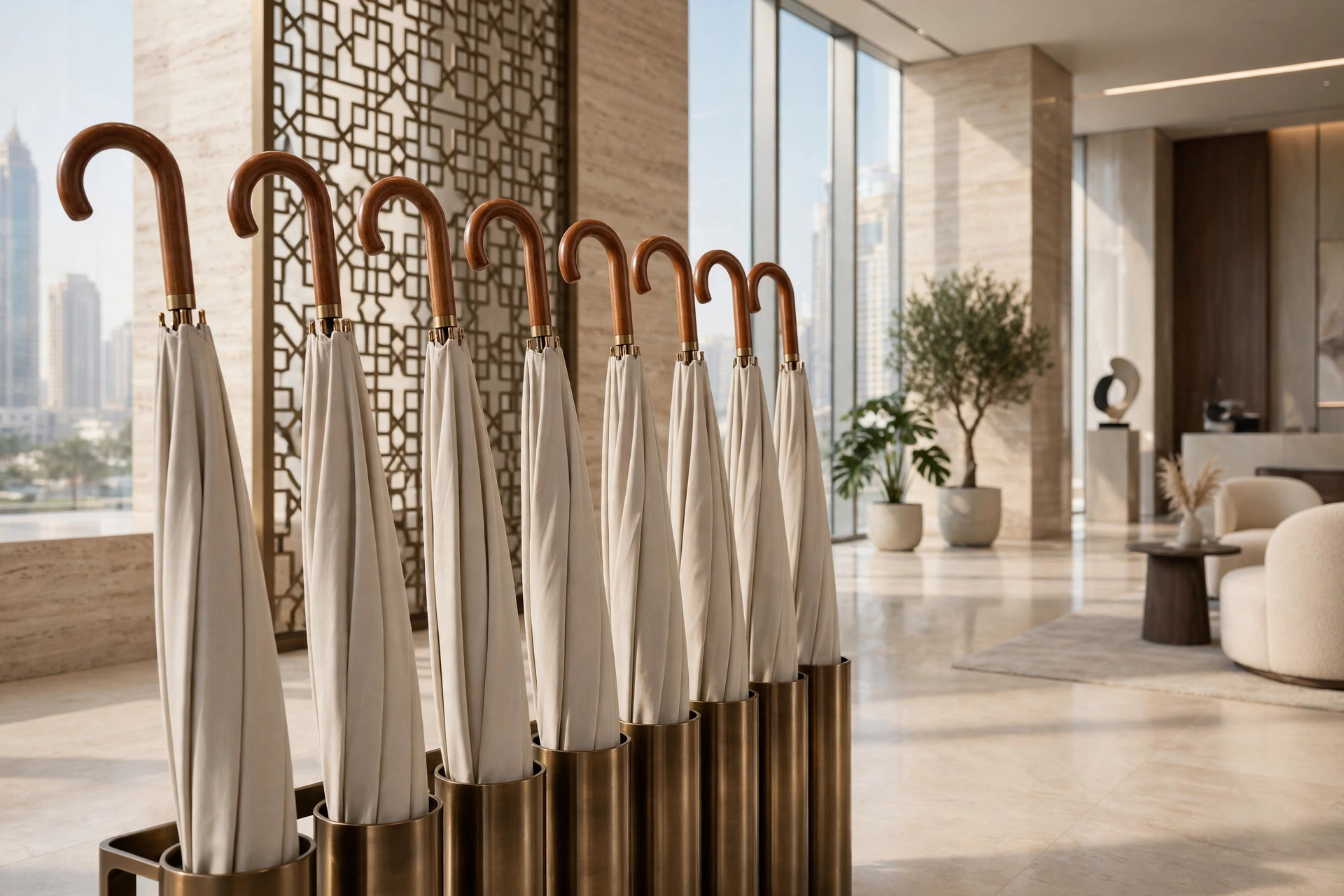
Walk into any busy Dubai hotel in December and look at what guests are carrying. A tote bag from the beach club over one shoulder. An umbrella by the concierge desk with the property’s crest on it. A kid at breakfast wearing a cap from the kids’ club. None of that is decoration. It’s advertising that the guest paid to receive, carried willingly through airports, malls and other hotels — and hotels here have figured that out faster than almost any other industry.
Branded merchandise for hotels works differently to the merchandise a bank or a tech company orders, and treating it like ordinary corporate gifting is where most properties waste money. A hotel’s branded items live in a harsher world. Towels get boiled in commercial laundry. Umbrellas get left in taxis at the airport. Key card holders get chewed up in handbags, stuffed into beach bags full of sand, and used five times a day. If the item can’t survive that, your logo doesn’t just fade — it makes the whole property look tired, which in a city with this much competition is the one thing you can’t afford.
This guide goes item by item through what hotels, resorts, serviced apartments, cafes and beach clubs across the UAE actually brand, what each item realistically costs, the minimum quantities involved, which materials survive hotel life, and the ordering timelines that matter when your deadline is a hotel opening, a refurbishment, or the start of the tourist high season.
A Hotel Isn’t a Normal Merchandise Buyer
The first difference is usage intensity. A pen given away at a trade show might get used twice a week. A hotel umbrella in the rainy weeks of January gets borrowed forty times. That changes the maths completely: the cheapest version of almost every hotel item is a false economy, because replacement cycles eat the saving within one season. Property managers who’ve been through it will tell you they’d rather buy 300 good umbrellas than 500 cheap ones that come back snapped by March.
The second difference is that your merchandise sits next to your brand at its most premium moments. A guest paying AED 1,400 a night who picks up a flimsy, peeling key card holder notices. The item is small; the signal isn’t. This is why five-star properties in Dubai tend to brand fewer items but brand them properly — real leather or good PU, debossed or engraved rather than printed, colours matched exactly to the brand palette rather than “close enough.”
Third, hotels buy in waves. Openings and refurbishments create huge one-off orders. Then high season — roughly October to April, with the Dubai Shopping Festival and the winter events calendar inside it — drives top-up orders for giveaways and event stock. Ramadan flips the pattern again, towards gifting. A supplier who doesn’t plan around those waves will let you down exactly when you’re busiest, so the timeline section at the end of this guide matters as much as the prices.
First Impressions: The Lobby, the Desk and the Door
Front-of-house items are the ones every guest touches, so start here if your budget is limited. Key card holders are the workhorse. The standard option is a printed card sleeve in thick art paper — cheap, around AED 1.5–3 per piece at quantities of 1,000+, and honestly fine for high-turnover properties where cards get replaced constantly. But the step up is where it gets interesting: PU or genuine leather key card holders, debossed with the hotel crest, cost roughly AED 9–22 depending on material and finish, with minimums usually starting at 300 pieces. Guests keep them. We’ve seen them turn up months later holding metro cards and loyalty cards, still carrying the logo around the city.
Umbrellas deserve more respect than they usually get. A hotel needs two kinds: sturdy guest umbrellas for the door and concierge — golf-style or classic stick umbrellas with a fibreglass frame, panels printed or the logo woven into the tie wrap — and smaller folding umbrellas for in-room or retail. Door umbrellas run roughly AED 45–85 each at 100–300 pieces; folding ones AED 25–45. The frame is the whole story here. A metal frame folds inside out in the first strong wind off the Gulf and a guest standing in the rain with your broken umbrella remembers the hotel, not the weather.
Doormats with the logo inlaid, branded luggage tags for the concierge team, valet parking tickets and tags, and printed paper bags for the lobby shop all sit in this category too. Luggage tags in leather or PU (AED 8–18, MOQ 300) double as a genuinely useful guest gift at checkout for long-stay and loyalty guests — small enough to pack, useful enough to keep.
And then there are the bags. Every property that hands guests a bag — for the spa shop, the deli, laundry returns — is choosing between a throwaway plastic-feel bag and something reusable that guests take to the beach. Cotton and canvas shopping bags with a clean one-colour print cost AED 8–20 at 500+ pieces and they walk out of the hotel all day long. If your property has any retail or F&B outlet at all, this is one of the highest-visibility items per dirham you can buy.
Inside the Room: Small Items, Long Exposure
In-room merchandise plays a longer game. A guest sees the “do not disturb” door hanger, the laundry bag and the stationery every single day of their stay, and repetition is exactly what branding is supposed to buy. Door hangers are almost free in this context — AED 1–2.5 per piece on thick board at 1,000+ — yet hotels routinely leave them generic. A well-designed hanger with the property’s personality on it (the quirky ones get photographed and posted) is the cheapest branding you’ll ever do.
Stationery still matters in business hotels: notepads and pens by the phone, a proper folder for the invoice at checkout. Pens are where hotels most often cheap out, and it shows. A metal pen with laser engraving, AED 6–14 at 500+, feels like it belongs in a premium room. A plastic pen with a printed logo that rubs off by checkout feels like a conference freebie. Engraving is the detail to insist on across most in-room metal items — prints wear, engraving doesn’t, and housekeeping won’t be swapping out shabby-looking stock every few weeks.
Laundry and shoe bags are quietly excellent branding surfaces because they travel home in the suitcase. Drawstring cotton laundry bags (AED 7–15) end up in wardrobes for years. The same goes for slippers: standard hotel slippers are disposable and guests treat them that way, but a resort that upgrades to a thicker embroidered slipper or includes them in a retail gift set finds guests actually taking them home — which is the point.
For suites and VIP arrivals, the in-room game changes completely, and this is where properties borrow from the world of luxury corporate gift sets — because a returning VIP or a honeymoon couple isn’t really a “room guest,” they’re a relationship you’re maintaining. Leather-bound notebooks, quality scent diffusers in presentation boxes, dates and chocolate in branded rigid boxes during Ramadan and festive periods, wine tools for properties licensed to serve them. Budgets here run AED 120–450 per set and volumes are small — 50 to 200 pieces — but the per-guest impact is the highest of anything in this guide. Arabic coffee sets and locally themed gifts land particularly well with international guests; a dallah-shaped keepsake in a good box says “Dubai” in a way a generic imported gift never will.
Pool Decks, Beach Clubs and Everything Outdoors
If in-room items are about exposure time, outdoor items are about visibility. A branded beach towel is a billboard that lies on the sand at JBR or on a Palm Jumeirah sunbed for six hours, surrounded by guests from other hotels. Jacquard-woven towels — where the logo is woven into the fabric rather than printed on top — survive commercial laundry far better than printed ones and still look sharp after a season of daily washing. Expect AED 55–110 per towel depending on size and weight (400–600 GSM), with woven designs usually starting at 300 pieces. Cheaper printed towels exist at AED 30–45, but be honest with yourself about how they’ll look by February.
Poolside is also where the famous problem happens: towels walk. Guests take them to their rooms, their cars, occasionally home. Smart properties treat this as a channel rather than a loss — a towel good enough to steal is a towel that advertises you at every beach and pool its new owner visits, and some resorts now sell the same towel in the gift shop so the desire has a legitimate outlet. Factor a realistic attrition rate (10–20% a season) into your order quantity instead of being surprised by it.
Beach bags follow the same logic: a sturdy canvas or jute beach tote (AED 14–28 at 500+) with a restrained design gets used for years of weekends. Caps and sun hats are the other outdoor staple — embroidery is non-negotiable here, since printed caps crack and peel in heat and salt air. A decent embroidered cap runs AED 16–30 at 300+ pieces. Water bottles for the gym, spa and beach service: stainless steel, vacuum-insulated, laser engraved, AED 35–65. In Dubai’s climate a good bottle is used daily, and guests ask to buy them more often than you’d expect.
Don’t forget the unglamorous outdoor branding: pool and beach umbrellas with the property mark, branded rescue and signage items for lifeguard stations, and kids’ club merchandise — colouring sets, small backpacks, character caps. Families are the highest-value segment for most UAE resorts, and the kids’ club item is the one thing guaranteed to be kept, because children refuse to throw it away.
The Staff Side: Badges, Pins and the Details Guests Ask About
Ask front-desk staff at any well-run Dubai hotel what guests comment on, and sooner or later someone mentions the pins. Concierges wearing Les Clefs d’Or keys understand this instinctively — a small, well-made metal badge signals membership, pride and standards before a word is spoken. Your own staff badges and name pins work the same way, which is why the flimsy printed-plastic name tag is such a missed opportunity.
Proper options, in ascending order: engraved metal name badges with a magnetic backing (magnets, not pins — pins chew holes in uniform fabric, and your housekeeping team will thank you), roughly AED 12–25 each at 100+ pieces; soft or hard enamel lapel pins for concierge, loyalty-programme and anniversary staff, AED 8–20 at 300+; and embossed leather or metal luggage-team and department identifiers for larger properties. For hotels running loyalty or guest-recognition programmes, a small pin for repeat guests — presented at check-in by the duty manager — costs almost nothing and creates the kind of moment guests describe in reviews.
Uniform accessories beyond badges: embroidered aprons for F&B teams (AED 28–55 with embroidery), ties, scarves and pocket squares matched to brand colours, branded lanyards for back-of-house staff and event teams, and caps for valet, beach and engineering teams. The rule with all of it is consistency. A five-star property where the beach team wears one cap design, valet wears another, and the concierge pin is a third style looks like three different businesses. One design language, applied everywhere, is what makes staff merchandise look like a brand instead of a procurement accident.
A note on durability that staff items make unavoidable: these pieces get washed, worn 10 hours a day, and replaced in ones and twos as people join and leave. Choose suppliers and methods with reordering in mind — keep your artwork and moulds on file, agree the repeat price upfront, and order badges and pins with a 10–15% buffer so a new starter isn’t wearing a handwritten tag for their first month.
Weddings, Conferences and the MICE Crowd
Events are where hotel giveaways earn their keep commercially. A conference delegate who leaves with a decent notebook, a working pen and a tote they’ll reuse has your property’s name in front of them at every future meeting — including the one where they choose next year’s venue. A delegate who leaves with a bag of items that go straight into the hotel bin has cost you money for nothing.
The reliable MICE set hasn’t changed much because it works: a quality notebook or conference folder, a metal pen, a tote or drawstring bag, a lanyard and badge holder for the event itself, and a USB or power bank for higher-value conferences. Where properties go wrong is ordering event merchandise at gift quality in gift quantities — for a 600-delegate conference, what you need is solid quality at volume pricing, which is a different conversation. Ordering event merchandise in bulk through a supplier set up for it typically brings notebooks down to AED 9–16, lanyards to AED 3.5–7, and drawstring bags to AED 6–11 at 500+ pieces, without dropping to the standard that makes your hotel look cheap.
Weddings are a separate art. Hotels hosting weddings brand the things couples don’t think of: welcome-card and itinerary printing, favours for guests (small scented candles, dates in personalised boxes, miniature dallah keepsakes for destination weddings), signage boards, and dance-floor and photo-area props for the fun end of the evening. Destination weddings — a huge segment in Dubai, with guests flying in from India, the UK and across the Gulf — are where branded welcome kits shine: a tote waiting in each room with the couple’s monogram on one side and practical contents (event schedule, hangover kit, local sim or transport card, sunscreen) inside. Couples budget AED 60–180 per room for these, and the hotel that makes it effortless wins the referral for the next wedding in that family.
Spa and wellness merchandise rounds out the events picture and feeds the gift shop too: branded scented candles (AED 25–55), bath and body sets in the property’s own fragrance, eye masks, and retail-ready versions of the towels and bottles mentioned earlier. The gift shop point matters — merchandise designed only as giveaway stock is a cost line, but the same item designed well enough to also sell turns the whole programme into something closer to self-funding. Properties with strong retail merchandise quietly recoup a meaningful share of what they give away.
A Realistic Starter Kit for a Mid-Size Hotel
To make all of this concrete, here’s what a sensible first order looks like for a hypothetical 150-room city hotel in Dubai — not a flagship resort, just a good property that wants to look like one. Quantities assume one high season of use with sensible buffers, and prices are the realistic Dubai ranges from the sections above, not best-case catalogue numbers.
| Item | Specification | Quantity | Unit cost (AED) | Approx. total (AED) |
|---|---|---|---|---|
| Key card holders | PU leather, debossed crest | 1,000 | 9–14 | 9,000–14,000 |
| Guest umbrellas | Fibreglass frame, printed panels | 200 | 45–85 | 9,000–17,000 |
| Door hangers | Thick board, double-sided print | 600 | 1–2.5 | 600–1,500 |
| Metal pens | Laser engraved | 1,000 | 6–14 | 6,000–14,000 |
| Canvas shopping bags | One-colour print, long handles | 1,000 | 8–20 | 8,000–20,000 |
| Beach/pool towels | Jacquard woven, 500 GSM | 500 | 55–110 | 27,500–55,000 |
| Staff name badges | Engraved metal, magnetic back | 150 | 12–25 | 1,800–3,750 |
| Concierge/staff pins | Hard enamel | 300 | 8–20 | 2,400–6,000 |
| Embroidered caps | Valet, beach and engineering teams | 300 | 16–30 | 4,800–9,000 |
| Laundry bags | Cotton drawstring, printed | 600 | 7–15 | 4,200–9,000 |
That puts a credible, property-wide programme at roughly AED 73,000–149,000 depending on where you land on quality — with towels, as always, the biggest single line. A serviced apartment operator or cafe group would scale this down hard (skip the towels, double the bags and badges) and land somewhere between AED 15,000–35,000 for a brand that suddenly looks established. The point isn’t the exact total; it’s that the items guests touch most are mostly the cheap ones, and the one expensive line — towels — is the one that advertises you furthest.
When to Order: The Timeline Nobody Warns You About
Standard branded merchandise in Dubai takes 2–4 weeks from approved artwork to delivery for locally produced and printed items, and 4–7 weeks for anything involving custom moulds, woven towels, enamel work or overseas production. Sampling adds a week or two on top, and for a new property or a rebrand you should always sample: the difference between a deboss that looks rich and one that looks like a dent is only visible on the physical piece.
Now lay the hotel calendar over that. High season stock needs to be in your store room by late September, which means artwork approved by mid-August — in the middle of the quietest, most holiday-depleted month of the year, when the people who sign off designs are on leave. Ramadan gifting decisions need making 8–10 weeks before Ramadan starts. A hotel opening or post-refurbishment relaunch should have merchandise ordered the moment the brand artwork is final, not when the snagging list closes, because merchandise is always the thing procurement remembers last and guests notice first.
The practical fix is boring and effective: keep a rolling stock list with reorder points for your top ten items, hold buffer stock of anything with a mould or weaving lead time, and put the seasonal orders on the calendar a full quarter ahead. Every experienced F&B and rooms-division manager in this city has a story about umbrellas arriving in week three of the rain, or National Day pins landing on December 4th. Every single one of those stories started with an order placed “in plenty of time” that wasn’t.
Mistakes We See Hotels Make Again and Again
Ordering for the opening, not the year. Launch quantities get consumed by attrition, breakage and the towel-walk effect within months. If your order doesn’t include a planned top-up, you’ll reorder in a panic at worse prices and mismatched colours.
Premium rooms, cheap items. The mismatch is what guests register. A property charging premium rates with a peeling printed pen on the desk is telling two different stories, and guests believe the object, not the rate card. Match merchandise quality to the room rate, even if it means branding fewer items.
Printing where you should engrave, weave or emboss. Print is fine on paper goods and bags. On metal, leather and textiles in commercial use, it wears — and worn branding looks worse than no branding. The method matters more than the logo size.
Skipping the laundry test. Towels, caps, aprons and laundry bags should survive your actual laundry cycle before you commit to volume. One sample, twenty commercial washes, then decide. This single test prevents the most expensive merchandise mistake in hospitality.
Treating every property the same. A beach resort, a business hotel near the airport and a boutique property in Al Fahidi need different merchandise mixes. Serviced apartments need durability and kitchen-adjacent items more than they need pins; beach clubs need almost nothing indoors and everything outdoors. Order for your guest, not from a generic list — including, respectfully, the starter list above.
Questions Hotels Ask Us Before Ordering
What are sensible minimum order quantities for hotel merchandise?
Printed paper items (door hangers, card sleeves) usually start at 500–1,000 pieces. Bags, caps and pens typically start at 300–500. Items with tooling behind them — woven towels, enamel pins, debossed leather — also start around 300, because the setup cost has to be spread. Below those levels, per-unit prices climb steeply and it usually makes more sense to consolidate into fewer, better items.
Which branding method lasts longest on items that get washed or used daily?
Weaving (for towels), embroidery (for caps, aprons and textiles), laser engraving (for metal and bottles) and debossing (for leather and PU) all outlast surface printing by a wide margin in commercial laundry and daily handling. Print has its place — paper goods, bags, anything with a shorter working life — but on hard-working items, the embedded methods are worth the modest premium.
How far ahead should we order for high season or a hotel opening?
Work backwards: 4–7 weeks production for custom items, 1–2 weeks for sampling and approvals, plus a buffer week you’d be foolish to skip. For October high-season stock, approve artwork by mid-August. For openings, place the merchandise order as soon as brand artwork is final — it has one of the longest lead times of anything in the FF&E tail.
Can merchandise match our exact brand colours?
Yes, with the right methods: Pantone-matched printing and dyeing, thread-matched embroidery, and enamel colours mixed to reference. The honest caveat is that different materials take colour differently — the same Pantone looks slightly different on canvas, metal and leather — so approve physical samples of each item rather than one master proof.
What should a small hotel or cafe group start with if the budget is tight?
Badges and pins for staff, one good reusable bag, and the item your guests touch most — key card holders for a hotel, cups sleeves and aprons for a cafe, towels for anything with a pool. Three items done properly beat fifteen done cheaply, and you can build the programme season by season from there.
Do guests really keep and reuse hotel merchandise?
The useful, well-made items, yes — that’s the entire mechanism. Leather card holders resurface as metro card wallets, beach totes become weekend bags, bottles live in gym kits. The items that get binned are the generic ones, which is a quality decision, not a category problem.
Can the same merchandise work across sister properties in different emirates?
Mostly, yes — groups often standardise the core items (badges, bags, umbrellas, towels) with the group mark and differentiate only the VIP and retail pieces per property. Standardising also unlocks combined volumes, which is where the better unit prices in this guide come from.
Branding Guests Carry Out the Door
Hotel merchandise isn’t really a procurement category. It’s the only part of your marketing that guests physically take home, keep in their wardrobes and beach bags, and show to other people — for months after a marketing campaign would have been forgotten. Done properly, it asks for three things: items matched to how your guests actually live during their stay, methods that survive the laundry and the lifestyle, and ordering early enough that none of it arrives after the moment it was for.
If you’re planning a property opening, a refurbishment, or simply a high season where the merchandise finally matches the hotel, talk to us before the artwork stage, not after it — the method and material choices are much cheaper to get right on paper than in a warehouse. Tell us your room count, your guest profile and your deadline, and we’ll build you an item-by-item programme with real prices, the same way this guide is written.




